
Skip to content
Select Your Language

Selecting a language changes the language and content on the Trane site.

  • United States English
  • Canada English French
  • Argentina Spanish
  • Mexico Spanish
  • Brazil Portuguese
  • Aruba English
  • Bahamas English
  • Belize English
  • Bermuda English
  • Bolivia Spanish
  • Bonaire English
  • Chile Spanish
  • Colombia Spanish
  • Costa Rica Spanish
  • Dominican Republic Spanish
  • Ecuador Spanish
  • El Salvador Spanish
  • Grenada English
  • Guadeloupe English
  • Guatemala Spanish
  • Guyana English
  • Haiti English
  • Jamaica English
  • Martinique English
  • Netherland Antilles English
  • Nicaragua Spanish
  • Panama Spanish
  • Paraguay Spanish
  • Peru Spanish
  • Puerto Rico Spanish
  • Saint Lucia English
  • St. Vincent & Grenadines English
  • Suriname English
  • Trinidad & Tobago English
  • Venezuela Spanish
  • Armenia English
  • Austria German
  • Belarus Russian
  • Belgium English
  • Croatia English
  • Czech Republic Czech
  • Denmark English
  • Estonia English
  • Finland English
  • France French
  • Georgia English
  • Germany German
  • Greece Greek
  • Hungary Hungarian
  • Israel English
  • Ireland English
  • Italy Italian
  • Kazakhstan Russian
  • Latvia English
  • Lithuania English
  • The Netherlands Dutch
  • Norway English
  • Poland English
  • Portugal Portuguese
  • Romania English
  • Russia Russian
  • Serbia Russian
  • Slovakia Czech
  • Slovenia English
  • Spain Spanish
  • Sweden English
  • Switzerland French German Italian
  • Turkey Turkish
  • Ukraine English
  • United Kingdom English
  • Azerbaijan Русский
  • Tajikistan Русский
  • Uzbekistan Русский
  • Turkmenistan Русский
  • United Arab Emirates English
  • Qatar English
  • Kuwait English
  • Egypt English
  • Lebanon English
  • Mainland China Simplified Chinese English
  • Korea, Republic of (South Korea) Korean English
  • Vietnam Vietnamese English
  • India English
  • Australia English
  • Japan Japanese
  • Guam English
  • Thailand Thai English
  • Taiwan Traditional Chinese English
  • Hong Kong SAR English
  • Indonesia English
  • Malaysia English
  • Philippines English
  • Singapore English
  • New Zealand English

ComfortSite Login

Trane ComfortSite is an extranet site designed to save you time. With your secure login, you can:

  • Order Equipment, Parts, Literature and track Order Status
  • View product literature
  • Register for Training programs
  • Complete Warranty requirements online
  • Search for specific Product Information
  • Use interactive Product Support functions
  • View and print invoices through Account Track Online
  • and More
Log In

Trane Connect

This is the login for Trane® Connect™ and other Trane® commercial applications. Trane® Connect™ is our secure, cloud-based customer portal to access your building systems to remotely monitor and manage building systems, and conduct routine maintenance.

Log In
Trane Commercial
  • Services
    • Services
    • Decarbonization & Electrification
      • Decarbonization & Electrification
      • Decarbonization Solutions
      • Energy Efficiency Solutions
      • Electrification of Heat Solutions
      • Refrigerant Management Solutions
      • Renewable Energy & DERs
    • Energy Services
      • Energy Services
      • Monitoring & Validation
      • Sustainability & Decarbonization
      • Distributed Energy Resources (DERs) for Resilience
      • Conservation & Optimization
      • Financing & Implementation
      • Infrastructure Renewal
    • Operate, Maintain & Repair
      • Operate, Maintain & Repair
      • Connectivity & Cloud Services
      • HVAC System Management
      • HVAC System Repair
    • Upgrade & Modernize
      • Upgrade & Modernize
      • Building Systems
      • HVAC System Retrofits
      • HVAC Equipment Upgrades
      • Infrastructure Renewal
      • Financing & Implementation
    • Rentals
      • Rentals
      • Air Conditioners
      • Air Handlers
      • Cooling Towers
      • Chillers
      • Heating Equipment
      • Generators
      • Emergency Response
      • Planned Maintenance
      • Contingency Planning
    • Indoor Environmental Quality (IEQ) Solutions
      • Indoor Environmental Quality (IEQ) Solutions
      • Indoor Air Quality
      • Thermal Comfort
      • Our 3-Step Process
      • Lighting
      • Acoustics
      • IAQ Services
  • Products & Systems
    • Products & Systems
    • VRF & Ductless Solutions
      • VRF & Ductless Solutions
      • N-Gen CITY MULTI VRF
      • P Series
      • Nv Series
      • HVRF
      • SMART MULTI®
    • Chillers
      • Chillers
      • Air-Cooled Chillers
      • Chiller Heaters
      • Comprehensive Chilled Water Systems
      • Comprehensive Chiller-Heater Systems
      • Modular Chillers
      • Process Chillers
      • Water-Cooled Chillers
    • Packaged Units & Split Systems
      • Packaged Units & Split Systems
      • CoolSense® Integrated Outdoor Air Systems
      • Intelligent VAV Systems
      • Zoned Rooftop Systems
      • Rooftop Units
      • Split Systems
      • Self-Contained Units
      • Water Source Heat Pumps
      • Dedicated Outdoor Air Units
    • Heat Pumps
      • Heat Pumps
      • Heat Pumps
      • Air-to-Water Heat Pumps
      • Electrification of Heat
      • Comprehensive Chiller-Heater Systems
    • Controls & Building Automation Systems
      • Controls & Building Automation Systems
      • Controls for Large Buildings & Campuses
      • Controls for Small Buildings
      • Wireless Systems
      • Lighting Solutions
      • Controls Solutions for Light Commercial Contractors
      • Cybersecurity
    • Air Handling
      • Air Handling
      • CoolSense® Integrated Outdoor Air Systems
      • Sensible-Cooling Terminal Unit
      • Terminals
      • VAV (Variable Air Volume) Units
      • Performance Air Handlers
      • Air Handler Accessories
      • Unit Heaters
      • Air Rotation Units
    • Thermal Energy Storage
      • Thermal Energy Storage
      • Thermal Battery Systems
      • Thermal Energy Storage Solutions
    • Design & Analysis Software
      • Design & Analysis Software
      • TRACE® 3D Plus
      • Trane® Design Assist™
      • myPLV®
      • Trane® Select Assist™ (Formerly known as TOPSS™)
      • myC02e™
      • Calculators & Charts
      • View All Design & Analysis Tools
    • Trane Drives
      • Trane Drives
      • TR200 Variable Frequency Drive
    • Liquid Cooling Systems
      • Liquid Cooling Systems
      • Coolant Distribution Unit (CDU)
  • Training & Support
    • Training & Support
    • Education & Training
      • Education & Training
      • Trane HVAC Education & Training
      • Trane University
      • Trane Education Center
      • Design & Analysis Tools Training
      • Engineers Newsletters & Engineers Newsletters Live!
      • Becoming a Trane Technician
    • Engineer & Contractor Support
      • Engineer & Contractor Support
      • Engineering Support
      • Contractor Support
      • Trane C.D.S. Software Support
      • BIM-Revit Library
    • Financing Support
      • Financing Support
      • OMNIA Partners
      • Anticipation Discount Program
      • Energy Savings Performance Contracting (ESPC)
      • Cooperative and Group Purchasing
      • Financing
    • Legislation and Incentives Resource Center
      • Legislation and Incentives Resource Center
      • View Legislation and Incentives Resource Center
      • Trane Equipment Rebate Finder
  • Industries
    • Industries
    • Commercial Real Estate
    • Data Centers
    • Food & Beverage
    • Federal Government
    • Fulfillment Centers
    • Grocery & Supermarkets
    • Healthcare
    • Higher Education
    • High Tech
    • Hospitality
    • Indoor Agriculture
    • Industrial
    • K-12
    • Life Sciences
    • Local Government
    • Restaurants
    • Retail Buildings
    • National Accounts
  • About
    • About

    • About Us
    • Contact Us
    • Locate a Sales Office
    • Trane Newsroom
    • Customer Stories
    • Trane Blog
    • Events & Webinars
    • Press Releases
    • Looking for Parts?
    • Safety Data Sheets
      • North America

      • United States English
      • Canada English French
      • Latin America

      • Argentina Spanish
      • Mexico Spanish
      • Brazil Portuguese
      • Aruba English
      • Bahamas English
      • Belize English
      • Bermuda English
      • Bolivia Spanish
      • Bonaire English
      • Chile Spanish
      • Colombia Spanish
      • Costa Rica Spanish
      • Dominican Republic Spanish
      • Ecuador Spanish
      • El Salvador Spanish
      • Grenada English
      • Guadeloupe English
      • Guatemala Spanish
      • Guyana English
      • Haiti English
      • Jamaica English
      • Martinique English
      • Netherland Antilles English
      • Nicaragua Spanish
      • Panama Spanish
      • Paraguay Spanish
      • Peru Spanish
      • Puerto Rico Spanish
      • Saint Lucia English
      • St. Vincent & Grenadines English
      • Suriname English
      • Trinidad & Tobago English
      • Venezuela Spanish
      • Europe

      • Armenia English
      • Austria German
      • Belarus Russian
      • Belgium English
      • Croatia English
      • Czech Republic Czech
      • Denmark English
      • Estonia English
      • Finland English
      • France French
      • Georgia English
      • Germany German
      • Greece Greek
      • Hungary Hungarian
      • Israel English
      • Ireland English
      • Italy Italian
      • Kazakhstan Russian
      • Latvia English
      • Lithuania English
      • The Netherlands Dutch
      • Norway English
      • Poland English
      • Portugal Portuguese
      • Romania English
      • Russia Russian
      • Serbia Russian
      • Slovakia Czech
      • Slovenia English
      • Spain Spanish
      • Sweden English
      • Switzerland French German Italian
      • Turkey Turkish
      • Ukraine English
      • United Kingdom English
      • Azerbaijan Русский
      • Tajikistan Русский
      • Uzbekistan Русский
      • Turkmenistan Русский
      • Middle East

      • United Arab Emirates English
      • Qatar English
      • Kuwait English
      • Egypt English
      • Lebanon English
      • Asia Pacific

      • Mainland China Simplified Chinese English
      • Korea, Republic of (South Korea) Korean English
      • Vietnam Vietnamese English
      • India English
      • Australia English
      • Japan Japanese
      • Guam English
      • Thailand Thai English
      • Taiwan Traditional Chinese English
      • Hong Kong SAR English
      • Indonesia English
      • Malaysia English
      • Philippines English
      • Singapore English
      • New Zealand English
  • Decarbonization & Electrification
  • Decarbonization Solutions
  • Energy Efficiency Solutions
  • Electrification of Heat Solutions
  • Refrigerant Management Solutions
  • Renewable Energy & DERs
  • Energy Services
  • Monitoring & Validation
  • Sustainability & Decarbonization
  • Distributed Energy Resources (DERs) for Resilience
  • Conservation & Optimization
  • Financing & Implementation
  • Infrastructure Renewal
  • Operate, Maintain & Repair
  • Connectivity & Cloud Services
  • HVAC System Management
  • HVAC System Repair
  • Upgrade & Modernize
  • Building Systems
  • HVAC System Retrofits
  • HVAC Equipment Upgrades
  • Infrastructure Renewal
  • Financing & Implementation
  • Rentals
  • Air Conditioners
  • Air Handlers
  • Cooling Towers
  • Chillers
  • Heating Equipment
  • Generators
  • Emergency Response
  • Planned Maintenance
  • Contingency Planning
  • Indoor Environmental Quality (IEQ) Solutions
  • Indoor Air Quality
  • Thermal Comfort
  • Our 3-Step Process
  • Lighting
  • Acoustics
  • IAQ Services
  • VRF & Ductless Solutions
  • N-Gen CITY MULTI VRF
  • P Series
  • Nv Series
  • HVRF
  • SMART MULTI®
  • Chillers
  • Air-Cooled Chillers
  • Chiller Heaters
  • Comprehensive Chilled Water Systems
  • Comprehensive Chiller-Heater Systems
  • Modular Chillers
  • Process Chillers
  • Water-Cooled Chillers
  • Packaged Units & Split Systems
  • CoolSense® Integrated Outdoor Air Systems
  • Intelligent VAV Systems
  • Zoned Rooftop Systems
  • Rooftop Units
  • Split Systems
  • Self-Contained Units
  • Water Source Heat Pumps
  • Dedicated Outdoor Air Units
  • Heat Pumps
  • Heat Pumps
  • Air-to-Water Heat Pumps
  • Electrification of Heat
  • Comprehensive Chiller-Heater Systems
  • Controls & Building Automation Systems
  • Controls for Large Buildings & Campuses
  • Controls for Small Buildings
  • Wireless Systems
  • Lighting Solutions
  • Controls Solutions for Light Commercial Contractors
  • Cybersecurity
  • Air Handling
  • CoolSense® Integrated Outdoor Air Systems
  • Sensible-Cooling Terminal Unit
  • Terminals
  • VAV (Variable Air Volume) Units
  • Performance Air Handlers
  • Air Handler Accessories
  • Unit Heaters
  • Air Rotation Units
  • Thermal Energy Storage
  • Thermal Battery Systems
  • Thermal Energy Storage Solutions
  • Design & Analysis Software
  • TRACE® 3D Plus
  • Trane® Design Assist™
  • myPLV®
  • Trane® Select Assist™ (Formerly known as TOPSS™)
  • myC02e™
  • Calculators & Charts
  • View All Design & Analysis Tools
  • Trane Drives
  • TR200 Variable Frequency Drive
  • Liquid Cooling Systems
  • Coolant Distribution Unit (CDU)
  • Education & Training
  • Trane HVAC Education & Training
  • Trane University
  • Trane Education Center
  • Design & Analysis Tools Training
  • Engineers Newsletters & Engineers Newsletters Live!
  • Becoming a Trane Technician
  • Engineer & Contractor Support
  • Engineering Support
  • Contractor Support
  • Trane C.D.S. Software Support
  • BIM-Revit Library
  • Financing Support
  • OMNIA Partners
  • Anticipation Discount Program
  • Energy Savings Performance Contracting (ESPC)
  • Cooperative and Group Purchasing
  • Financing
  • Legislation and Incentives Resource Center
  • View Legislation and Incentives Resource Center
  • Trane Equipment Rebate Finder
  • Commercial Real Estate
  • Data Centers
  • Food & Beverage
  • Federal Government
  • Fulfillment Centers
  • Grocery & Supermarkets
  • Healthcare
  • Higher Education
  • High Tech
  • Hospitality
  • Indoor Agriculture
  • Industrial
  • K-12
  • Life Sciences
  • Local Government
  • Restaurants
  • Retail Buildings
  • National Accounts
  • About Us
  • Contact Us
  • Locate a Sales Office
  • Trane Newsroom
  • Customer Stories
  • Trane Blog
  • Events & Webinars
  • Press Releases

CONTACT A TRANE EXPERT

Blog

Published: June 10, 2022

Demystifying Decarbonization: A Restaurant Owner and Facility Manager Survival Guide

As public and private pressure to reduce greenhouse gas emissions increases across industries, restaurants face several challenges to create more sustainable operations. Gas equipment is the norm in many kitchens and cannot easily be replaced with a cleaner energy source, razor-thin margins don’t allow for major capital investment projects, and many restaurants are still recouping from the impact Covid-19 had on their business. Improving indoor air quality and airflow to get customers back while keeping staff and guests experience a top priority.

Quick Facts

Industry
Restaurant
Topics
Sustainability • Services
Kasey Boxleitner

About the author
Trevor Joelson, Decarbonization Program Lead – Key Accounts

Trevor Joelson is a program lead for Trane’s decarbonization program for key account customers. Through this program, Trevor collaborates with larger enterprises to define their environmental sustainability objectives and establish initiatives and programs to reduce operational emissions through financially attractive and measurable projects.

Trevor joined Trane through an acquisition of Fellon-McCord in 2016 and has held various roles in corporate energy & sustainability management over the last decade. His subject matter expertise is in the energy markets and how the supply-side of energy connects to the built environment.

Trevor lives with his family in Dallas, TX and is a graduate of the University of Louisville. 

As public and private pressure to reduce greenhouse gas emissions increases across industries, restaurants face several challenges to create more sustainable operations. Gas equipment is the norm in many kitchens and cannot easily be replaced with a cleaner energy source, razor-thin margins don’t allow for major capital investment projects, and many restaurants are still recouping from the impact Covid-19 had on their business. Improving indoor air quality and airflow to get customers back while keeping staff and guests experience a top priority.  

But it’s critical to get a handle on your sustainability goals and develop a realistic plan to achieve them. This blog is meant to be used as a guide to help restaurant owners and facility managers get on the right path to creating a decarbonization (decarb) plan that will help to meet the goals of today and set the restaurant up for long-term energy and cost savings, as well as increased operational resiliency, well into the future.

Let’s start with some definitions
When it comes to the sustainability space there are a ton of terms and acronyms that can get confusing. Word choice and clarity matter to ensure everyone is aligned with what you’d like to accomplish.

  • Greenhouse gasses (GHG) are the gasses that trap heat in the atmosphere, for example, methane, CFCs, and H2O.
  • Carbon dioxide equivalent (CO2e) includes CO2 and other greenhouse gasses.
  • Decarbonization is any process that removes carbon from the atmosphere or prevents carbon from being emitted.
  • Carbon neutral is when GHG released into the atmosphere is equal to GHG removed from the atmosphere.
  • Global warming potential (GWP) is the degree to which a gas traps heat in the atmosphere, indexed relative to Co2, which has a GWP of 1.

Generally speaking, there are two types of emission sources:

Direct emissions are related to onsite processes, i.e. fossil fuels used for heating and cooling or refrigerant management.

Indirect emissions are related to off-site electricity production.

By looking at efficiency options that impact both direct and indirect emissions, you’ll identify the various levers you can pull to develop a decarbonization plan best suited for your facility.

3 Steps to Successfully Decarbonize your Restaurant 

Step 1: Understand where the decarb initiative is coming from to determine appropriate goals for each location in your portfolio

You’re likely feeling the pressure to become a more sustainable operation from multiple sources. And it’s important to understand the nuances of each so that you know what emission reduction goals you’re accountable to meet.

Policy & Regulatory
There is no shortage of regulations aiming to help achieve a more sustainable future. From overarching policies like the Paris Agreement to nationwide goals like the Department of Energy’s 2023 efficiency requirements for residential and commercial HVAC equipment to varying local policies and regulations across the U.S. Making sense of the complex weave of regulations that impact each of your restaurant facilities can be overwhelming. Coordinate with experts to help you navigate the regulatory landscape, so you have clear guidance on emissions requirements across your portfolio of restaurants.

Public Pressure
With climate change growing in importance in the minds of everyday Americans, people increasingly expect businesses to operate responsibly and ethically. More and more customers consider the environmental practices of their favorite brands and employees are demanding responsibility from their employers. 

Investors
Because of this increase in public pressure, investors are also under the microscope to ensure that the businesses they invest in have emission reduction plans in place. In addition, franchisee restaurants have a unique stakeholder in that the corporate brand will often make emission reduction goals that the franchisees are then responsible for meeting.

Step 2: Determine your current emissions baseline

To understand where you want to take your business in the future, you must first get a baseline understanding of your current energy and emissions landscape. Getting honest about your current carbon footprint provides a realistic view of how to build a realistic and effective decarbonization strategy.
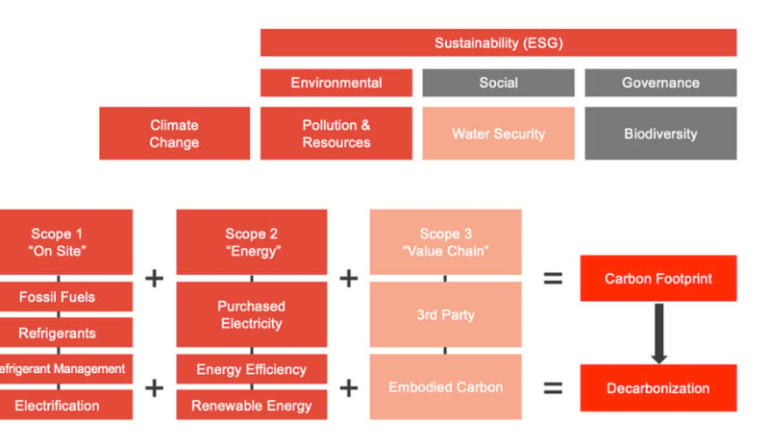
tc-demystifying-decarb-graphic.jpg

As is illustrated in the graphic below, three components make up your sustainability program: Environmental, Social, and Governance – commonly referred to as ESG. Your carbon footprint is comprised of three “Scopes” – Onsite, Energy, and Value Chain.

  • Scope 1 “Onsite” emissions are emissions used directly within your operations and are commonly made up of fossil fuels.
  • Scope 2 “Energy” emissions are electricity purchased from the electrical grid. While you are accountable for these emissions, it is not directly in your control.
  • Scope 3 “Value Chain” emissions are a more complex set of emissions related to the creation and transportation of products and services.  

Making changes to reduce emissions in any of these three scopes is how you achieve decarbonization. Working with an expert, you can determine the appropriate mix of initiatives within this framework to achieve your sustainability goals. 

Step 3: Make a Restaurant Decarbonization Plan

Decarbonization for restaurants comes down to three main components: Energy Efficiency, Electrification, and Renewable Energy. Let’s look at what goes into each component.

Energy Efficiency
The goal of energy efficiency is to improve the building’s infrastructure to eliminate waste in your operations. This can be done by upgrading to more efficient equipment, making improvements to limit the heat entering or escaping from the building, or reducing the load it takes to heat or cool the space.

The process of becoming more energy efficient starts with simple, cost-effective measures such as identifying and addressing unnecessarily air leaks to installing sophisticated building automation systems that monitor energy use and waste in real-time. A great way to gain greater restaurant efficiency is to start with an energy assessment.

Upgrading to high energy efficient equipment, including HVAC and lighting, helps to reduce the overall cost of ownership and may help to improve the energy efficiency within your restaurant. Installing automation equipment allows you to centrally monitor and manage buildings across the country, leading to significant savings. Your HVAC expert can work with you to find ways to pay for building upgrades now by using future energy savings.

Electrification
To create a greener energy grid, electricity is increasingly moving to more renewable energy sources like solar and wind. This means electricity is becoming less emission-intensive across the U.S. One of the best ways to take advantage of these greener energy sources is to electrify your heating and cooling operations. An emerging strategy in decarbonization, you can replace your natural gas boiler system with high-efficiency heat pumps. This single piece of equipment that is used for both heating and cooling will remove nearly all onsite direct emissions from your operations. This is a huge advantage for any restaurant looking to achieve decarbonization goals.

Since energy companies are making significant investments to update the grid, many are incentivizing customers to take advantage. The right expert can help you determine how you can receive reimbursements from energy companies that can go towards paying for electrification updates.

Renewable Energy
Restaurant operators can leverage renewable energy as a tool to reduce emissions while gaining more control over their energy supply. While renewable energy has historically been seen as a “cost premium” to traditional energy sources, there are emerging models that allow buildings to secure renewable energy at a discount to traditional power sources.

There are two main ways to secure renewable energy:

  • Onsite: A renewable energy asset or system is installed at the facility and provides energy supply directly to the building.
  • Offsite: A commitment is made to an offsite renewable energy asset (likely a large utility-scale development) that allows the owner to recognize the renewable energy attributes.

Restaurant operators should explore all the renewable energy options available to them and identify which one has the best alignment and significant returns to the business.

Restaurant owners and facility managers will have growing pressure to decarbonize their operations in the years to come. There are unique challenges, as well as immense benefits, that come with reducing emissions while not impacting core business operations and customer experiences. Balancing these challenges by developing a roadmap to decarbonization that focuses on creating financially attractive solutions to achieve your goals is a core competency of Trane.

Looking to begin, accelerate or complete your restaurant decarbonization journey? Connect with a Trane restaurant expert to develop a financially attractive solution to meet your sustainability ambition.

Restaurants

Learn more about the Trane total restaurant design solutions
  • Energy and Building Services
  • Products and Systems
  • Education & Training
  • Newsroom
  • About Us
  • About Trane
  • Wellsphere™
  • Newsroom
  • Customer Stories
  • Contact Us
  • Locate a Sales Office
  • Engineering Support
  • Contractor Support
  • Careers
  • Environmental Compliance
  • Quality
  • Ethical Business Conduct
  • Supplier Terms
  • Facebook
  • Twitter
  • LinkedIn
  • YouTube

Privacy Policy  |   Terms of Use

All trademarks referenced are the trademarks of their respective owners.

© 2025 Trane. All Rights Reserved.

Trane Technologies