HVAC Basics: How Does an Air Conditioner Work?
By Anne Fonda
When it’s a hot summer day outside, but you walk into the refreshing cold air inside your home, you might find yourself wondering, “How does air conditioning work?” To sum it up, air conditioners use the refrigeration cycle to remove heat and humidity from the air inside and send it outside to ultimately cool down your home.
To complete this process, a lot of different parts of the central air conditioning system need to work together. Here, we’ll explore central air conditioning systems, since that’s our area of expertise. Just know that a window AC unit or car air conditioner works in much the same way.
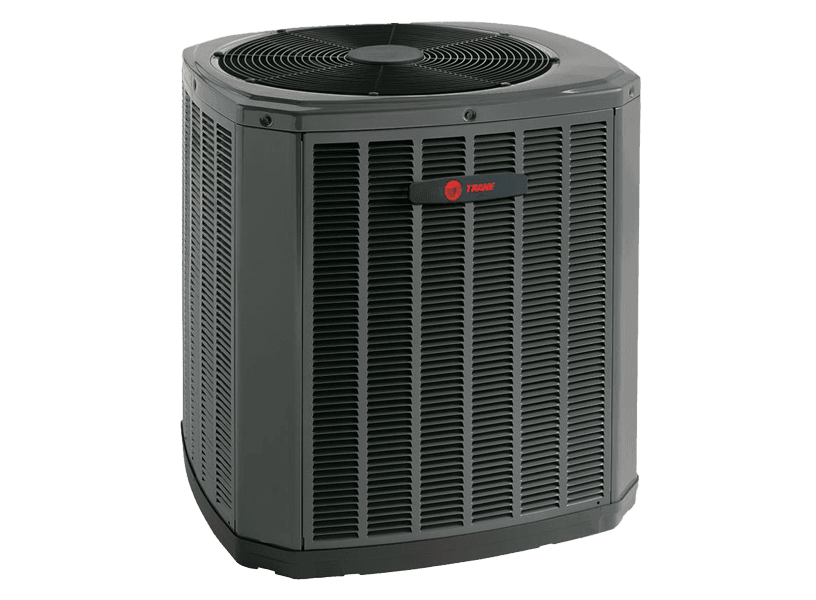
How AC works: split systems and packaged systems
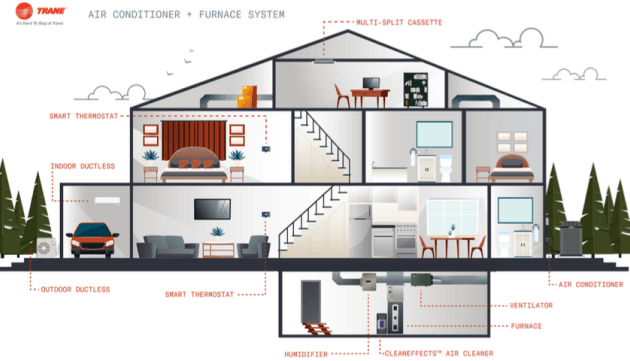
Central air conditioners are designed to cool your entire home. To do this, they distribute cooled air through the ducts in your home so the air reaches every single room. In a split system, you have an outdoor AC unit and an indoor HVAC unit (typically a furnace but sometimes an air handler) that are connected by copper refrigerant lines.
The smallest possible size for a central air conditioner is 1.5 tons. Air conditioners of all sizes have a SEER2 rating, which stands for Seasonal Energy Efficiency Ratio, and measures the energy efficiency of an air conditioner. Minimum SEER2 ratings are set by the federal government and vary based on system type, system capacity, and region.
The higher the SEER2 rating, the more energy-efficient the air conditioner is. While a high-SEER2 energy-efficient air conditioner will cost more upfront than a unit with a lower SEER2, your operating costs will be lower with a more efficient unit.

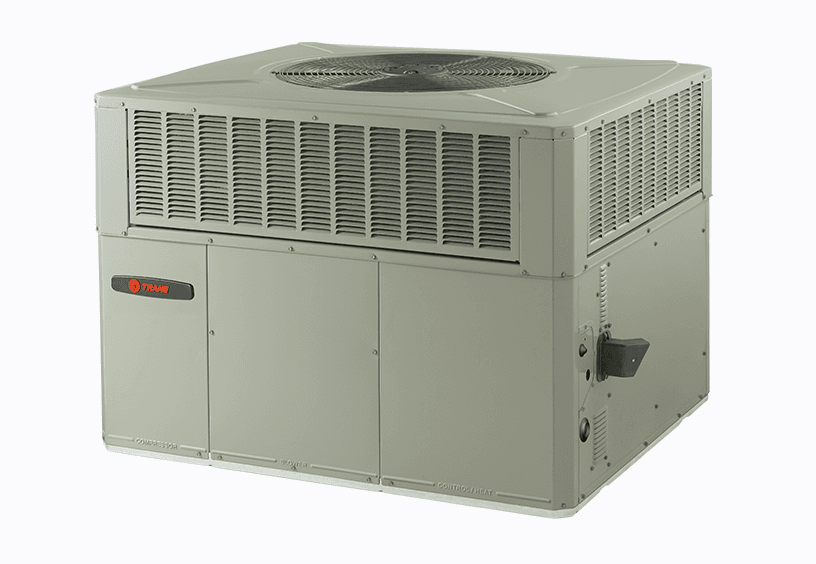
Packaged air conditioners are another type of central air conditioner. Packaged systems are unique because they provide air to the entire home, but they don’t feature a 1:1 indoor-to-outdoor unit split. Instead, packaged systems are located entirely outside the home, except for the ductwork.
Packaged systems are available in both cooling-only and AC + gas furnace combinations. These units are great for homeowners with limited indoor space.
Air conditioning system components
Now let’s take a closer look at the components that make your air conditioning system work.
Your central AC is controlled by a thermostat that sends signals to the HVAC system when it’s time to start cooling. There are two main types of thermostats available with your Trane system – traditional thermostats and smart thermostats.
Traditional thermostats are either basic, non-programmable thermostats or simple programmable thermostats. Smart thermostats are just that – smart. They connect to the internet, allowing you to control your HVAC system from anywhere at any time via the Home App.
The programming features, geofencing capabilities, and remote diagnostics compatibility that come with your Trane smart thermostat help optimize your comfort at all times.
Refrigerant is an essential part of an air conditioning system — without it, the entire system wouldn’t be able to function. This chemical cooling compound flows throughout the air conditioner coil, refrigerant lines, and indoor coil, absorbing and releasing heat at different stages to cool down your home. The cooling process kicks off when a fan blows air from inside your home across the indoor coil, called the evaporator coil.
The evaporator coil is the place for absorbing heat. When the fan blows room temperature indoor air from your home over the cold evaporator coil, the cold liquid refrigerant inside absorbs the heat from the warm air, changing the refrigerant to a gas, which then makes its way to the compressor.
After the refrigerant absorbs heat from the air in the evaporator coil, it goes to the compressor. The compressor increases the pressure of the now-hot refrigerant, which increases its temperature even more so that it's hotter than the outdoor air. Once the gaseous refrigerant is hotter than the outdoor climate, it can dispense heat outside.
The condenser coil receives that hot, pressurized gaseous refrigerant from the compressor. The condenser coil is designed to release the heat from the refrigerant to the outside air. This cools the refrigerant down and turns it back into a liquid, ready to absorb more heat from your home.
When the refrigerant leaves the condenser coil and releases most of its heat outside, it’s still too hot to re-enter the evaporator coil. The expansion valve works by decreasing the pressure of the refrigerant and cooling it down even more. The expansion valve sends the cold refrigerant back into the evaporator coil, where it picks up more heat from the air inside your home, and the process repeats itself.
Air conditioner zoning
Take even more control of your home comfort with air conditioner zoning.
A zoned air conditioning system divides your existing home into multiple comfort zones that are each controlled independently by their own thermostat. You and your HVAC service provider set your zones, which can be anything from a single room to an entire floor of your home.
Each zone you create is then connected to an individual thermostat (which are all connected to a central control unit), so that you can set each one to your ideal temperature. Motorized modulating HVAC dampers located inside your ductwork open or close incrementally to control and direct airflow to where you need it.
Zoning allows you to elevate your home comfort by giving yourself control, plus you can save energy by heating and cooling occupied rooms rather than empty spaces.
Zoning systems are great for all homes, but work particularly well in certain circumstances. Homes that are multi-level will benefit greatly from HVAC zoning, because different levels tend to experience different temperatures.
Zoning systems work year-round – not just for cooling. They can also help regulate comfort in homes with design features that impact temperature, such as high ceilings or large windows. Work with an HVAC professional to explore your options.
Anne Fonda, Content Writer
A Content Writer with Trane Technologies, Anne Fonda researches topics and writes for Trane® and associated residential HVAC brands. She works in collaboration with Trane Technologies subject matter experts, offering easy-to-understand, informative content on complex topics. Her goal is to help consumers make informed decisions on the products and services they need.
She has written for HVAC and other service provider websites for over 16 years. Before transitioning to web content writing, Anne had a 14-year stint as an award-winning journalist. She graduated cum laude from the University of Missouri-Columbia School of Journalism.
When she’s not working, Anne enjoys playing word games, reading, gardening, spending time with family, and visiting gardens and museums.
Expert review by Kimberly Sexton, Senior Systems Engineer
Related products
Get helpful HVAC tips in our newsletter
Sign up for our email newsletter to learn helpful HVAC tips and tricks before your purchase your system.Related articles


Contact a local dealer
Dealers can answer questions, help you find the right products for your home, and repair your system.
We’re here to help
Connect with our Customer Care team about your products, warranties, and dealer concerns.
Available Monday – Friday from 7am to 5pm CST
A phone