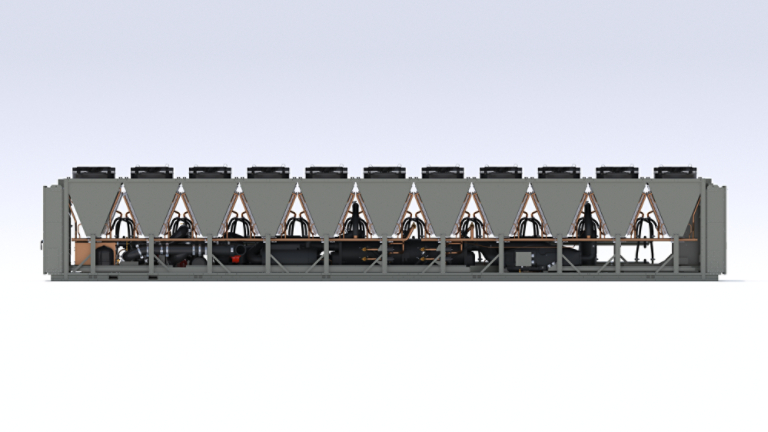
What Is an Air-Cooled Chiller?
An air-cooled chiller is a refrigeration system that provides cooling for commercial and industrial applications. Unlike its water-cooled counterpart, an air-cooled chiller utilizes ambient air as the medium to transfer heat from the refrigerant to the outside environment. This process eliminates the need for a cooling tower, making it a sustainable choice for systems that don’t require a larger chilled water plant.
How Does an Air-Cooled Chiller Work?
All chillers operate on the principle of vapor compression or vapor absorption. Here's how the typical vapor compression chiller works for an air-cooled chiller:
- In the evaporator, liquid refrigerant absorbs heat from the building’s water loop, causing it to boil. That refrigerant vapor is then drawn into the compressor.
- The compressor increases the temperature and pressure of the refrigerant, converting it into a high-temperature, high-pressure gas.
- In the condenser, large fans draw ambient air across the condenser coils. This process causes the refrigerant to condense back into a liquid, transferring the heat to the ambient air.
- Next, the liquid refrigerant passes through an expansion device, which reduces its pressure and temperature.
- Finally, the lower-pressure refrigerant returns to the evaporator to repeat the cycle.
Considerations for Air-Cooled Chiller Systems
Air-cooled chillers offer many benefits that make them the ideal choice in several situations:
Lower initial costs: The absence of a cooling tower and associated pumps simplifies the system, often leading to easier installation and lower upfront costs compared to their water-cooled counterparts. They are self-contained units that can be installed on rooftops or at ground level, saving valuable indoor space.
- Water conservation: Since air-cooled chillers reject heat to the ambient air, they are an excellent choice in areas with water scarcity or high water costs..
- Versatility: These chillers are available in a variety of configurations, including packaged units that come complete with pumps and tanks. They are also available as portable units, making them suitable for temporary or emergency cooling needs.
- Heat recovery potential: In some applications, the heat discharged from the air-cooled chiller can be recovered via an auxiliary heat exchanger to supplement a heating load, leading to energy savings.
- Multiple possible outputs: Some configurations can provide year-round hot water for building applications. For example, Trane’s Ascend ACX air-cooled heat pump chiller generates heating, cooling, and hot water from one electric source.
Types of Air-Cooled Chillers
- Helical rotary chillers (also called screw chillers)
- Scroll chillers
- Magnetic bearing chillers
Common Applications of Air-Cooled Chillers
These chillers tend to be used more often in small to mid-sized facilities, such as: