
Blog
Published: September 17, 2026
What Is a Data Center?
Learn what a data center is, the different types, and how data center sustainability can be a reality with the proper design and optimization.
Quick Facts
- Industry
- Data Centers
Sustainability First: The Data Center Challenge We're Solving Together
Before we talk about the types of data centers and how they work, we want to address the issues in the industry head-on: the environmental footprint of digital infrastructure. Data centers and sustainability are hotly debated from the global to the local level. Concerns about overtaxing the electrical grid, water usage, and emissions are understandable. We share them, which is why we are working hard to engineer sustainable solutions.
The Energy Reality
Electricity consumption from data centers is estimated to be 415 terawatt hours (TWh), or about 1.5% of global electricity consumption in 2024. Over the last five years, it has grown at 12% per year.
Conservative estimates for global electricity consumption for data centers project it to double, reaching around 945 TWh by 2030 — growing at approximately 15% per year, more than four times faster than the growth of total electricity consumption from all other sectors.
Cooling alone accounts for 30–40% of total facility energy use, making thermal management the single largest lever available to data center operators who want to reduce their environmental impact.
While data centers have achieved impressive efficiency gains, improving average Power Usage Effectiveness (PUE) from 2.5 in 2007 to 1.55 in 2022, these improvements are being outpaced by explosive demand growth.
Understanding PUE: The Efficiency Benchmark
Power usage effectiveness is a core international metric for data center energy efficiency. It is defined as the ratio of total data center energy consumption to IT equipment load energy consumption — accurately reflecting energy losses from non-IT systems such as power distribution and cooling.
Theoretically, the ideal PUE value is 1.0, meaning all power is exclusively utilized by IT equipment. In practice, factors such as inefficient equipment, cooling technology limitations, and power losses in non-IT systems make a PUE of 1.0 nearly impossible to achieve.
Every fraction of a point of improvement translates directly into energy savings, cost reduction, and lower carbon emissions. Trane's thermal management solutions are specifically engineered to help data center operators close that gap.
The Sustainability Opportunity
The good news? Cooling technologies have a major impact on data center sustainability because they influence energy efficiency, water use, and carbon emissions. Advanced data center cooling solutions and strategies, such as liquid cooling, free cooling, economizers, and intelligent controls, can help reduce energy consumption, lower operating costs, and support more sustainable data center operations.
In addition to helping to reduce data center energy consumption through improved controls and thermal energy storage, there's momentum building around data center sustainability through waste heat recovery. Instead of simply wasting heat, data centers can reuse it for free cooling or share it with neighboring communities or industrial processes, feeding district heating systems and turning a liability into community value.
Trane's Commitment: The Gigaton Challenge
Trane Technologies has committed to eliminating one billion metric tons of greenhouse gas emissions from our customers' carbon footprints by 2030. To put that in perspective, one billion metric tons of carbon is equal to about 2% of the world's annual carbon emissions, or the equivalent to the combined annual emissions of Italy, France, and the United Kingdom.
Sustainability is at the heart of modern data center operations. Initiatives like Trane Technologies' Gigaton Challenge aim to help customers save a gigaton of emissions by 2030. Data centers are central to achieving that goal, and we're engineering every solution with that target in mind.
How a Data Center Works
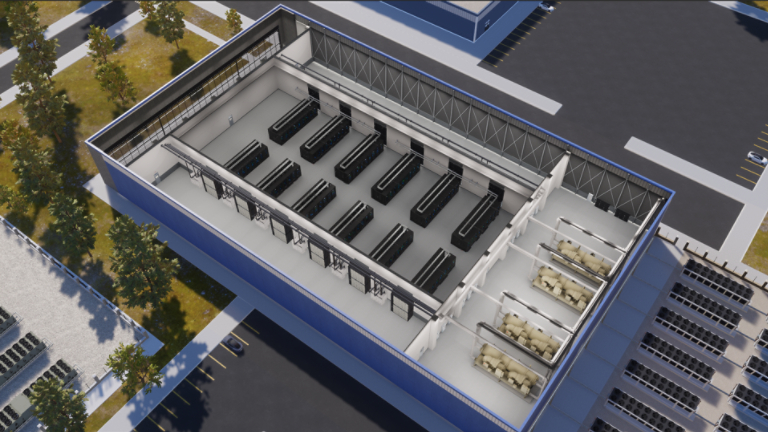
A modern data center is a carefully engineered ecosystem of interdependent systems that includes these data center components:
- IT Equipment: Servers, storage arrays, and networking hardware perform the actual computing work. These components generate significant heat as a byproduct of operation.
- Power Infrastructure: Utility feeds, backup generators, uninterruptible power supplies (UPS), and power distribution units (PDUs) ensure continuous, conditioned power delivery.
- Cooling Systems: Chillers, computer room air handlers, precision cooling units, liquid cooling systems, and free-cooling technologies remove heat from the IT environment and maintain precise temperature and humidity conditions.
- Controls & Monitoring: Building management systems, data center infrastructure management (DCIM) tools, and AI-powered controls provide real-time visibility and optimization across all facility systems.
- Physical Security & Fire Suppression: Access control, surveillance, and suppression systems protect the facility and its contents.
Of all these systems, cooling is the most energy-intensive and the most critical to uptime. Data center cooling systems are specifically designed to remove heat from IT equipment and maintain precise environmental conditions around critical loads. This makes them different from broader building HVAC systems, which focus on comfort cooling or heating for occupants.
Types of Data Centers
Not all data centers are created equally. Understanding the different models helps clarify why cooling requirements vary so dramatically — and why a one-size-fits-all approach simply doesn't work.
Enterprise Data Centers
Enterprise data centers are private facilities owned and operated by an individual organization to meet its own IT infrastructure requirements. They are particularly well-suited for organizations that require customized networks or can benefit from economies of scale due to significant amounts of traffic or data being processed and managed within their data center.
Colocation data centers consist of one data center owner selling space, power, and cooling to multiple enterprise and hyperscale customers in a specific location. Interconnection is a large driver for businesses. Colocation data centers offer interconnection to Software as a Service (SaaS) platforms and Platform as a Service (PaaS) offerings, enabling businesses to scale and grow with less complexity efficient resource use.
In a colocation data center, multiple businesses share the same building. Each company has its own space to set up servers and IT hardware, but the facility takes care of things like power, cooling, and security. There are two types of colocation data centers:
- Wholesale colocation: Offers large spaces, often entire data halls or private suites, designed for single tenants with substantial IT infrastructure needs. Its typical power requirements exceed 300 kW and can reach up to 1 MW, supporting hundreds or thousands of servers.
- Retail colocation: Provides smaller increments such as individual racks, cabinets, or cages within a multi-tenant facility. This type is ideal for small to medium-sized businesses or enterprises with limited IT infrastructure.
Hyperscale Data Centers
Hyperscale data centers meet enterprise data needs by offering scalability and high-speed processing for large volumes of data. A data center with more than 5,000 servers and more than 10,000 square feet of space is generally considered hyperscale, and some hold more than a million servers. They are designed for homogenous scaling to support projects that need almost endless processing power.
In terms of business model, a hyperscale data center is not a multi-tenant facility for rent; rather, it is an investment by the owner company to support its own services. The owner fully controls the design and operations, optimizing for maximum efficiency through extensive server virtualization, software-defined networking, and ultra-high-speed fiber networks.
Edge Data Centers
Edge data centers are smaller, distributed facilities located closer to end users or data sources that help to reduce the latency for applications like autonomous vehicles, IoT, and 5G networks. While smaller in scale, they present unique thermal management challenges due to their compact footprint and often non-ideal environments.
Why Data Center Cooling is the Critical Variable
AI-driven compute has fundamentally altered the thermal profile of modern data centers. Higher chip-level power densities, coupled with fluctuating workloads, are forcing operators to rethink cooling strategies across the entire facility, from central plant design through to on-chip heat removal.
Chillers have long been a cornerstone of data center cooling for over 25 years. However, the scale of operations has dramatically increased in recent years. Where once a few chillers sufficed, now entire infrastructures can require hundreds of these critical components.
As artificial intelligence reshapes the architecture of data centers, Trane is rolling out a reengineered suite of thermal management systems designed to meet the heat rejection demands of hyperscale growth, hybrid deployments, and soaring rack densities — expanding from traditional HVAC into advanced liquid cooling, high-capacity chillers, and customizable fan coil wall platforms purpose-built for the data center.
Trane's Data Center Solutions
As part of Trane Technologies, we collaborate with leading hyperscale and colocation data center operators to help drive peak performance, sustainability, and lasting resilience. From early-stage concepts to proven, measurable results, our experts collaborate with customers throughout the full lifecycle of data center thermal management, designing, building, enhancing, and continuously evolving systems to help support operational excellence and sustainability goals.
We deliver the expertise, insight, tailored solutions, and scalable support needed to fuel growth, help reduce environmental footprint, and keep pace with shifting business needs. Our portfolio includes a variety of efficient, scalable cooling technologies, from air- and water-cooled chillers to chiller plant controls, fan coil units, and cutting-edge liquid cooling systems — all built with the conservation of energy, water, and resources as a core design principle.
Data Center Chillers
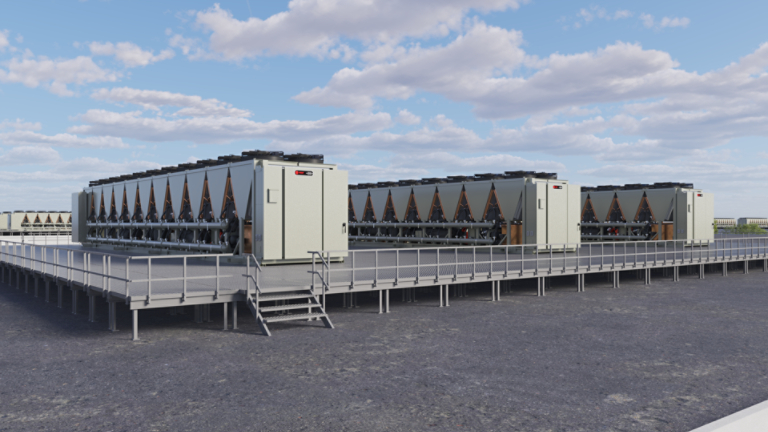
Trane data center chillers are designed to handle demanding applications, with advanced features that help cut operational costs and help reduce environmental impact. Trane data center cooling systems use advanced controls for reliable, quiet operation, rapid restart, and low peak power consumption, even in high ambient conditions.
Trane's chiller portfolio for data centers includes air-cooled and water-cooled options, engineered specifically for the continuous, high-load demands of mission-critical environments.
Liquid Cooling Systems & Coolant Distribution Units (CDUs)
Liquid cooling solutions are engineered to address the increasing thermal demands of high-performance IT workloads. These systems offer precise control over the delivery and return of coolant to IT racks, helping to provide stable temperature management even under the most intensive conditions, especially vital for data centers handling AI-driven operations and other energy-intensive applications.
We offer enhanced liquid cooling capabilities for our advanced thermal management systems, tailored specifically to help data centers become future-ready. With new, scalable Coolant Distribution Unit (CDU) solutions, such as Trane’s GigaModular™ CDU, which supports up to 14 MW, Trane is helping to drive greater cooling capacity and energy efficiency for hyperscale and colocation data centers.
Validated and certified to help reduce energy consumption and lower operational costs, our 1 MW CDU supports up to 1,350 kW, making it ideal for data centers transitioning to hybrid cooling strategies, including, direct-to-chip cooling. Trane CDUs leverage LiquidStack® technology, offering seamless integration with high-efficiency chillers and enhancing the entire thermal management system.
Precision Air Cooling & Computer Room Air Handlers (CRAHs)
Equipped with the Symbio® controller, Trane's CRAH solution offers a broad capacity range and customizable options to help meet the specific needs of data centers, including reduced power consumption, exceptional cooling, and dependable performance. Symbio allows for flexible leader designation and dynamic reassignment for up to 32 units, providing continuous operation and access to a suite of digital solutions for ongoing lifecycle management.
For high-density environments, Trane data center air handlers provide exceptional airflow and precise temperature control to help improve use of space and ease system loads.
Free Cooling & Heat Recovery
Trane's range of data center solutions includes free cooling, which leverages ambient air temperatures to cool data centers naturally. When outdoor conditions allow, free cooling helps reduce mechanical cooling loads, cutting energy consumption and improving PUE without sacrificing reliability.
Trane's range of data center solutions also includes heat recovery systems, which capture and reuse waste heat for other applications, turning a traditional challenge into a community asset or an operational efficiency gain.
Thermal Energy Storage
Trane® thermal storage systems help lower utility bills, increase sustainability, and provide greater operational flexibility. By shifting cooling loads to off-peak hours, thermal storage reduces demand charges and provides an additional layer of operational resilience.
Chiller Plant Controls & Building Operations
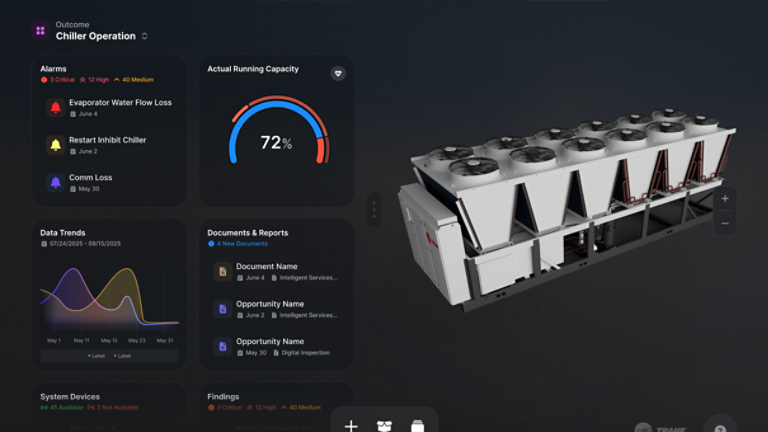
Harnessing Trane's deep systems knowledge and expertise, chiller plant control helps convert complex programming into a simplified, efficient solution that can be customized to meet the needs and conditions of data centers.
Trane data center services are designed to prevent downtime and enhance performance, from commissioning and retrofits to maintenance and long-term service plans. Trane's building optimization solutions utilize monitoring, energy efficiency measures, and AI technologies to help boost building performance and sustainability.
Engineer-Ready Reference Designs
Trane's engineer-ready data center reference designs include detailed system layouts, temperature and flow data, and best practices for integrating air and liquid cooling, help reduce redundancy, and improve free cooling. Use them as a proven blueprint to accelerate data center design, help reduce water usage, and balance performance with energy efficiency.
Thinking Beyond the Chiller Plant
What sets Trane apart is a connected ecosystem of technologies, brands, and expertise that spans the entire data center thermal management stack.
LiquidStack: Next-Generation Immersion & Direct-to-Chip Cooling
LiquidStack solutions are engineered to meet the unprecedented demands of generative AI and hyperscale computing. Data centers and high-performance compute organizations rely on LiquidStack for high-density liquid, direct-to-chip, and immersion cooling solutions that improve efficiency, sustainability, and performance.
LiquidStack's portfolio includes direct-to-chip systems, which circulate coolant to cold plates mounted on processors, and immersion cooling systems, which submerge servers in specialized fluid. These approaches can help reduce reliance on traditional air cooling in parts of a facility and change how heat is captured and rejected from the data hall, potentially resulting in a dramatic reduction in a data center's direct and indirect carbon footprint.
Trane Can Help You Address Sustainability Challenges Head-On
As a global climate innovator, Trane is committed to helping you achieve your data center sustainability goals while maintaining operational efficiency and mitigating concerns, including noise reduction, water usage, energy consumption, and regulatory compliance.
Energy Efficiency & Carbon Reduction
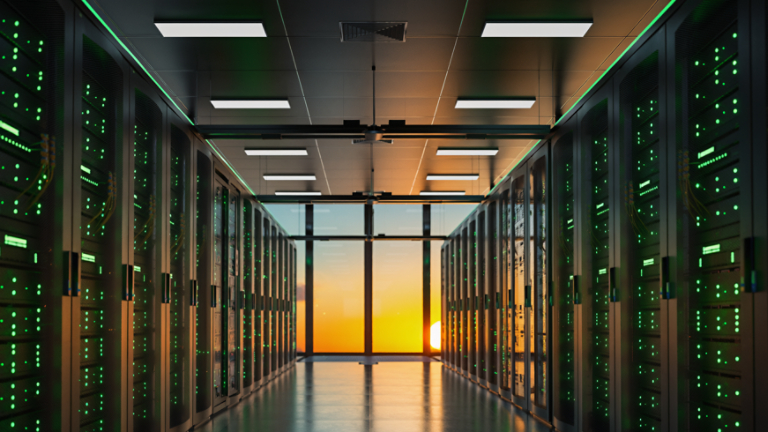
Trane's solutions provide a combination of energy efficiency, environmental benefits, regulatory compliance, scalability, and support for data center sustainability initiatives. Trane's advanced solutions help enable your data center to operate more intelligently, reducing energy use and reducing waste while improving your PUE, meaning more of your consumed power goes directly to computing work.
Water Conservation
Water usage is a critical aspect of data center sustainability. Trane offers water-efficient cooling technologies that utilize air-cooled systems and closed-loop water systems to reduce water usage, as well as water recycling systems to reduce overall consumption.
Noise & Community Relations
Trane offers solutions to help mitigate challenges with community relations due to perceived environmental impact, including implementing quieter cooling systems to lower noise pollution or acoustic concerns. Trane also helps support community engagement by collaborating with with local communities to help promote sustainability initiatives, transparency, and energy repurposing opportunities.
Navigating Regulatory Compliance & Green Certifications
Sustainability is an achievable outcome with Trane's innovative solutions purposefully engineered with energy efficiency in mind, including helping data centers achieve LEED and other green certifications. As regulatory requirements around energy use and heat recovery tighten globally, Trane's portfolio is designed to help your facility navigate regulatory requirements.
Waste Heat Recovery
Instead of simply wasting heat, data centers can reuse it for free cooling or share it with neighboring communities or industrial processes, feeding district heating systems and turning a liability into community value. As population density rises around data centers, and regulatory expectations tighten around the world, innovation in capturing and managing waste heat will be critical.
Trane heat pump technology enables Infomaniak's Geneva data center to recover waste heat and supply thermal energy to thousands of nearby homes, creating a circular energy system. At full capacity, the system enables Infomaniak to recover 1.7 MW of heat — enough to warm 6,000 energy-efficient homes during winter months or provide 20,000 five-minute showers each day in summer.
From Design to Enhancements: Trane's End-to-End Approach
As data centers continue to evolve with increasing capacity demands, tighter timelines, and zero tolerance for downtime, Trane is introducing significant enhancements to its comprehensive portfolio of data center support services. These advancements underscore Trane's commitment to delivering end-to-end thermal management support, helping improve uptime, efficiency, and long-term performance for mission-critical data center operations.
Our model covers every phase of the data center lifecycle:
- Design & Engineering: Reference designs, system modeling with TRACE® software, and collaborative engineering support
- Products & Equipment: Chillers, CDUs, CRAHs, fan coil walls, controls, and thermal storage
- Commissioning: Expert HVAC startup and commissioning services that maximize efficiency, reliability, and performance from day one
- Service & Maintenance: Maintenance and repair services that help commercial buildings run efficiently, reduce downtime, and help extend equipment life
- Optimization: AI-powered controls, remote monitoring via Trane® Connect™, and ongoing energy management services
- Rental & Emergency Support: Reliable HVAC and power rental solutions for commercial, industrial, or emergency needs with fast delivery, expert setup, and professional support
Trane's data center solutions help boost uptime, reduce costs, and improve investment value, offering long-term value for hyperscale and colocation owner/operators. Our automated systems and smart controls help offer efficient, reliable operations, support growth, and deliver energy savings for high-density computing in a rapidly evolving market.
This is for informational purposes only and does not constitute professional advice. Trane believes the facts and suggestions presented here to be accurate; however, final design and application decisions are your responsibility. Trane disclaims any responsibility for actions taken on the material presented.
This Article includes “forward-looking statements” within the meaning of securities laws, which are statements that are not historical facts, which include, but are not limited to, statements regarding our Embodied Carbon reduction, our sustainability commitments and the anticipated impact of these commitments.
These forward-looking statements are based on our current expectations and are subject to risks and uncertainties, which may cause actual results to differ materially from our current expectations. Factors that could cause such differences can be found in our Form 10-K for the year ended December 31, 2023, as well as our subsequent reports on Form 10-Q and other SEC filings. New risks and uncertainties arise from time to time, and it is impossible for us to predict these events or how they may affect the Company. We assume no obligation to update these forward-looking statements and no undue reliance should be placed on any forward-looking statements.
All trademarks referenced are the trademarks of their respective owners.
© 2026 Trane. All Rights Reserved.