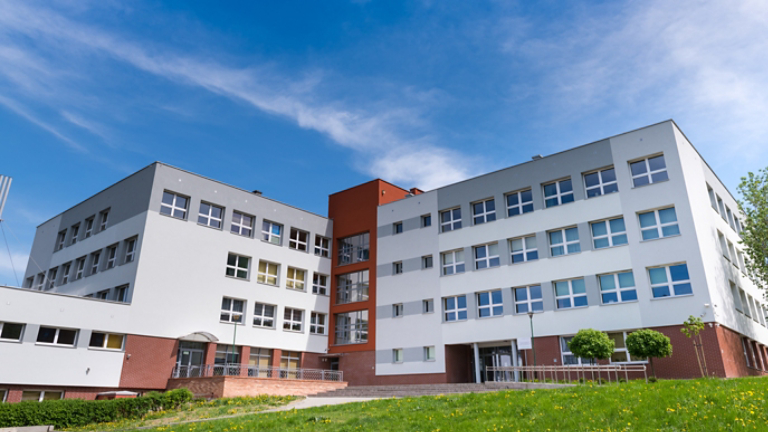
Schools today face a convergence of challenges: aging infrastructure, rising energy costs, tightening budgets, and increasing expectations for environmental responsibility. At the same time, learning environments must be productive and appealing spaces that help institutions compete for students and talent. Sustainability—once considered primarily an act of environmental stewardship—has become a strategic tool for strengthening operational performance, improving resilience, and creating better educational outcomes.
Why Sustainable School Buildings Matter More Than Ever
Energy remains one of the largest controllable expenses in education, especially for K-12 districts where utility costs are often the second highest budget line after teacher salaries.1 Students and families also increasingly expect environmentally responsible campuses with modern, comfortable spaces that reinforce productivity and well-being.
When thoughtfully designed, sustainability initiatives can reduce energy costs, enhance reliability, and build community trust while lowering operational costs. These advantages directly support the mission of educational institutions, helping align environmental responsibility with financial stewardship and student success.
Modern Infrastructure, Measurable Outcomes
According to the International Energy Agency, buildings account for 30 percent of global final energy consumption and 26 percent of global energy related emissions.2 For schools, modernizing outdated equipment with high efficiency HVAC, advanced controls, LED lighting, and integrated building automation can deliver meaningful reductions in both energy usage and maintenance spending.
Beyond cost savings, smarter, more efficient systems improve comfort, indoor air quality, and resilience, helping institutions avoid disruptions tied to energy volatility or aging equipment. These improvements create more stable learning environments that benefit students, educators, and staff.
Sustainable schools across the country are already seeing the impact:
- North Shore District 112 saved more than $3 million by pairing incentives with a geothermal modernization project, reducing expected carbon footprint by 30 percent.
- Ozark Schools implemented LED retrofits, district wide building controls, and solar power, generating $98,000 in annual solar savings and enhancing classroom comfort.
- Northern Illinois University is projected to reduce energy consumption by 26 percent through a zero upfront capital, budget neutral modernization effort. The project combines smart HVAC controls, solar, EV charging, and thermal energy storage and is expected to generate approximately $100 million in savings over 20 years.
These examples demonstrate how efficiency, electrification, and modern infrastructure can unlock measurable financial, environmental, and operational value for educational institutions of all sizes.
Financing Tools That Make Sustainability Attainable
While capital constraints remain a common challenge, today’s funding landscape offers multiple paths to advance modernization and sustainability goals. Local and regional incentives, utility rebates, and flexible financing models allow institutions to pursue impactful upgrades without sacrificing mission critical priorities.
One of the most effective funding mechanisms for education facilities is the Energy Savings Performance Contract (ESPC), a budget neutral approach that allows organizations to pay for improvements using future guaranteed energy savings. Guaranteed savings ensure that institutions only pay for improvements once the cost reductions are realized, reducing financial risk.
ESPCs and related funding tools enable institutions to:
- Address deferred maintenance
- Introduce modern, efficient technology
- Improve learning environments
- Avoid new debt and preserve capital
When institutions reduce energy costs and operational expenses, they gain flexibility to reinvest in academic programming, campus experiences, and long-term strategic initiatives. Modern, efficient sustainable buildings have become a foundation for both operational stability and student success.
Sustainability as a Driver of Educational Excellence
Modernization is about more than sustainable school buildings. It’s about people.
Improved indoor environments can support student engagement, enhance staff and teacher satisfaction, and boost overall well-being.3 Institutions with strong sustainability practices also benefit from enhanced community trust and stronger competitive positioning, particularly as sustainability grows in importance for prospective students and families. While many institutions face declining enrollment, visible commitments can help differentiate campuses, strengthen value propositions, and attract mission‑aligned students who increasingly prioritize environmental responsibility.
Sustainability isn’t just the right thing to do. It’s a strategic investment in the future of education.
To learn more about how Trane helps schools and campuses modernize facilities, reduce energy costs, and strengthen sustainability initiatives, visit trane.com/energyservices.
This is for informational purposes only and does not constitute professional advice. Trane believes the facts and suggestions presented here to be accurate; however, final design and application decisions are your responsibility. Trane disclaims any responsibility for actions taken on the material presented.
1 https://www.energy.gov/cmei/articles/guide-financing-energysmart-schools#:~:text=DOE's%20EnergySmart%20Schools%20Program,training%20for%20building%20industry%20professionals
2 https://www.iea.org/energy-system/buildings
3 https://www.epa.gov/iaq-schools/indoor-air-quality-high-performance-schools#:~:text=Higher%20Test%20Scores.,better%20facility%20%E2%80%94%20one%20with%20appropriate: