
Customer Story & Case Study
NIU Campus Transformation Through Sustainable Innovation and Student Collaboration
NIU collaborated with Trane to modernize campus infrastructure, cut energy use, and enhance student learning through renewable energy, efficiency upgrades, and hands‑on sustainability projects.
Quick Facts
- Location
- DeKalb County, Illinois
- Industry
- Higher Education
- Products
- Thermal Energy Storage • HVAC Controls
- Topics
- Solar • Sustainability • STEM • Energy Efficiency
Results
- 26% Projected reduction in energy consumption
- 11% Projected greenhouse gas emissions reduction
- $100M In savings over 20 years; $5M annually
- $3.9M Leveraged in tax credits; significant utility rebates and state of Illinois incentives

Award-Winning Project: 2026 Award for Energy Innovation by Environment+Energy Leader.
Highlights
- NIU collaborated with Trane on a campus sustainability and modernization program aligned with its Climate Action Plan.
- Upgrades included solar arrays, thermal energy storage, smart HVAC controls, LED lighting, and EV charging infrastructure.
- The initiative was financed through a budget‑neutral ESPC model, leveraging tax credits and state and utility incentives.
- Projected results include a 26% reduction in energy use, 11% lower greenhouse gas emissions, and $5 million in annual savings.
- Students and faculty played a major role through data‑driven capstone projects, leading to real‑world experience and career pathways.
- Campus and community benefits extend to improved learning environments, job creation, and enhanced sustainability leadership.
The Challenge: A Bold Commitment to Campus Sustainability
Northern Illinois University (NIU) set out to transform its campus in support of both its sustainability commitments and broader mission—to deliver an exceptional, future-focused student experience.
Like many higher education institutions, NIU faced increasing pressure to attract and retain students in a competitive landscape, deliver modern curricula aimed at workforce readiness, and foster inclusive, vibrant learning environments. The launch of its comprehensive Sustainability and Climate Action Plan reflected NIU’s bold commitment: to reduce campus greenhouse gas emissions by 50% by fiscal year 2030, supporting both environmental stewardship and the university’s mission to serve students and the broader community.
Achieving these mission-aligned outcomes required the NIU campus to confront longstanding challenges: outdated facilities, surging energy costs, deferred maintenance stretching across campus, and the complexities of funding major capital improvements on a limited budget.
To move forward, NIU needed to strategically identify and prioritize projects that would significantly impact campus sustainability, enrollment, student success, and the university’s relevance in a rapidly evolving educational landscape. This required balancing strict financial constraints and competing demands for resources.
The Solution: A Tailored, Comprehensive Approach for the Entire NIU Campus
Through strategic discussions that addressed NIU’s academic needs, evolving campus sustainability initiatives, financial challenges, and infrastructure requirements, NIU collaborated with Trane to develop a comprehensive, campus-wide program—incorporating decarbonization, efficiency upgrades, student engagement opportunities, and broader community involvement.
The project blended innovative strategies across the campus:
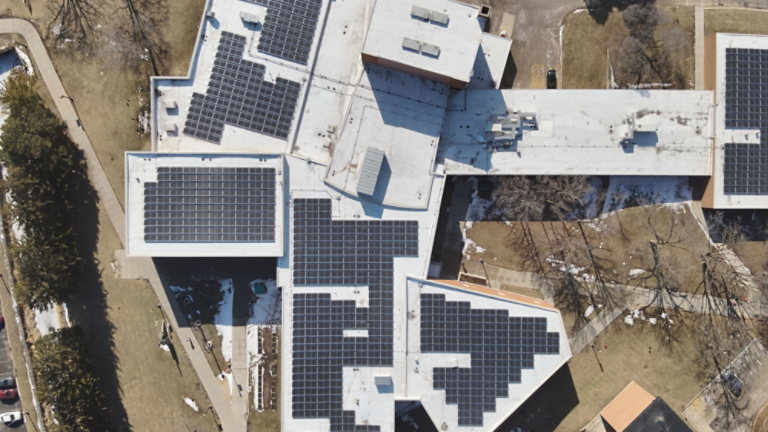
- Solar photovoltaic arrays provide onsite renewable electricity, visible to students, and integrated into science curricula.
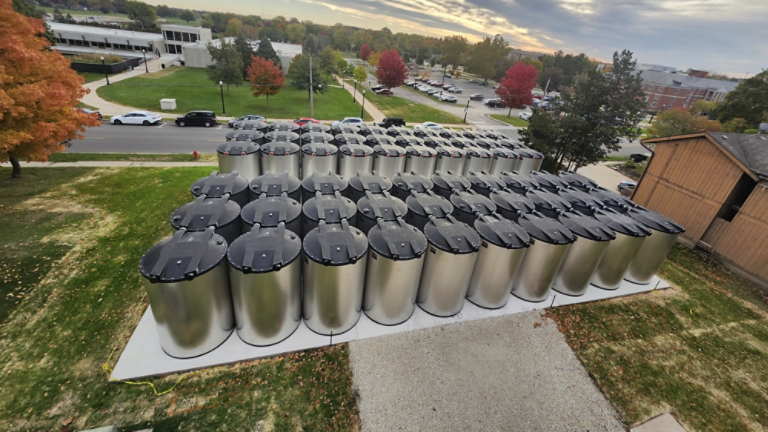
- Thermal energy storage tanks deployed in three facilities to enable strategic load shifting—charging tanks using off-peak electricity and discharging cooling during peak times, improving energy economics and system resilience. Half of the campus’s chilled water is provided by one facility alone.
- Smart HVAC controls in 39 buildings and advanced energy metering support deep monitoring and diagnostics, fostering a data-driven approach to operational efficiency and accountability.
- Efficiency upgrades included a comprehensive retrofit to energy-efficient LED lighting for 51 buildings, high-efficiency heating and cooling systems in two buildings, targeted water conservation, and enhanced insulation and weatherization for envelope integrity.
- EV charging stations to promote sustainable campus transportation options for commuters.
Leveraging an Energy Savings Performance Contracting (ESPC), the initiative was structured to be budget-neutral—redirecting future savings to fund the upgrades, thereby overcoming financial barriers and risk. NIU combined federal, state, and utility incentives to maximize impact.
The Results: Campus Energy Savings, Student Empowerment & Much More
This NIU campus transformation has delivered exceptional, measurable impacts across energy, financial, academic, and community dimensions.
Campus-wide energy consumption is projected to decrease by over 26% annually, while greenhouse gas emissions are expected to be reduced by 11%, equivalent to removing 10% of all vehicles from the road in Dekalb county. Smart controls and thermal energy storage will further reduce peak energy demand and improve system flexibility throughout campus.
The initiative will generate $5 million in annual savings, with savings of just over $100 million in 20 years. NIU leveraged $3.9 million in tax credits and has captured significant utility rebates and State of Illinois incentives to support the program's financials.
Faculty and students were integral to the program, engaging in nine multidisciplinary capstone projects co-developed with Trane, where they used real‑time energy data to shape recommendations that informed the project approach.
For many, the experience went far beyond a classroom assignment. Recent NIU graduates—and now new Trane Technologies’ hires—Stephanie Verdin and Ben Koranda described how the program shaped their paths.
Stephanie shared that the opportunity connected her with “amazing mentors and resources,” and as a Latina in engineering, it empowered her to “open doors for other people like me.”
For Ben, contributing to NIU’s Climate Action Plan brought a sense of purpose rarely found in undergraduate work. He described the experience as “like winning the Super Bowl,” because “the work I did mattered” and the impact was visible across campus.
These authentic student experiences highlight the transformative value of applied learning—strengthening diversity in STEM, inspiring future leaders, and creating lasting workforce pathways, including hires directly into Trane Technologies pathways.
The impact extended beyond academics and economics, contributing to job creation and meaningful investment in the local community. Campus‑wide upgrades have enriched learning, athletic, and residential spaces, elevating comfort and functionality for students, faculty, and staff alike. Increased student engagement in campus sustainability planning and STEM innovation—through capstone projects, internships, and hands‑on experience—has driven academic growth and opened new employment opportunities.
Collectively, these results highlight how NIU’s initiative has advanced campus sustainability, enhanced academic and community experiences, and established a model for energy innovation and leadership.
Video