HVAC Basics: Central heating and cooling
By Anne Fonda
In a nutshell, a central heating, ventilation, and air conditioning (HVAC) system heats or cools your home by blowing heated or cooled air through your ductwork. While the process seems simple, achieving the perfect temperature (and humidity) in your home requires a complex interplay of various HVAC equipment.
Understanding the central heating and cooling processes will help you achieve a higher level of home comfort and better maintain your HVAC system.
How does central cooling work?
A central air conditioning system works by taking heat and humidity from your home and releasing it outside, to ultimately drop the temperature in your home. This happens during the refrigeration cycle.
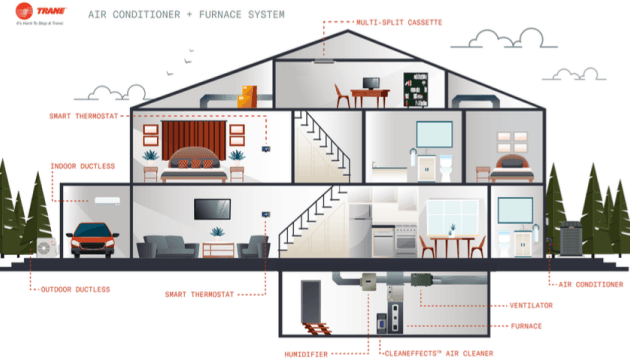
Central cooling process
Central cooling kicks off when a thermostat senses that the temperature in your home needs to be changed. In the case of central cooling, the thermostat will alert your cooling unit that the temperature needs to drop, and all parts will work simultaneously to get your home to your desired temperature.
Once the cooling cycle is triggered, the central air system takes these steps to cool your home:
- A fan from the indoor portion of your AC pulls room temperature air into the return air vent system.
- This air is blown over the evaporator coil. The evaporator coil is filled with cold liquid refrigerant that absorbs the heat from the air, which turns the refrigerant into a gas.
- The newly cooled air is blown back into your home via supply ducts and supply registers.
- The refrigerant continues flowing into the compressor, which pressurizes the gas and sends it to the condenser coil.
- The condenser coil releases the heat from the refrigerant into the outdoor air.
- When the refrigerant leaves the condenser coil and releases most of its heat outside, it’s still too hot to re-enter the evaporator coil. The expansion valve works by decreasing the pressure of the refrigerant and cooling it down even more before sending it back to the evaporator coil.
- The process starts again.
Central cooling system options
There are two main types of central cooling systems – the split system and the packaged system.
Split system
A traditional split system is composed of a thermostat, an outdoor AC unit or heat pump, an indoor unit (air handler or furnace), copper refrigerant lines that connect the outdoor and indoor units, and ductwork throughout the home. While a split-system AC unit only cools, a heat pump can reverse the flow of refrigerant to heat the home as well.
Packaged system
A packaged air conditioner is the other type of central cooling. A packaged unit works the same way as a split system AC or heat pump, except the whole unit sits outside the house; there is no equipment inside the home. The packaged unit takes air from your house through the return air vents and ductwork, cools it, and then sends it back to the house through the supply ductwork. A packaged system can house both the heating and cooling systems.

How does central heating work?
Central heating systems can work in the same general way as central cooling systems by moving air around to change the temperature in your home. Instead of moving hot air out, central heating systems either burn fuel to heat the air (gas furnace) or extract heat from the outdoor air (heat pump).
Central heating system options
There are two main options for central heating systems: heat pumps and furnaces.
Furnaces
Furnaces work by burning fuel (natural gas, propane, or heating oil) to generate heat and then distribute heated air through ducts. Furnaces produce heat at a relatively fast pace.
Heat pumps
Heat pumps reverse the refrigeration cycle to extract heat from the outdoor air and transfer it inside your home. They use electricity to do this rather than burning fossil fuels.
Hybrid systems
Hybrid heating systems combine an electric heat pump with a gas furnace for reliable comfort. The heat pump provides heat down to a certain temperature based on the efficiency of the heat pump and whether it’s a cold climate heat pump (CCHP) or not.
When it gets cold enough that the heat pump starts to become less efficient, the furnace kicks in until temperatures rise again. Your local Trane dealer can help you select the right components for your climate.
Packaged systems
For homes without a lot of space, a packaged system offers an alternative to the traditional split system. This can be a gas furnace and air conditioner, a packaged heat pump system, or a gas furnace and heat pump hybrid system.
Central heating process
All central heating processes start the same way central cooling processes do: a thermostat registers the temperature and signals the HVAC system to start heating.
Heat pumps reverse the refrigeration cycle from cooling to heating as the seasons change and you switch to heat mode on the thermostat. The heat pump absorbs heat energy from the outside air and transfers it into the home to warm it up.
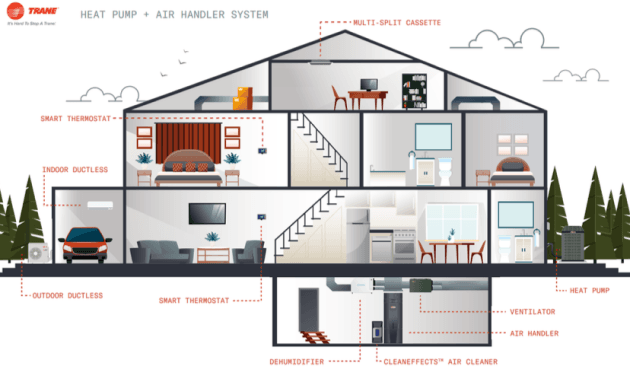
Furnaces, on the other hand, function in a totally different way than other HVAC products. While the thermostat still kicks off the heating process, furnaces burn fuel to produce heat. The heating process works like this, with some differences based on the efficiency of your furnace.
- The thermostat signals the need for heat.
- Fuel comes into the furnace through a pipe, and an ignitor lights the furnace burner.
- The furnace burner heats up the heat exchanger.
- Cold air from your home is warmed as it passes over the furnace heat exchanger.
- A blower fan inside the furnace directs the newly warmed air through the various supply ducts and registers in your home.
- Flue gases from combustion are piped out of the furnace through a vent and exit your home.
- More cold air is directed from your home into the furnace via the return ducts.
- The process repeats itself until your home is warmed, at which point the thermostat signals the furnace to stop.
What steps should homeowners take before HVAC replacement?
STEP 1
Determine your heating and cooling needs
Do you live in a place where the temperature outside plummets in the winter? If yes, consider investing in a high-efficiency furnace to heat your home quickly and reliably. Does the temperature where you live stay consistent and mild most of the year? If so, a heat pump could provide the heating and cooling you need all year long. Somewhere in between? Consider a hybrid system.
STEP 3
Work with a licensed HVAC professional
When it’s time to replace your HVAC system, leave it to a licensed HVAC professional. They can offer recommendations, ensure proper sizing, and help maintain your system for peak performance. Proper sizing and installation are crucial to getting the highest efficiency and reliable comfort from your new system.
STEP 2
Clear your schedule for installation
Most new HVAC equipment takes a few hours to a day to install, and you must be home for the process in case your technician has any questions for you. Before they leave, the technician should test your system, explain new features to you, and answer any questions you may have.
Anne Fonda, Content Writer
A Content Writer with Trane Technologies, Anne Fonda researches topics and writes for Trane® and associated residential HVAC brands. She works in collaboration with Trane Technologies subject matter experts, offering easy-to-understand, informative content on complex topics. Her goal is to help consumers make informed decisions on the products and services they need.
She has written for HVAC and other service provider websites for over 16 years. Before transitioning to web content writing, Anne had a 14-year stint as an award-winning journalist. She graduated cum laude from the University of Missouri-Columbia School of Journalism.
When she’s not working, Anne enjoys playing word games, reading, gardening, spending time with family, and visiting gardens and museums.
Expert review by Kimberly Sexton, Senior Systems Engineer
Related products
Get helpful HVAC tips in our newsletter
Sign up for our email newsletter to learn helpful HVAC tips and tricks before your purchase your system.Related articles
Contact a local dealer
Dealers can answer questions, help you find the right products for your home, and repair your system.
We’re here to help
Connect with our Customer Care team about your products, warranties, and dealer concerns.
Available Monday – Friday from 7am to 5pm CST
A phone