What Is a Screw Chiller?
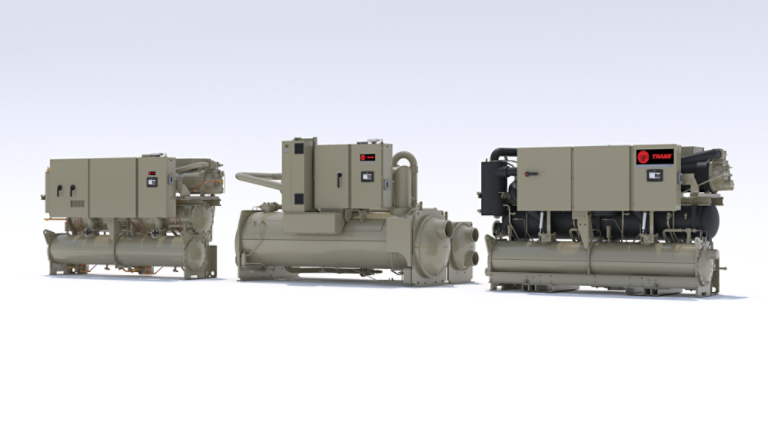
A screw chiller is a type of refrigeration system that provides cooling or heating for commercial and industrial processes. Typically offering a cooling capacity that falls between smaller scroll chillers and larger centrifugal chillers, screw chillers are highly versatile workhorses. They are available in both air-cooled and water-cooled configurations to suit a wide variety of facility layouts and climates.
How Does a Screw Chiller Work?
The defining feature of a screw chiller is its compressor, which uses two interlocking helical rotors, which look like large, threaded screws. The cooling process works as follows:
- Evaporation: In the evaporator, heat is transferred from water in the building loop to the refrigerant.
- Compression: The compressor contains two interlocking helical rotors that look like screws. As they turn, they compress the refrigerant gas smoothly and continuously. This process increases the refrigerant’s temperature and pressure.
- Condensation: The high-temperature, high-pressure refrigerant gas is discharged into the condenser, where it is cooled by ambient air or by water from a cooling tower. Heat is transferred via the phase change as the refrigerant condenses into a high-pressure liquid.
- Expansion: The liquid refrigerant passes through an expansion valve, which drastically drops its pressure and temperature, turning it into a cold, low-pressure mixture.
Benefits of Installing a Screw Chiller
Screw chillers are a popular choice for commercial facilities due to their balance of performance and practicality. Key benefits include:
- Exceptional reliability: Because rotary screw compressors have very few moving parts compared to older reciprocating compressors, there is less mechanical wear and tear, leading to a longer operational lifespan and reduced maintenance costs.
- High energy efficiency: Screw chillers are highly efficient, particularly at "part-load" conditions. When paired with variable frequency drives (VFDs), the chiller can precisely adjust its motor speed to match the exact cooling demand of the building, saving a significant amount of energy.
- Precise capacity control: The compressor design allows for modulating capacity control, with a wide operating range to maintain tight temperature control.
- Compact footprint: Screw chillers deliver high-capacity cooling in a relatively compact design, making them ideal for facilities with limited mechanical room space or strict roof load limits.
Common Applications of Screw Chillers
Screw chillers are incredibly versatile thanks to their mid-to-large capacity range and reliability. They are often used in:
- Commercial buildings: Office towers, corporate campuses, and mixed-use developments.
- Healthcare facilities: Hospitals and clinics that require highly reliable, uninterrupted cooling for patient comfort and sensitive equipment.
- Educational institutions: K-12 schools and university campuses with varying daily occupancy loads.
- Data centers: Facilities that need continuous mission-critical cooling to prevent servers from overheating.
- Industrial and process cooling: Manufacturing plants, food and beverage processing, and pharmaceutical facilities that require precise temperature control.
- Hospitality: Hotels and resorts where guest comfort and quiet mechanical operation are top priorities.