What Is a Data Center Control System?
A data center control system (often referred to simply as data center controls) is a specialized network of hardware and software designed to monitor, orchestrate, and automate the cooling and thermal management infrastructure of critical data facilities.
In enterprise, colocation, and hyperscale environments, maintaining a stable temperature, precise humidity, and optimal airflow is an operational necessity. Data center controls act as the brain of the thermal ecosystem, coordinating chillers, air handlers, and next-generation liquid cooling systems to protect server uptime, maximize energy efficiency, and lower the facility's carbon footprint.
How Do Data Center Controls Work?
Similar to standard commercial HVAC controls but optimized for mission-critical environments, data center control systems operate by continuously completing a loop of data collection, logical processing, and physical action. However, they run at much faster response rates and with higher levels of redundancy. The core components of the system include:
- Inputs (sensors): High-precision sensors are strategically placed throughout the white space (server rooms), hot/cold aisles, air plenums, and fluid loops. They measure real-time variables such as air temperature, humidity, static pressure, fluid flow rates, and server rack temperatures.
- Controllers: Microprocessors, such as Trane’s factory-installed Symbio® digital equipment controllers, reside directly on cooling equipment (like chillers, computer room air handler (CRAH) units, and coolant distribution units). These controllers process the sensor data locally, executing rapid adjustments to variables like fan speeds, valve positions, and compressor cycles.
- Supervisory orchestration: A centralized system controller, like Trane's Tracer® SC+, acts as the master coordinator. It integrates individual equipment controllers into a unified system. For example, rather than operating independently, chillers and pumps are staged and sequenced collectively based on the real-time thermal load of the entire facility. acts as the master coordinator. It integrates individual equipment controllers into a unified system. For example, rather than operating independently, chillers and pumps are staged and sequenced collectively based on the real-time thermal load of the entire facility.
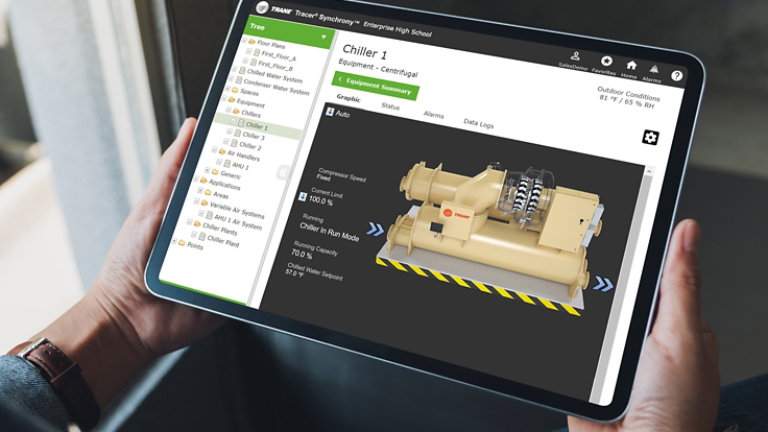
- User interface: Software platforms, such as Tracer Synchrony® or enterprise-wide Tracer Ensemble®, present this complex operational data to facility managers via intuitive dashboards. This allows operators to monitor alerts, run analytics, and adjust parameters remotely.
Key Benefits of Data Center Control Systems
1. Improving uptime: In high-density server environments, a thermal failure of just three to five minutes can cause temperatures to spike past safe operating limits, leading to automatic server shutdowns and catastrophic hardware damage. These server downtimes can translate into millions of dollars of lost revenue. Advanced controls actively mitigate this risk by detecting cooling anomalies early and triggering fail-safes before a thermal runaway occurs.
2. Energy efficiency and sustainability: As artificial intelligence (AI) and high-performance computing (HPC) demands expand, data centers require immense amounts of electricity. According to the International Energy Agency (IEA), global electricity consumption from data centers is projected to double by 2030, largely driven by rapid AI deployment. Implementing intelligent controls optimizes data center infrastructure efficiency (DCiE) by running only the exact cooling capacity required, maximizing free cooling windows, and utilizing precise chiller staging.
3. Rapid restart: Following a power disruption, a data center's backup generators kick in, but the cooling infrastructure must recover immediately to prevent servers from overheating. Advanced control sequences feature specialized software logic, such as Trane's Rapid Restart™ technology, which can restore chillers to full-load cooling capabilities in 120 seconds or less after power restoration.
Data Center Control Systems from Trane
Trane is the end-to-end thermal management partner for hyperscale and colocation data centers, delivering comprehensive solutions that span system design, equipment, controls, and ongoing operational optimization. By combining deep expertise in cooling, energy efficiency, and mission-critical performance, Trane helps data center operators build resilient, scalable, and sustainable environments that support uptime, adapt to dynamic load demands, and optimize total lifecycle value.
Trane's data center products include chillers, controls, fan coil walls, and liquid cooling paired with local expert service. Through Trane Autonomous Control, connected tools, and smart services, Trane equips thousands of local Trane service experts across North America and customers with the tools needed to resolve issues fast and efficiently.
To learn more about Trane's full suite of data center controls, thermal management products, services and capabilities, visit Trane Data Center Products.