
Customer Story & Case Study
Harnessing Wind Farm Power to Cool Campus Coliseum
By pairing wind power with thermal storage, Fort Hays State University achieves year-round comfort and energy efficiency at Gross Memorial Coliseum.
Quick Facts
- Location
- Hays, Kansas
- Industry
- Higher Education
- Products
- Chillers • Controls and Automation • Thermal Energy Storage
- Topics
- Electrification • Energy Efficiency • Sustainability
- Services
- Energy Services
Results
- 1,480 ton-hours of cooling when charged
- ~$18,000 per year saved in electricity charges during peak hours when demand is highest
- Zero kWh needed for chiller during peak hours or when wind is unavailable
Highlights
- Fort Hays State University maximized on-campus wind farm investment with thermal energy storage.
- Innovative thermal storage solution boosts energy efficiency by shifting cooling to off-peak hours.
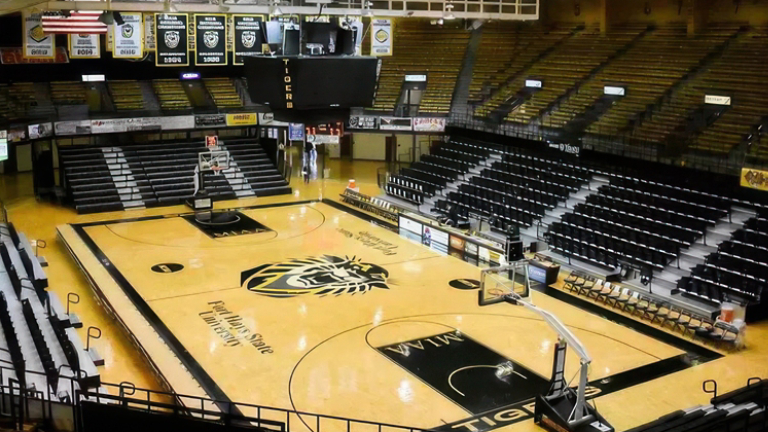
- Transformed Gross Memorial Coliseum from limited-use space into a comfortable, year-round venue.
- Collaboration between university, Trane, and engineer delivered a turnkey, proven solution.
The Challenge
Founded over a century ago, Fort Hays State University (FHSU) has built its reputation on delivering high quality, affordable education. That commitment extends to how the university manages resources, always looking for ways to help keep tuition affordable for students and their families.
Several years ago, FHSU installed wind turbines to expand its use of renewable energy. The turbines performed so well that they often produced more electricity than the campus could use, leaving valuable clean power untapped. At the same time, Gross Memorial Coliseum had no air conditioning, which limited its use for campus and community events. Leaders looked into storage technologies to capture the wasted energy and cool the coliseum, but options like batteries proved too costly.
The Solution
A Turnkey Answer to a Longtime Challenge
After years of searching for answers, the breakthrough came when Trane introduced thermal energy storage. It was simple, reliable, and the first solution that made economic sense for the university.
To build confidence in the solution, Trane arranged for the university team to visit a nearby facility already using thermal storage. Seeing the technology in action and talking directly with peers reinforced that this was the right choice for FHSU.
Working alongside Brack & Associates Consulting Engineers, P.A., and FHSU’s energy leadership team, Trane delivered a pre-packaged system that minimized risk and streamlined implementation.
Turning Nighttime Wind into Daytime Comfort
The system uses excess wind energy generated at night to make ice, which is then used to cool Gross Memorial Coliseum during the day, putting renewable energy to work in a way the campus had never achieved before.
“Our wind turbines give us more power than we can use at night. Thermal storage lets us capture that energy and shift it to be used the next day, so we can cool the coliseum without paying for electricity when demand is highest,” said Keith Dreher, Director of Energy Management at Fort Hays State University.
Opening Doors to More Possibilities
Families attending commencement could finally celebrate in comfort, and athletes gained an arena worthy of their effort. Staff discovered the building could be cooled for nearly 12 hours on ice alone, holding the interior temperature near 76° even on the hottest days. The athletics department hosted its annual auction and dinner at the coliseum, avoiding approximately $70,000 in rental costs for temporary equipment.
The Results
“With ice in the tanks we avoid peak electricity charges, and we’ve calculated savings of about $18,000 each year in demand alone,” said Dreher. By aligning renewable energy with practical design, the project not only saves the university money, but also reduces reliance on the grid, and has strengthened FHSU’s reputation as a careful steward of resources.
The transformation of Gross Memorial Coliseum elevated its role on campus and in the community. For the first time, commencements, tournaments, and celebrations could take place in comfort, turning what was once a limited venue into a reliable asset throughout the year.
Equally important, the project underscored FHSU’s leadership in sustainability. Thermal storage is one of the lowest carbon storage options available and pairing it with on-site wind turbines created a model that is both affordable and future-ready. Encouraged by this success, university leaders are already evaluating other campus buildings for similar upgrades. What began as a solution to wasted wind energy has become a blueprint for how FHSU can continue providing high quality, affordable education while modeling environmental responsibility for other universities facing similar challenges.