Charlie: [00:00:00] Hey there, listener. Charlie here. We've got a favor to ask. We love making Cooler Hot Takes, but we wanna make sure you love listening to
Dan: it. So head to podpolls.com/hottakes, fill out our survey, and give us your hottest takes about the show. We'll bring you more of what you love and less of the rest You're listening to Cool Air, Hot Takes
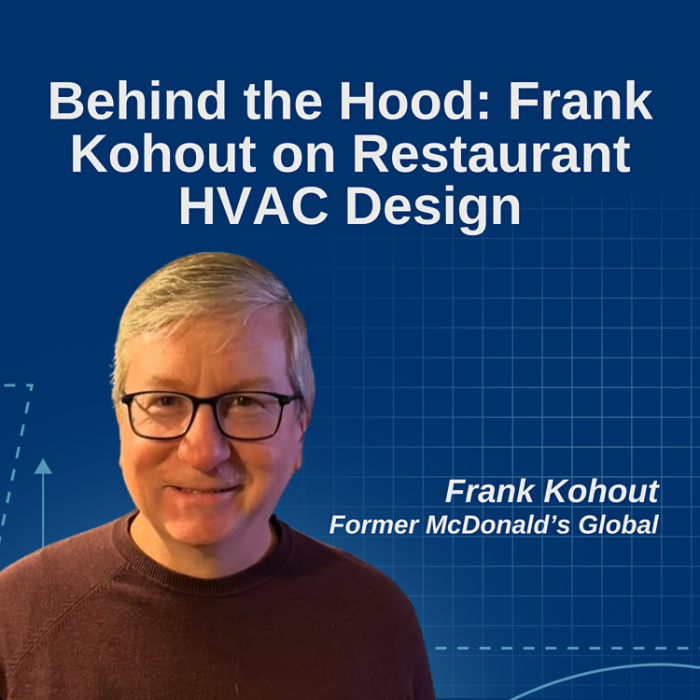
Charlie: Welcome to Cool Air Hot Takes. I'm Charlie Gelin. And I'm Dan Gentry. Every couple of weeks we get together and we bring you the latest in HVAC headlines. We bring you an expert interview. This week it's Frank Kohout. Frank led engineering at McDonald's Global. We're gonna talk about his 35-year career in the industry, what restaurant HVAC looks like.
So we're gonna get into all that. It's a fun conversation. And then at the end, of course, we're gonna bring you your stat of the day. But first, it's time for some hot takes. I'm gonna kick us off. Any [00:01:00] banter today? No banter. Oh. Just straight into the hot takes. You got anything? Oh, you need
Dan: today. We got some beautiful weather.
Charlie: I'm doing okay. Uh, just it's a hectic end of the, end of the school season here. I'm sure there's a lot of listeners out there, same thing. Kids are all winding down here. We've got one day left of school. Very
Dan: exciting. So speaking of that, here's a, here's a tangent. Okay. But why are the kids in school this last week of school when they're not doing anything?
Charlie: That's a great question. It's like a- They're just having,
Dan: like, fun day every day. This- Fun day.
Charlie: And
Dan: Monday
Charlie: they didn't
Dan: have school at
Charlie: all. They were off. Last week, Friday, they had a fun day. It's like... I, I agree. I think, I think school should end before Memorial Day.
Dan: Yeah. Well, or it could be they don't have to go there if they're not learning.
Charlie: Well, that's... goes without saying. Yeah. It's
Dan: kinda what the heck, guys?
Charlie: But- Make it optional the last week.
Dan: Well, you guys wanna come for fun day or go on vacation? All
Charlie: right.
Dan: One of the fun things. So that's
Charlie: where we're at. All right. Exactly. That's where I'm thinking, 'cause we've got, we've got a big RV [00:02:00] trip coming up.
Dan: Yeah. Yeah, big RV trip. So I'm gonna run a Gentry Gelan All-American road trip.
Charlie: That's right. That's right. We're heading... We're heading to the, the land of the Black Hills.
Dan: Mm-hmm. I think it's fun.
Charlie: We're excited. But anyways, all right, hot take. What do you got? We got a listener hot take. Okay. Who?
Dan: Randy. Randy in Chicago.
Dirty- Longtime listener ...
Charlie: Dirty Randy in Chicago. Just kidding, Randy. He's-
Dan: We love Randy. Uh, Randy says, "410A will make a comeback by the end of 2026."
Charlie: Randy is refrigerant obsessed.
Dan: He is very- He's,
Charlie: he's always giving us, uh, refrigerant hot takes. He is a refrigerant hot take guy. Yeah. We, uh... Randy, we appreciate all the hot takes.
Keep 'em coming. Uh, 410A will make a comeback by the end of when? 2026. That's,
Dan: well,
Charlie: this year. Okay. There was some, uh... One of our headlines today is, is, uh- Listen, we're
Dan: gonna, we're gonna dig into this more 'cause that's a good hot take. Yeah. And we're gonna let... Maybe we'll [00:03:00] let the headlines fill in the, fill in the gaps.
Charlie: All right. I like it. I like it. I have a hot take that has nothing to do with, uh, anything in, in our business. It's about my youngest, Tucker, got a new dirt bike, same dirt bike that Mav has. Yeah. KMB 60 KO. Great bike if anybody's looking to get their kids into a... Probably up to about what? Seven year old.
Mav's seven, and he's probably gonna need something else soon. Yeah, he's, he's gonna grow out of that pretty quick. Tucker's a little smaller. Great little bike though. But anyways, so before, the bike he had before this, tiny bike, like six-inch wheels, chainsaw engine.
Dan: Vroom.
Charlie: Could kinda keep up with him, keep an eye on him with, like, a little, you know, mini bike or even my mountain bike.
Not the new bike Couldn't keep up with him. Needed something with a little more juice to it. So I bought a, an EV dirt bike, and I love it.
Dan: And I have to say it, listener, I did sit on it on my way into the studio just now. And I will be taking it for a spin [00:04:00] after said recording. So, uh, like, review time will be coming, but, uh, this thing looks pretty freaking cool.
Charlie: Full gentry, uh, EV dirt bike to follow, but it's really cool. Yeah. Check it out, people. Reach out if you've got questions. Did quite a bit of research on, you know, which one I wanted to buy, so I've, I've got some, I've got some details for you if you're interested. And up next, HVAC headlines.
HVAC Headlines, Your news today All right, listener. It's 2:00 PM in Mexico City. Here's your headlines. We got a split headline here. We got a... We're, we're gonna let, uh... What do we got, three today? Three today. And Danny Boy had two of them that he threw in there. I like it. Why don't you give the listener headline number one?
Headline number one:
Dan: EPA removes 410A installation deadline.
Charlie: So this is, this is directly related to, uh, Mr. Randy's, Randy in [00:05:00] Chicago's hot take.
Dan: Yeah, so I mean- What do we got? ... essentially what they're saying is they're extending the deadline for installation of 410A units. So think about, um, units that were made before, whatever, the date in '25, they had to be installed and charged and running by then, and they're pushing that date back.
So if there's equipment that was manufactured before that date, it can now be installed with 410A. So I started looking at... I was like, "How much time do I wanna spend on this?" 'Cause look, it changed... Like, I, I'll let you... I'll give you just an idea. So this is broken down by different sectors. So there's food retail supermarkets, food retail condensing units- Yeah
cold storage, industrial proce- there's all these different things, and- Yeah ... and really, they just, like, they all have slight nuances with them, but really, they just pushed all those, all those dates back, so you can still use... You can still install the units. So the, kind of the maybe political idea was that if we push this date back, people can still use [00:06:00] the...
They don't have to buy the newer expensive stuff. They can use this existing stuff, and it can save consumers money for- Sure ... a time period moving forward. But- But- I don't know if you can make new stuff. That's a good question ...
Charlie: yeah, that's the... Is it just like you can deplete the built-up stock of, of equipment, and you can delay the installation, whatever the deadline was?
Uh, but being able to create new equipment would be- Interesting ... a very big difference.
Dan: Headline number two, less... I'm, I'm gonna have less questions for this one. Okay. Okay. I like, I like these headlines. This is a cheesy one, but Portsmouth courts closed again due to HVAC issues, reopening Wednesday.
Charlie: I love your headlines.
Dan: Obviously, this isn't like game ch- changing n- news or anything. But hey, HVAC equipment is very important. Maintenance is important, and look at this. This courthouse is down. People gotta miss their- Yeah ... get their court dates shifted and, you know, can't get sentenced to [00:07:00] prison or not sentenced to prison.
And like, it's an issue. And they... It's, it's again, this courthouse has to close down multiple times because their chillers went down. Like, that's just... You know, the importance of HVAC maintenance is something that- Preventative maintenance ... under... Yes, preventative maintenance- Preventative maintenance
cannot be underestimated.
Charlie: This is... Yeah. You know, I like this headline for, for our service crews out there. If, if you want to avoid the catastrophic failure at your courthouse, reach out We'll get you in touch with our people. We'll do preventative maintenance. We can do quarterly, annually, whatever you need.
Yes. Make sure your stuff is running and give you an idea of if it is about to fail, how you can replace it.
Dan: And these guys had two chillers. They lost one, and another one a week later. Like, that's crazy. Like, come on. Got... I'm
Charlie: with you. Over to you. Headline number three, Denver has a plan to heat and cool buildings with, wait for it, sewage.
Dan: Mm.
Charlie: [00:08:00] Dirty business. I like it. All right, so this one came from Canary Media. I like Canary. They got a bunch of articles. They lean very heavy into the sustainability side of things, and, and that's where this one went. So I'll, I'll, I'll read a, a couple of the sentences. Bless you. Thank you. Uh, more than 100 buildings in downtown Denver are currently heated by the world's oldest continuously operating commercial steam system, which requires burning fossil gas or fossil fuels.
When the steam network was first built in the late 1800s, newspapers heralded it as a marvel I would not have guessed that the oldest network steam system is in Denver I would've thought somewhere out east, but Yeah, New York's the obvious choice
Dan: Yeah.
Charlie: Denver, oldest operating steam network It's pretty cool.
That's pretty old Crazy, but it's still in operation. They're still using it today Oh, wow And customer steam bills have more than doubled in the past decade Mm-hmm All right, so they're looking, they're looking to change it out. They're looking to [00:09:00] update it, make it more efficient. In 2021, City of Denver requires large buildings to cut their greenhouse gas emissions or potentially face penalties in the next few years.
So meeting those targets, really, really hard, especially for large buildings, downtown urban setting, that are hooked up to this network 'cause they're kind of beholden to the network, the steam network
Dan: They didn't plan on the infrastructure in the building and all that kind of stuff
Charlie: Right, yeah. So what do they do?
So they, they need help, and so the city is, is trying to come up with a plan. So over the next decade, the city plans to repurpose parts of its old steam system, create a new heating and cooling network for 11 of the buildings that's on the network Mm-hmm And they're gonna create an ambient loop
Dan: Nice
Charlie: Ambient loop is a fancy word for, I don't know what you wanna call it, like a, like a m- mild temperature
Dan: A big loop that you pull heat out of or put heat into
Charlie: Yeah.
It's a water source heat pump common loop Sure If, if you're used to that at a building [00:10:00] level. This is just at a network level. And so how this works is you run this ambient loop to as many buildings as you want, and then that building puts heat pumps in their building. So that heat pump can pull energy out of the ambient loop or can put energy into the ambient loop Mm-hmm And the hope is that you get enough building diversity on that loop that when one building needs heating, another building needs cooling, or the building is balanced on its own, and this ambient loop just acts as like a big source sink of heat
Dan: It's like a big recovery system
Charlie: You got it.
The problem becomes is when all of the buildings go one way. You know, like in Denver, it's obviously gets cold in the winter, and so you're gonna be pulling energy out of that loop more so than you would otherwise. And so you need to balance that loop up. You need to add heat to that loop. And so they're planning on adding two different sources.
One is geothermal, which we've talked about a bunch
Dan: Yeah,
Charlie: makes sense It acts like a big [00:11:00] battery. You put boreholes down. They're working on that. The other one, which is where the headline came from, is they're working on a waste energy system where they're gonna put massive heat exchangers into their municipal sewer lines, and they're going to pull heat or reject heat to that
Dan: I love it.
I have a name for this, actually What's it called? I call it a repo-able resource Like renewable, but you know, repoable
You heard it here first. Yeah, I've, I've been, I've been working on that one for a little while. Me, me and Morgan have actually been working on that, and, uh-
Charlie: It's, it's pretty good ... '
Dan: cause these sort of app- So we go to those IDA conferences- Yeah ... and there's sort of the systems just like this- Yep ... come up all the time, and, and we're like, "Hey, let's just come up with a funny name for that.
It's repoable resource."[00:12:00]
Hey, Danny boy. Hey. Uh, what's your favorite destination for a conference? You know I love a good old honky-tonk, so I have to say Texas.
Charlie: Well, you're in luck. The 2026 ASHRAE Annual Conference is happening in Austin, Texas, from June 27th to July 1st. Yeehaw. Tell me more. Trane will be presenting two tech talks on high-temperature heating solutions and Thermal Loop, Trane's new fully integrated energy recovery system that combines a hydronic loop, exhaust and supply air coils, pump skid, controls, and a performance-based selection tool.
You definitely have to check that out.
Dan: Oh, yeah. Thermal Loop is going to bring the energy back to your building. We hope you join Trane at one of their tech talks in Austin next month.
Charlie: All right, listener, if you've ever walked into a McDonald's and not sweated through your shirt, you can probably thank our next guest. Frank Kohout is a 35-year HVAC engineer [00:13:00] veteran who spent a big chunk of his career making sure those glass buildings actually worked. Uh, if you've been a longtime listener, you also know that my co-host here, Mr.
Dan Gentry, is a big fan of the Golden Arches. Mm-hmm. So we're excited for this one. We're gonna talk about Frank's career in HVAC that spanned 35 years. Welcome to Cool Air Hot Takes, Mr. Frank Kohout. How you doing? I'm doing well. Thank you for having me, Dan. Thank you for having me, Charles. Absolutely. So, you know, we always start these with a hot take, right?
The name of the show is Cool Air Hot Takes. We ask all of our guests to come on with, with a hot take. It could be your personal life, your professional life, anything in between. Did you bring a hot take for the show today?
Frank: Um, hot take, restaurants, HVAC. In real estate, they say location, location, location.
In restaurants, it's air balance, air balance, and air balance.
Charlie: This is too funny. So my, uh, my uncle, [00:14:00] he runs restaurants in, in Minneapolis area, uh, shout out Maynard's, Malone's if you're up in that area, and he was telling us a story about how they used to balance the HVAC system or the air conditioner as he would call it. Mm-hmm. You know, back in the day, you just go out, you know, turn the air conditioner on, and go out, go out by the front door and just take a big drag off a cig and blow-
blow the smoke by the door and see which direction it went. I'm assuming you got a little bit more sophistication than that
Frank: Uh, yeah, it's gotten a lot more sophisticated because smoking is not really allowed anymore. Uh, we now use, um, sticks of incense.
Charlie: Oh.
Frank: Uh, f-
Dan: scented? Not champa?
Frank: It depends. I, I actually did this in a restaurant.
We were trying to show what an air balance is like in India, where we were trying to show them how it should work and, and so I made the comment that, you know, a lit cigarette is actually really good. And they said, "Well, we can't do that here, but we can burn incense, and we'll get the kind that blesses things, and people will like it."[00:15:00]
And so we walked in a very busy restaurant at noon with a bunch of McDonald's project managers from India- Hmm ... showing them how the air should flow, that it should flow from the dining room over the front counter into the kitchen, but very gently. And when you go to the front door, it shouldn't get pulled in, it should get pushed out, meaning positively pressurized.
And, uh, it's actually a really effective way to determine if your restaurant is air balanced. There's a few more things you should look for, obviously, such as air movement around the hood, make sure it captures- Mm-hmm ... as well as making sure the diffusers in the kitchen aren't blowing into the hood, which could impact capture or blowing on the food, and making sure the dining room is, uh, like I said, the whole restaurant's positively pressurized unless you're in a situation where it should be slightly negative, such as if you were in a food court or in part- Mm-hmm
of a larger building where you don't want the smells to escape.
Charlie: Yeah.
Frank: So it's a little
Charlie: bit subjective. Let's get... You know what? We're gonna get into all that for sure and, and some of the, the [00:16:00] finer details of quick-serve restaurants or restaurants in general. But let's take you back. You've been in this industry in, in engineering for a long time.
Give the listener a little background on, on where you started, where'd you go to school, and what was your career arc.
Frank: So my first job, I worked for a very small consulting company called Brook and Shapooras, which is no longer around. It was a seven-person company. They didn't even really have CAD then, so I learned to draw by hand.
All right. Yeah. So- Nice ... I learned that skill, and- What was the worst thing to draw? Uh, lettering. I... You had to hand letter everything, and just getting... I have really bad penmanship, so I had to work on that. Me too, by the
Dan: way. Absolutely. Same way.
Frank: It was an interesting experience because it was very hands-on.
We did a lot of work for industrial clients, where you would go out there and survey what was out there, draw it up, and then draw up your plans accordingly. So there was a lot of field work, a lot of checking things out on [00:17:00] your own. I got a lot of great field experience. And then that company merged in with a larger engineering company in downtown Chicago called WMA, and that was a very different experience.
It was a lot larger. They worked on bigger projects. They were a lot more, um, professional. Not that we weren't professional, but when you're a small company, you tend to be a little scrappier.
Charlie: Yeah.
Frank: I learned a lot there, did a lot more detailed HVAC design work, bigger projects. And I worked there till '99, and then in '99 I got an opportunity to go to McDonald's as a standard engineer in their US development team.
So what was interesting about McDonald's at the time is they did their own designs for their freestanding stores in-house. They didn't outsource it. When I joined McDonald's, they were doing about 4 to 500 designs every year for new stores in the US Yeah.
Dan: Wow. Each store had a different design, uh, essentially its own design.
Frank: There were a couple of prototypes we went off of, but each one [00:18:00] would have to be customized, especially HVAC-wise. If you're building a store in Minnesota, for example, you need more heat than if you're building one in Texas- Mm-hmm ... or in Southern California. So we'd run load calcs for each site. We'd pick which units we're gonna use.
I mean, they're all gonna be in the same location, but is it gonna be a 10 ton for the dining room or a 5 ton or s- or something like that?
Dan: Yeah.
Frank: And then, um, any local code requirements that were required. Typically, it was all standard code, but, you know, in California, we had to do the Title 24 at the time- Jesus
when the, um... And it's been a while since I've done some of these, but there were some other code compliant forms we had to fill out for every site. Oh. We had to prove that we met energy codes. A lot of times we ran into issues with the fact that we didn't use standard hoods for the kitchens. They used their own hood.
Like, like a custom
Charlie: hood? Yes. Just give the listener here who's not Yeah ... uniquely, uh, or, or intimately involved in restaurant design what is a [00:19:00] hood. When you say a hood, what are you talking about?
Frank: A hood is a, a metal box that fits over the grill or the fryer or the char broiler or any other cooking device that produces a lot of smoke, grease, and in some cases steam.
It captures the smoke and grease so it doesn't get into the restaurant. Mm-hmm. And it exhausts it out of the building, and it has special requirements. So there's a big,
Charlie: there's a fan that's pulling air through like a, it's a big diffuser over the top of all this equipment that you don't want that grease, that smell, that air- Yeah
to go anywhere but out. Out. So it's a, it's a big like suction cup.
Frank: Yep.
Charlie: Big
Frank: vacuum cleaner.
Charlie: Vacuum cleaner. There you go. There you go. Yeah. So give the listener here, for, you know, the average person out there that walks into a McDonald's and isn't looking to see what's on the roof like the two guys in this room right now.
What systems are involved with quick serve, with [00:20:00] fast
Frank: food restaurants? In a restaurant, you start out with the hood because the hood dictates the amount of outside air you need, and you will need a lot of outside air for a restaurant as a percentage-wise. Why do you need so much outside air? To make up for the fact that the hood's exhausting so much air.
Mm-hmm. Typically, and when I say a lot of air, it's, it's for a footprint of that size.
Charlie: Yep. Give, give us like a, like if an office building, you know, you look at your, the amount of outside air that you bring in for an office.
Frank: 20, 25%.
Charlie: Yeah, 20, 25%, maybe 15 if you're doing some, some recovery or, or some air cleaning, whatever.
Mm-hmm. What's a restaurant run at?
Frank: Uh, non-McDonald's, at least 40% to 60%.
Charlie: Okay, so double to triple the amount of outside air required. Yes. From a normal office
Frank: building. Correct. Yeah. For equipment that size. Uh, McDonald's, 'cause they use their specialized hoods, got it down to like 20 to 25%. Wow. So they could use standard rooftops, but if you got into a [00:21:00] regular restaurant, you would have to find rooftop units that can handle 50 to 60% of outdoor air, which, uh, I don't know, the typical commodity package rooftop can only handle about 20 to 25% outdoor.
Right. Maybe you can push it to 30 in a dry climate.
Charlie: Interesting. So McDonald's is using regular rooftop units, regular mixed air units, and- Yep ... most others are using dedicated outside air units. Yes.
Dan: Interesting. So if they don't have to handle all that air, are McDonald's operating costs like that much lower than a typical- N- They'd have to be, right?
Frank: You're asking me some questions I don't know if I can easily answer.
Charlie: That's okay. If somebody's sitting in a restaurant, you know, like they're sitting there having a, having a nice cocktail- Oh ... having a nice steak, whatever it is, how would they know if something's not right?
Frank: Uh, watch the hood. If it doesn't capture everything, it's not balanced.
Charlie: Okay.
Frank: What would that mean? Like you see, you see steam- See the smoke spilling out of it, yeah. [00:22:00]
Charlie: Yeah, okay.
Frank: They're cooking something, they're cooking steaks, and the smoke is rolling out into the kitchen.
Dan: All right. And you could smell it, too.
Frank: Pato Azul. Oh, yeah. That's-
Dan: I would say- Pato Azul. That's number two.
Frank: If you walk
Dan: out- You can't- you just reek when you leave. It's like, "You need a hood."
Frank: Yeah, that's number two. And the third one is do you have a hard time opening up the front door? All right. Hm.
Dan: Okay.
Frank: Like, you know, you gotta pull on that handle hard, and when you open it, you feel that whoosh of air going into the restaurant.
Charlie: And that, does that usually mean you don't have enough outside
Frank: air coming
Charlie: in?
Frank: Yes. You don't have enough makeup air. Or you're, you're drawing too much- Nope, not enough ... air out. No. You don't have enough makeup air coming in. All
Charlie: right.
Frank: Interesting. Because everybody-- And that's the third part of air balance because you have to maintain that air balance as you own the restaurant.
Dan: People don't, uh, understand what it goes into like being comfortable in a restaurant. It's like not just plug and play.
Frank: None of this is really difficult, but you have to be diligent to make sure it gets done and done properly and maintained properly. [00:23:00] Another example is restaurant air filters in their HVAC units get dirty very quickly.
Mm-hmm. You have to change them frequently. It's better to put in the lower- efficiency HVAC filters rather than get some super high-efficiency HEPA filter and just replace it more often because as it clogs up, it's going to affect the operation of the fan and the air handling unit, which is gonna impact air balance.
Another recommendation is no plenum air returns in restaurants, especially not in kitchens- Mm ... because that air will work its way into the ceiling cavity, and after a while, like a year or two, everything's coated in grease up there- ... which also attracts- Nasty ... dust, and everything looks like it's growing, you know, moss, except the moss is-
gray. So you
Charlie: do
Frank: ducted
Charlie: returns,
Frank: but then you got the same problem, right? Uh, at least you can contain it within the ductwork-
Charlie: And then you just- ... versus- You clean the ductwork? Yes,
Frank: versus having an entire ceiling- How do you clean, how do you clean ductwork for grease? You know, you can at least contain it. You don't have grease growing all over your lighting fixtures and everything else you have- Mm, yeah
above your [00:24:00] ceiling- Okay ... and all of your wiring- Uh-huh ... 'cause there's a lot of wiring in restaurants for communications and such.
Dan: Yep.
Frank: So-
Dan: Don't look in the return air ductwork at restaurants.
Frank: Have 'em clean 'em once in a while. It's easier to clean a duct than it is to clean an entire ceiling cavity.
Charlie: Sure.
I've got a, I've got a question on behalf of The Barrel Inn in Wisconsin, uh, La Crosse, Wisconsin. They have a hood, and it's a bar. It's a great little bar, great food. Great food. And they've got a, a hood over their little, you know, flat top and- Fryer ... fryer little combo there, and on the outside they have so much grease coming out that they've had to try to, like, mask, you know, with, like, a little sheet metal Mm-hmm
like, all this grease that's dripping down. Oh, yeah. How do, uh, like, is, is there a grease trap, a grease reclaim off of hoods? Like, how do you handle all that without it just looking like complete crap?
Frank: Is [00:25:00] that fan on the side of a wall or is it on a roof? Side of a wall. Sidewall. Yeah, that's a problem with those.
The grease will get pulled up into the ductwork, and it'll get to the fan, and- Yeah ... if it hasn't been properly set up with a grease collection cup for sidewall, it'll just run over everything and drip down. The way to really prevent that is to clean it as frequently as needed, which means somebody has to g- go in there with a pressure washer and open up the fan.
Yeah. You know, literally hinge it open and go in there with a pressure washer and pressure wash it from both ends.
Dan: All right. I don't think the bartenders are pressure washing. I don't I don't think the-
Frank: I- ...
Charlie: I don't think the fine team at The Barrel is doing that.
Dan: They... No, they could do that.
Charlie: I'm not gonna comment
Frank: on that, but that's- You're probably right.
Yeah,
Charlie: so grease cup with a little, a little sheet metal cover is where they're at. Okay. Well, thanks for that. For young engineers, contractors, you know, people looking to get into building [00:26:00] management, you've gone through starting with a small company, working for a massive company, back to a small company.
You know, you've, were working with ASHRAE the whole time, I assume. What wisdom would you pass on to them? Hmm.
Frank: Get your hands dirty and get out in the field. And if you're a, a supervisor, get your people out in the field to see what happens. You'll learn so much, and if you have a good contractor, if you're an engineer and you know there's a good contractor out in the field who you can trust to send your people out with, who they're not just gonna get beaten up and yelled at by the contractor-
they'll, they'll actually walk them around and show them stuff- Yeah ... good and bad and ugly, those are the best. And it doesn't have to be somebody high up from the contractor. A site supervisor who is... Those are the best guys. Those guys see what's going on. They, they don't give feedback a lot, 'cause they're just expected to solve things in the field and make them go away- Yeah
problems go away. But those are the guys who if you can talk to, they can give you a life lesson.
Charlie: I love it. [00:27:00] That's good stuff. I love it, too. Get out and take a field trip, guys. Yeah. Check out a plant. Little show and tell. Go see what you got g- go see what's cooking. Go see what's happening in the kitchen.
Frank: Yes. Yeah, go watch a kitchen in operation. See if the smoke gets pulled into the hood or if it rolls out.
Charlie: That's right. All right, Frank. Thank- thanks for coming out today. That was a really fun conversation. Thanks, Frank. Next up, Stat of the Day.
Dan: Stat of the Day. Buildings are no longer just overhead. They're strategic assets.
At Trane, we call that building brilliance, helping buildings work smarter through connected systems, deep expertise, and energy strategies that support business goals. Every
Charlie: building has the potential for brilliance. Trane has the ingenuity to unlock it. Visit trane.com/buildingbrilliance.
Here comes your star of the
Dan: day,
Charlie: star of the day, star of the day
All right, listener, for your stat of the day, [00:28:00] as a, as a nod to Frank's time at, uh, McDonald's and that great conversation that we had, our stat is the world's largest fast food chains by revenue, and the data comes from Bloomberg market data from 2025. So I've got 20 of them on here. I'm gonna fly through these, but you wanna take a guess- I do, and I-
at a couple of them? ... I'm
Dan: mostly keep, trying to keep my head up because I don't wanna... I'm trying not to look. I saw the graphic, but I didn't see the details.
Charlie: Yeah, yeah.
Dan: Um- Shoot for the top. What, what's your top five? Well, I mean, I'm gonna go McDonald's. I'm gonna go Subway. Okay. Um, what's another one? Is like...
Is Taco Bell a big one? Pizza Hut. Okay. Uh, that's four Ah, there's gotta be like another one of the like burger joints. No, you know what? I'm gonna go throw something out there, like Chipotle.
Charlie: It's pretty good. You got one of the top five.
Dan: Okay.
Charlie: All right, let me, let me start. Number 20, Papa [00:29:00] John's, 4.8 million, and then it goes Dairy Queen, Raising Cane's, Sonic, Panda Express.
Okay. By the way, my brother loves Panda Express.
Dan: Yeah, and Amber's sister's a big Panda Express gal, and I... Like, I only experience it really through like airports, and I think it's wildly not good. But maybe I wanna like try a-
Charlie: My favorite, my favorite brother, uh, experience with Panda Express, sorry listener for the tangent here, is we went, we went to San Francisco last summer for my cousin's wedding.
Like, our whole family went, stayed at a big Airbnb, like downtown San Francisco or like in, you know, like the heart of San Francisco. We stayed next to, literally the next building over, there was a restaurant called the Shanghai Dumpling King.
Dan: Which, um, as a- Yes ... connoisseur of Asian delights, I would definitely be there.
100%. 100%.
Charlie: [00:30:00] And the first night we were there, found out they were open till 2:00 AM, and- Oh ... guess where I ate that night?
Dan: Got some dumplings.
Charlie: I got some dumplings. And it was fantastic. So good. All right, but then like two days later, we're hanging out and, you know, everybody's kinda going, doing their own thing, seeing the sights, and my brother orders Panda Express- Panda Express
to the, to the Airbnb.
Dan: Like, cost more and is of like severely inferior quality. I just... I was
Charlie: like, "What are you... The, the Shanghai Dumpling King is next door."
Dan: Anyways. Well, you gotta, you gotta
Charlie: figure it out, you know? Panda Express, Popeyes, Panera, Tim Horton's- Geez ... Chipotle, there you go, Burger King. Was just there today.
Dunkin' Donuts. So number 10 is Dunkin' Donuts at 12.47 million. Next, it goes Pizza Hut, Wendy's, Subway, Taco Bell- There we go ... Domino's, [00:31:00] Chick-fil-A. The biggest surprise, in my mind, KFC. Wow. 34.4 billion. Number two, Starbucks, 36 billion. Number one with a bullet- Oh ... McDonald's at 130 billion. It's not even close.
Starbucks number two, 36 billion. Number one, McDonald's, 130 billion. 100 billion. So McDonald's is a juggernaut.
Dan: I did not really realize it was that- far. I'm a, I'm a, I'm a pretty big fast food guy. I didn't know KFC
Charlie: was- I didn't realize that big of a difference. That's funny ... yeah, you, you have to add up the, the next six, seven fast food restaurants just to equal McDonald's.
KFC, I did not
Dan: see that. I know. I, I hear these things. I wonder if it's like a global thing, 'cause I know they, they did blow up. But man, I, I have to say,
Charlie: huh, interesting. I do like the colonel though.[00:32:00]
Dan: Thanks for listening to this episode of Cool Air Hot Takes. Remember, n- episodes are released every two weeks on
Charlie: Tuesdays. Leave us a comment on Spotify or YouTube, a review on Apple, and don't forget to take our listener survey. We love making the show and we wanna make sure you enjoy listening to it too.
Head to podpolls.com/hottakes, which is all lowercase. Fill out the survey and let us know what you think.
Dan: And while you're at it, why not send us your hot takes to coolair.hottakes@trane.com. If we feature it on the show, you might find some of that merch in your mailbox. And until next time, stay cool and keep those takes hot.