What Is a Water-Cooled Chiller?
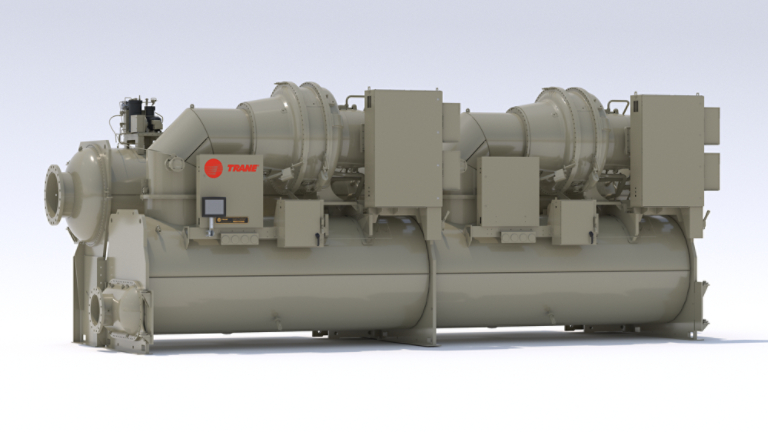
A water-cooled chiller is a refrigeration system that provides cooling for large-scale commercial and industrial applications. Unlike its air-cooled counterpart, a water-cooled chiller utilizes water as the medium to transfer heat from the refrigerant to the outside environment. This process is highly efficient and makes water-cooled chillers a preferred choice for large buildings and industrial processes that require consistent and powerful cooling.
How Does a Water-Cooled Chiller Work?
All chillers operate on the principle of vapor compression or vapor absorption. Here's how the typical vapor compression chiller works for a water-cooled chiller system:
- In the evaporator, cold, low-pressure liquid refrigerant flows around a bundle of tubes containing water from the building. The refrigerant cools the water by absorbing heat from it, causing the refrigerant to boil and turn into a gas. The now-chilled water is then circulated throughout the building to provide cooling.
- Then, a compressor pressurizes the refrigerant, raising its temperature and converting it into a hot, high-pressure gas.
- In a water-cooled condenser, water is pumped through the tubes of this shell-and-tube heat exchanger while refrigerant vapor fills the shell space surrounding the tubes. The condenser has a baffle plate that helps distribute the refrigerant evenly within the shell. As heat is transferred from hot, high-pressure refrigerant vapor to the water, refrigerant condenses on the tube surfaces.
The condensed liquid refrigerant then collects in the bottom of the shell where the lower tubes are now submerged, resulting in further cooling, or subcooling, of the refrigerant. This arrangement is called an integral subcooler.
Cooling water flows first through the lower tubes of the condenser and then through the upper tubes. This produces a nearly constant temperature difference between the downward-moving refrigerant and the tube surfaces, resulting in a uniform heat transfer rate within the tube bundle.
Subcooled liquid refrigerant leaves the condenser (subcooler) and flows through the liquid line to the expansion device. - Next, the liquid refrigerant passes through an expansion device, which reduces its pressure and temperature.
- Finally, the lower-pressure refrigerant returns to the evaporator to repeat the cycle.
Considerations for Water-Cooled Chillers
These chillers are a popular choice for a variety of applications due to their numerous benefits:
- Greater energy efficiency: Water-cooled chillers are generally more energy-efficient than air-cooled chillers. This is because water is a more effective heat transfer medium than air, allowing the system to operate at lower condensing temperatures and pressures, which reduces the workload on the compressor.
- Longer lifespan: Typically, water-cooled chillers have a longer operational life, often lasting 20 to 30 years. This is partly because they are usually installed indoors, protecting them from harsh outdoor elements.
- Location flexibility: Since they don't require open space with fresh airflow, water-cooled chillers can be installed inside a building's mechanical room.
- Heat recovery opportunities: By harnessing some of the heat rejected in the process of producing chilled water, heat-recovery chillers can produce useful hot water while providing cooling, which improves overall building energy performance.
- Free Cooling: Free cooling allows the chiller’s compressors to be turned off while taking advantage of lower condenser return water. Pressure differences allow the refrigerant to migrate and still provide adequate cooling capacity without having to run the compressors.
Types of Water-Cooled Chillers
- Centrifugal chillers, including centrifugal oil and oil-free (also called magnetic bearing)
- Scroll chillers
- Helical rotary chillers (also called screw chillers)
Common Applications of Water-Cooled Chiller Systems
These chillers tend to be used more often in larger facilities, such as: