What Is an AI Cooling System?
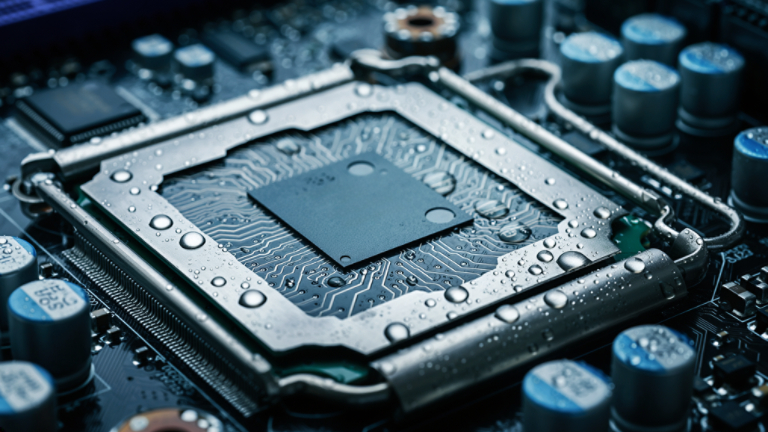
An AI cooling system refers to the tools, techniques, and processes used to cool high-density servers. The system’s top priority is maintaining server (chip) temperatures within their operating range. Its secondary job is ensuring the entire facility has sufficient pressurization, humidity control, and cooling to keep all equipment within desired temperature ranges. Specifically for artificial intelligence (AI) workloads, these systems must address the unprecedented thermal demands created by high-density computing equipment, particularly graphics processing units (GPUs) and AI accelerators that generate significantly more heat than traditional IT equipment.
Types of Data Center Cooling Systems
AI data center cooling systems may include the following specialized technologies:
1. Direct-to-Chip (D2C) Liquid Cooling
- Also known as direct liquid cooling (DLC), this system circulates a liquid coolant through micro-channel cold plates attached directly to the hottest components. The fluid absorbs the heat and carries it away to acoolant distribution unit (CDU), which can be configured as liquid-to-liquid (L2L) or air-to-liquid (A2L) depending on the facility's heat rejection infrastructure. As AI deployments scale, facilities are progressing from smaller in-row CDUs to larger, centralized facility CDUs capable of managing the extreme heat loads generated by AI workloads.Best for: High-density AI chips where traditional air cooling falls short.
2. Immersion Cooling
- Entire servers are completely submerged in a thermally conductive, non-electrically conductive (dielectric) fluid.
- Single-phase immersion: The fluid stays in liquid form, absorbs heat, and is pumped to a heat exchanger to be cooled.
- Two-phase immersion: The fluid boils when it absorbs heat, turning into a vapor that rises, hits a condenser coil, and rains back down as a liquid.
- Best for: Ultra-high-density deployments requiring maximum energy efficiency and space savings.
3. Rear-Door Heat Exchangers (RDHx)
- These look like heavy-duty screen doors attached to the back of a server rack. They contain coils filled with chilled water or refrigerant. As hot air from the AI servers blows out the back of the rack, it passes through the coils and is cooled before re-entering the room.
- Best for: High-density racks that still utilize fans, acting as a bridge between air and liquid cooling.
4. High-Capacity Chilled Water Systems
- Regardless of whether a data center uses D2C or immersion at the rack level, the absorbed heat must ultimately be removed from the building. This requires industrial-grade commercial HVAC infrastructure, including high-efficiency air-cooled chillers, water-cooled chillers, cooling towers, and dry coolers.
- Best for: Providing the primary thermal rejection loop that makes rack-level liquid cooling possible.
5. AI-Controlled Air Cooling (CRAH/CRAC)
An AI cooling system might also include equipment like a fan coil wall, thermal storage and airflow management accessories.
Considerations When Choosing an AI Cooling System
If you are upgrading an existing data center or designing a new build for AI workloads, here are the key considerations:
- The shift to liquid is highly probable: Even if your facility historically relied on air cooling, supporting AI requires planning a transition to liquid cooling. This means ensuring your facility has the plumbing, pumping capacity, and chilled water infrastructure to support high-volume heat rejection.
- Impact on power usage effectiveness (PUE): AI cooling systems can drastically improve a data center's PUE. Liquid transfers heat more effectively than air. By upgrading to high-efficiency Trane chillers and intelligent controls, operators can offset the massive energy demands of AI servers.
- Heat recovery opportunities: Because AI generates so much high-grade heat, modern AI cooling systems can capture this thermal energy and repurpose it. Advanced HVAC designs can route this heat to warm neighboring commercial buildings, greenhouses, or district heating networks, contributing to corporate sustainability goals.
- Reliability is mission-critical: AI workloads are incredibly expensive to run. A cooling failure can lead to millions of dollars in hardware damage or lost compute time. Redundancy (N+1 or 2N configurations) at the chiller plant and pumping level is vital.
- Retrofit constraints: Older data centers may not have floor load capacities to handle heavy liquid-cooled racks or the ceiling height for new piping. Partnering with an experienced commercial HVAC provider as your AI cooling system company helps in designing custom modular chiller plants or outdoor cooling skids to bypass indoor space limitations.