
Blog
Published: October 06, 2026
How Facility Teams Can Build a Smarter Preventive Maintenance Strategy
Building a preventive maintenance strategy can help your facility team reduce downtime, improve equipment reliability, and increase efficiency.
Quick Facts
- Products
- Trane Cloud Digital Hub • Maintenance Manager
- Topics
- Smart Building Solutions • Innovation
- Services
- Nuvolo Asset Management
That cycle can be especially difficult to break when facility teams are lean, as an unexpected repair can quickly push planned work aside. It can also have broader implications for building owners as unexpected downtime and declining equipment reliability negatively impact operations.
Part one of this series covered why centralized asset data is the foundation of smarter maintenance operations. Building on that foundation, we now explore why preventive maintenance is worth protecting and how teams can prioritize and schedule the work without adding unnecessary complexity.
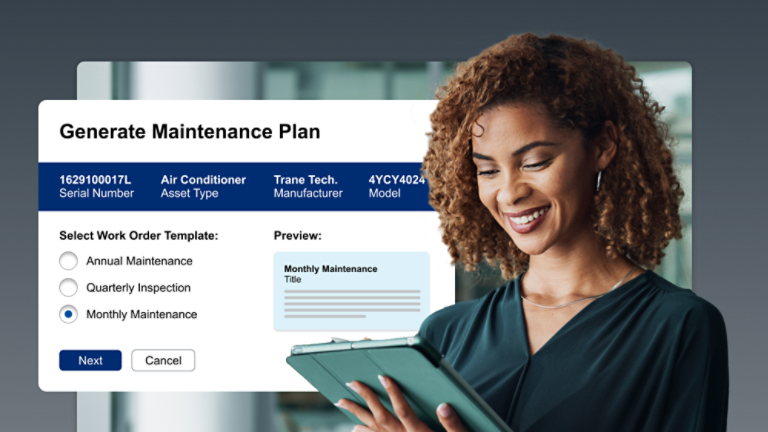
Trane Maintenance Manager (TMM), a maintenance management application within the Trane Cloud digital hub, helps teams put that strategy into practice by making preventive maintenance easier to schedule and sustain.
Why Is Preventive Maintenance Worth Protecting?
Preventive maintenance gives teams an opportunity to address equipment needs before they become urgent. Instead of responding to an issue on the equipment’s timeline, often with little warning and fewer options, teams have greater control over when maintenance happens and how resources are allocated.
That shift from reacting to planning can improve equipment reliability, help reduce unexpected downtime, and help teams use limited time more efficiently. For building owners, those benefits can translate into fewer operational disruptions and a more deliberate approach to maintaining the equipment their facilities depend on.
Yet despite the value, preventive maintenance is often the work that gets pushed aside when the day gets busy. Understanding why is the first step toward protecting it.
What Makes Preventive Maintenance Hard to Sustain?
The challenge is not recognizing the value of preventive maintenance. It is finding the time and having the processes in place to sustain it.
Limited staff means urgent work gets prioritized, and manual processes can make preventive work harder than it needs to be.
When schedules live in spreadsheets or in someone’s memory, staying ahead of equipment needs depends on a person remembering, and people forget.
It’s also hard to prevent what you cannot see. Without centralized asset records and maintenance history, teams may not know which equipment is due for service, what was done last, or what needs attention next.
Best Practices for Prioritizing and Scheduling Preventive Maintenance
An important best practice is to prioritize by criticality rather than ease.
“It’s tempting to schedule preventive maintenance on whatever asset has the simplest checklist, but that’s focusing on completed task counts, not actual risk reduction,” Surve says.
Equipment that’s most likely to create costly downtime or significant disruption if it fails should receive the highest priority, even when it is more complex to service. A practical way to apply that principle is to tier assets based on the consequences of failure:
- Mission critical assets: Equipment where failure would cause significant operational or financial impact receives the most frequent preventive maintenance.
- Important but lower risk assets: Equipment with less significant consequences of failure can follow a standard maintenance schedule.
- Routine, low consequence assets: Equipment with limited impact if it fails may follow a less frequent schedule or be maintained reactively.
Implementing this tiered approach can help direct available resources toward supporting uptime where it matters most.
From there, recurring schedules and standardized checklists can reduce the time spent manually tracking what is due and initiating the work.
“This is where automation earns its keep,” Surve says. “You’re not adding staff, you’re reducing the manual overhead that was eating the time your existing staff already had.”
Automation does not determine which equipment matters most. But once teams establish those priorities, it can make the resulting preventive maintenance strategy easier to sustain.
How Trane Maintenance Manager (TMM) Can Help Simplify Preventive Maintenance
TMM helps put that strategy into practice. Automated maintenance plans and recurring work orders can reduce the need for someone to remember what is due and when.
Additionally, native integration with Trane’s field service management (FSM) tool can give teams visibility into completed, in progress, and planned maintenance under their Trane Service contracts. Teams can see preventive services already completed for assets under Trane’s care, plan around work in progress or scheduled, and gain a clearer view of the value their service contracts deliver.
TMM also brings Trane service expertise into the process. Trane Account Managers draw on OEM knowledge and service experience to help build maintenance schedules and plans for HVAC equipment, with that expertise reflected directly in TMM.
Getting started is hands-on, too. During onboarding, Trane helps teams set up Maintenance Plan templates, enter initial plans, and account for corrective maintenance already underway.
What Comes Next?
For teams doing the work, a preventive maintenance strategy prioritized by critical need and backed by consistent scheduling can turn reactive firefighting into planned assignments.
For building owners, it can support greater reliability and fewer unexpected disruptions.
In the final post in this series, we’ll look at what that discipline can unlock over time, using asset visibility and maintenance history to make smarter planning and investment decisions.
Learn more about Trane Maintenance Manager.
Source: Deloitte Insights, “Smart Buildings for People-Centered, Digital Workplaces”
This is for informational purposes only and does not constitute professional advice. Trane Technologies believes the facts and suggestions presented here to be accurate; however, final design and application decisions are your responsibility. Trane Technologies disclaims any responsibility for actions taken on the material presented.