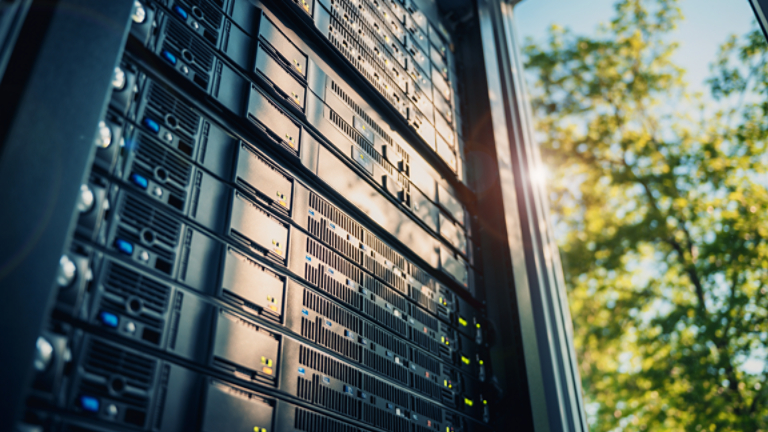
Today’s data centers must support higher rack densities, faster deployment timelines, stricter sustainability goals and more pressure to use power and water wisely. At the same time, AI workloads and other compute-intensive applications are changing what “efficient cooling” really looks like.
That shift is forcing a broader conversation. Making a data center future-ready is no longer just about adding capacity. It means building a cooling strategy that can adapt to changing thermal loads, evolving regulations and long-term decarbonization goals, without compromising reliability.
There’s no single path forward for every facility. But there are several practical strategies that can help operators improve data center sustainability while preparing for what comes next.
Cooling decisions now have a direct impact on energy use, water use, resilience and long-term operating flexibility. For many operators, one of the first questions is whether existing air-based approaches can continue to meet demand or whether it’s time to evaluate liquid cooling, hybrid approaches or a combination of both.
Air-cooled chillers remain an important option for many data centers, especially where water conservation is a priority or local water risk is a concern. Reducing dependence on water-intensive systems can help facilities improve sustainability while simplifying operations in regions where water availability is under scrutiny.
At the same time, many modern data centers are seeing rack densities that push conventional cooling strategies to their limits. That is where liquid cooling and hybrid cooling architectures are gaining attention. For high-density applications, liquid cooling can remove heat more efficiently at the source and help operators support more compute in the same footprint. A hybrid approach can also make sense, pairing traditional cooling infrastructure with targeted liquid cooling where the heat load demands it.
The key is selecting a cooling strategy that fits your facility’s current needs while leaving room to scale as workloads evolve.
What data center decision makers should consider:
- Water use: Can your cooling design reduce or avoid process water consumption?
- Rack density: Will your system support future high-density or AI-ready deployments?
- Energy performance: How efficiently can the system manage part-load and peak-load conditions?
- Scalability: Can you expand capacity without a full redesign?
- Climate conditions: Is the solution suited for your region and ambient conditions?
One of the biggest challenges in data center planning is uncertainty. Compute demand can shift quickly. Expansion plans can accelerate. Utility constraints can affect where and how capacity comes online. And sustainability targets can become more ambitious over the life of a facility. That is why flexibility matters.
Future-ready cooling systems are designed to respond to variable operating conditions without sacrificing uptime or efficiency. This includes the ability to handle a mix of load profiles, support phased expansion and optimize performance as demand changes across the site.
Advanced controls play a major role. More connected cooling systems can help operators monitor conditions in real time, optimize equipment sequencing and identify opportunities to help reduce energy use without affecting reliability. Better visibility also supports smarter maintenance decisions and can help teams manage performance across the full system lifecycle.
Thermal energy storage may also deserve a closer look in some applications. By shifting cooling load to different times of day, storage can help reduce peak demand, support energy cost management and complement broader decarbonization strategies. As utilities face more strain and electric demand rises, that kind of flexibility can become more valuable.
In addition, facilities planning for long-term sustainability should consider how cooling systems fit into broader environmental goals. That may include:
- integrating low-GWP refrigerant strategies where appropriate,
- designing for heat recovery opportunities,
- reducing exposure to grid volatility,
- and creating a pathway for future upgrades rather than locking into a rigid design.
The most resilient data centers are built to adjust.
Data center growth rarely happens all at once. Capacity is added in phases, equipment gets updated, and cooling requirements become more complex over time. That is why many operators are moving toward more modular and service-friendly infrastructure.
Packaged and modular cooling solutions can help streamline deployment, reduce field complexity and make it easier to scale as business needs change. They can also support more predictable installation timelines, an important advantage when speed to market matters.
Just as important, modularity can help improve maintainability. Cooling systems that are easier to access, service and upgrade can reduce disruption over the life of the facility. That matters for sustainability, too. Extending equipment life, improving system performance and modernizing critical components may deliver meaningful gains without requiring a full replacement strategy.
For operators managing aging infrastructure, lifecycle support is a major part of future-proofing. In many cases, the smartest path forward may involve a mix of new equipment, system optimization, and strategic upgrades that help improve efficiency and reliability while aligning with sustainability targets.
This is especially relevant as cooling technologies continue to evolve. A data center that is designed with modularity in mind is better positioned to incorporate newer approaches—such as expanded liquid cooling capacity, smarter controls or refrigerant transitions—when the timing is right.
There is a tendency to treat cooling as a mechanical decision; however, it is a business decision.
The right cooling strategy can help data center leaders address several priorities at once:
- support high-performance computing and AI workloads,
- reduce energy and water impacts,
- improve resilience,
- prepare for regulatory and refrigerant changes,
- and create a more adaptable path for growth.
For some facilities, that may mean investing in high-efficiency air-cooled systems. For others, it may mean preparing for liquid cooling or adopting a hybrid approach. In many cases, it will involve a combination of technologies, controls and services working together to help support both operational and sustainability goals.
What matters most is building a solution around the realities of your facility, not relying on a one-size-fits-all approach.
The data center industry is moving quickly, but the fundamentals remain the same: reliability, efficiency and long-term adaptability matter. Cooling systems that conserve resources, support changing densities and enable smarter operation will be central to that effort.
Future-proofing sustainable data center cooling starts with asking the right questions now:
- How will our thermal profile change over the next five to ten years?
- Where are we most exposed to water, energy, or infrastructure constraints?
- Which cooling technologies give us the best balance of efficiency, flexibility, and resilience?
- How can we design for what comes next without overbuilding today?
Those are the questions shaping the next generation of data center decisions—and the answers will define which facilities are best prepared for the future.
To learn more about sustainable data center cooling solutions, contact Trane Data Center experts today.
This is for informational purposes only and does not constitute professional advice. Trane Technologies believes the facts and suggestions presented here to be accurate; however, final design and application decisions are your responsibility. Trane Technologies disclaims any responsibility for actions taken on the material presented.