Glossary
Geothermal
What does geothermal mean, and how does it relate to heating and cooling? Learn how a geothermal HVAC system works and its benefits.
Quick Facts
- Products
- Geothermal Systems
Selecting a language changes the language and content on the Trane site.
ComfortSite Login
Trane ComfortSite is an extranet site designed to save you time. With your secure login, you can:
Trane Cloud
Trane Connect is now Trane Cloud—your secure, digital foundation for remotely monitoring and managing building systems, while bringing together insights, applications, and future innovations in one unified experience.

Latin America
Europe
Asia Pacific
Glossary
What does geothermal mean, and how does it relate to heating and cooling? Learn how a geothermal HVAC system works and its benefits.
Quick Facts
The term geothermal means "of or relating to the internal heat of the earth." Geothermal energy is a renewable and sustainable source of thermal energy that originates from the Earth's core. This natural heat is continuously produced within the earth and can be harnessed for various applications, including heating, cooling, and electricity generation.
A few feet below the surface, the ground maintains a relatively constant temperature year-round, typically between 40°F and 70°F, depending on your location. This stable underground temperature is warmer than the air in the winter and cooler than the air in the summer, making it an efficient energy source for heating and cooling buildings.
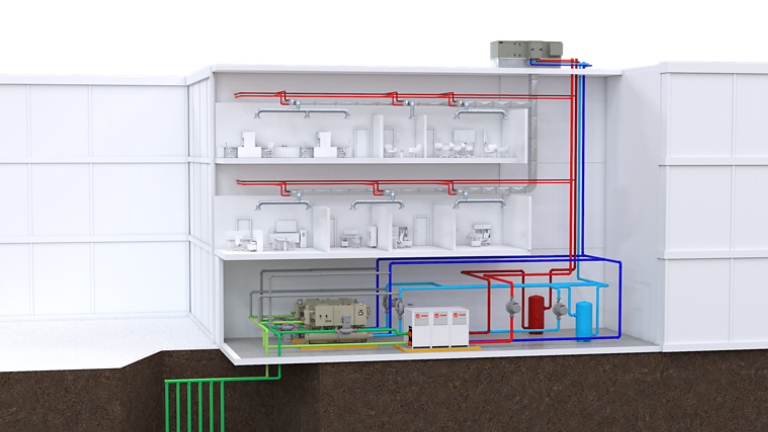
In commercial HVAC systems, geothermal energy is used by geothermal heat pumps (GHPs), also known as geoexchange or ground-source heat pumps. These systems leverage the stable temperature of the earth to provide highly efficient heating and cooling. A geothermal heat pump system consists of three main components: an underground loop of pipes (also called an exchanger), an indoor heat pump unit, and a distribution system to deliver conditioned air throughout the building.
A geothermal HVAC system works by circulating a water-based solution through underground pipes (called ground loops). These loops absorb or release heat, depending on the season, and deliver it back to the building through a geothermal heat pump.
Additionally, the geothermal heat pump may recover excess heat from within the building – for example, from people, computers, and lighting. That heat is then transferred to other parts of the building or into the ground or lake for later use.
The size of the available land and your budget determine the ground-source heat pump depth you need. Three types of heat exchangers are available:
Geothermal systems are a viable option for a wide range of commercial buildings, including schools, universities, government buildings, office parks, and healthcare facilities. They are particularly effective in:
Geothermal systems offer a multitude of benefits for commercial buildings:
Ground-source heat pumps are among the most efficient heating and cooling systems in existence today, and they are a powerful tool in the engineer's arsenal for application in green buildings due to their energy benefit.
The design of the ground loop and distribution system, and the number and size of heat pumps, can be modified depending on your specific facility's footprint and layout so that commercial geothermal will work in any commercial building.
Resources for Geothermal Heat Pump Systems
Geothermal systems represent a proven, reliable technology for commercial HVAC applications that delivers exceptional performance, significant energy savings, and environmental benefits across all climate zones. Contact your local Trane Commercial HVAC representative today to determine if a geothermal HVAC system will work for your building or campus.