Intro Voice: [00:00:00] You're listening to Cool Air Hot Takes.
Charlie Jelen: Welcome to Cool Air Hot Takes. I'm Charlie Gellen. And I'm Dan Gentry. And every couple of weeks we get together and bring you the latest in HVAC energy in the built environment. This week, we're joined by Chris Gagermeyer, someone we both know through a program called GTP Graduate Training Program. I'm a graduate of the program and, uh, my co-host here, Mr.
Gentry. We'll call him an, an honorary member. Sure. Close enough. Works for me. We sat down with Chris as the program GTP celebrates 100 years. We're gonna hear all about HVAC training and how it's evolved over the years.
Dan Gentry: And we also, of course, have the latest HVAC headlines on your stat of the day. But first, time for some hot takes.
Charlie Jelen: Actually, first, it's time for a little intervention.
Dan Gentry: Oh, uh-oh. Okay.
Charlie Jelen: Okay. So I was talking to my, my pal, my pal, Amber Gentry.
Dan Gentry: I know her well. [00:01:00]
Charlie Jelen: Amber Schulz. Uh, so listener out there. Dan and I met in seventh grade, but I also met Amber at the time, was just a friend.
Dan Gentry: I have no idea where this was going.
Charlie Jelen: Dan's future wife.
So we all met probably within hours. But anyways, so I, I say this because like me hanging out with Amber isn't that weird. Yeah. Yeah. Just throw it out. It's normal. It's throwing it out there. Actually, it was a, it was a pop in, popped in, popped over. Uh, you weren't around, so we just hung out. And she's like, "Oh my God, I gotta tell you a funny story."
And I was like, "All right."
Dan Gentry: Okay.
Charlie Jelen: Hit me with it. So listener, this is no surprise to anybody, I think, if you've listened to more than a couple of episode. Uh, Dan really likes war documentaries.
Dan Gentry: I do. It's
Charlie Jelen: right up there.
Dan Gentry: Every night.
Charlie Jelen: Okay. And so Amber's like, "Yeah, I wake up in the middle of the night. I'm, I get startled and Dan's talking in his sleep."
And the lines that he says are, "They're approaching the front lines. Yes, they're ready for battle." So I think, I [00:02:00] think we need to lay off the, uh, the war documentaries right before bed.
Dan Gentry: Yeah, it sounds like I was probably getting into a little Dan Carlin and probably doing some quote. Quote. The soldiers marched forward.
One after another. Blood all
Charlie Jelen: over. I gotcha.
Dan Gentry: Yeah, that's funny.
Charlie Jelen: I thought
Dan Gentry: that
Charlie Jelen: was funny.
Dan Gentry: I have animated dreams, I guess. Uh-huh. She tells me about this stuff. I think I talk a lot.
Charlie Jelen: Yeah.
Dan Gentry: When I'm sleeping and it sounds kind of-
Charlie Jelen: That doesn't surprise me. Anyways-
Dan Gentry: Well, I'll try to lay off the, uh, history at night then I guess, so, uh, I'll, I'll work on that.
Charlie Jelen: Work on that. For Amber's sake.
Dan Gentry: Yes. Well, thank you for that.
Charlie Jelen: All right. Hot take. Number one, I'll give you mine. We'll be paying big tech companies for our power in the future. That's my hot take.
Dan Gentry: Okay.
Charlie Jelen: All right. And so I, I was reading an article here that by 2030, 5% of all total power generation in the US will come from onsite power from data centers.
Dan Gentry: So question, does it all still [00:03:00] go through the provider? Or would we actually be like paying a bill to whatever?
Charlie Jelen: I don't know. This is what I'm thinking. So in my head, what's, you know, there's, over the last two years, you've seen articles that, you know, Microsoft or Meta or whoever they're, they're buying power plants and they're taking them behind the meter to power data centers or they're building out massive data centers and there's a bottleneck and getting utility power so they're building out onsite generation.
I don't know how long that's gonna last, but there's also companies like BlackRock that are buying or taking massive stakes in power generation- mm-hmm. ... power transmission companies, utility companies.
Dan Gentry: Yep.
Charlie Jelen: And so I don't know, so I just was envisioning that one day your Nest thermostat is just gonna send you a bill from Google for your energy.
You know, something like that. That's funny. And, and I'm sure there's listeners out there that are like, "Oh, that'll never happen because of X, Y, and Z." And if you feel that way, please let us know. CoolAir.hottakes@train.com. We love the comments, but that was my hot take for the day from an article.
Dan Gentry: No, that's interesting.
I like it. So I am like, just got back. I just landed like two hours ago from- Where were you? ... data [00:04:00] center world in Washington, DC. Yeah. Yeah. So I was there all week seeing all this kind of stuff. And I was talking to one of the large data center providers and they were going through their whole thing and I was like, you know, what are these
I know what chillers are, but what's all this stuff? And he was talking about these like battery packs and like generators and all the stuff they do and he was using that as an example. He was like, remember in Texas a few years ago when this happened, yeah, this data center powered however much and, you know, it was kind of part of their thing, you know, like, hey, can, you can use this power, but as a good neighbor, if the utilities have problems-
Charlie Jelen: Yep.
Dan Gentry: this is another resource.
Charlie Jelen: Mm-hmm.
Dan Gentry: I think it's great.
Charlie Jelen: Yeah.
Dan Gentry: I mean, it makes sense. It's there.
Charlie Jelen: Right. Yeah. Use it.
Dan Gentry: Yeah. What a good neighbor.
Charlie Jelen: What's your outtake?
Dan Gentry: My hot take, so mine is a, mine's the last second hot take.
Charlie Jelen: Last second hot take, what's that mean?
Dan Gentry: Last second hot take, meaning like I just got it like two days ago from a, a guy came by the booth.
Charlie Jelen: Okay.
Dan Gentry: And he was like, "Hey, I got a hot take for it. " I was like, "Okay." Sweet. He's like- Who was it? This is from Dave [00:05:00] Stebniki. He's, uh, he works for Copeland, Copeland Compressors. We was talking about compressors a little bit. Oh yeah,
Charlie Jelen: okay.
Dan Gentry: But he started off with this. He said, "Capacity is currency."
Charlie Jelen: Capacity of what?
Dan Gentry: That's what I was like, okay, give me a little more. And he's like, in this market we're in data centers because we're there. If you have the capacity to build stuff, that is currency- Sure. ... because it's all about lead time and getting things. So if you can build things that people can buy in a reasonable amount of time, that's currency in- All right.
I
Charlie Jelen: thought you were gonna hit me with a Field of Dreams line there.
Dan Gentry: I didn't go that route. I kept it there. I liked what Dave had to say and I was like, "You know what? "
Charlie Jelen: Yeah, that's, that's exactly ... So I, I know you weren't here for the interview with Matt Caldwell and Hyper, but that's exactly what their business model is, is they go and find manufacturers that have extra capacity and they basically give them the plans to go build electrical equipment.
Oh,
Dan Gentry: so that's a hot take.
Charlie Jelen: So they're, they're trying to find as much [00:06:00] capacity to- Yeah. ... fill the need, yeah.
Dan Gentry: Uh, I mean, it makes sense.
Charlie Jelen: Capacities currency. There you go.
Dan Gentry: I like it.
Charlie Jelen: All right, listener, up next, we got your HVAC headlines.
Intro Voice: HVAC headlines, your news today.
Charlie Jelen: All right, listener. It's 9:00 AM in Fairbanks. Here's your headlines. Headline number one, 2026 HVAC industry trends, repairs are driving more revenue. So this is an interesting article that looked at trends from 2021 to 2025, and it was looking at mechanical contractors and how much of their business is being driven by service over new equipment installation.
So repair revenue share, so like the percentage of the revenue that makes up repair work- mm-hmm. ... at a mechanical contractor was 21% in 2021, and it was 31% last year in 2025. Wow. 10%.
Dan Gentry: It's quite a bit.
Charlie Jelen: Repairs per organization [00:07:00] is up 65%. Whoa. Average repair revenue per job is up 47%, and the craziest stat, which caught my eye, is repair costs are down 26%.
All right, and so it's kind of a head scratcher. So everything's going up. If you look at this, like, big picture, you know, if you just get these stats and you're like, "All right, what does this mean?" Generally, I think it means we're not building as much, we're repairing more.
Dan Gentry: I, I
Charlie Jelen: agree. Um, all right. And so if we're not building new buildings, if we're not building new homes or, you know, new office buildings, new, new schools, that means we're just maintaining what we have more.
And I think it's a combination of not building as much and equipment has gotten very expensive post- COVID with supply chain issues and global economic fluctuations. So I think that is all driving the market to do more repairs. I think what's really interesting is the repair costs have gone down 26%.
And I know equipment costs haven't gone down. So like there's two parts to a [00:08:00] repair. It's the piece that you're repairing and the labor to do it. Yep. So if you're repairing a compressor and not replacing the entire piece of equipment, just the compressor, the compressor cost hasn't changed. If anything, it's gone up.
Dan Gentry: Mm-hmm.
Charlie Jelen: So it's gotta be the labor cost. And so it, it feels like the labor cost is coming down in the mechanical contractor side, but I have not heard anybody say that. I've heard, like, the opposite.
Dan Gentry: Maybe they're just working faster. I,
Charlie Jelen: I don't know. Maybe AI is starting to pay off.
Dan Gentry: I mean, that's interesting.
I don't know, but-
Charlie Jelen: Productivity is through the roof.
Dan Gentry: Yeah.
Charlie Jelen: I don't know.
Dan Gentry: That is interesting.
Charlie Jelen: So we'll throw it out there to the audience. Yeah. If you've got some info on that, if you're a HVAC contractor out there and you're like, "Yeah, this is what's driving that, " let us know. CoolAir.hottakes@train.com.
Headline number two, US startup breaks ground on advanced nuclear plant in Wyoming, and like the subheadline was Bill Gates back startup boosts US nuclear push with 500 megawatt Wyoming reactor.
Dan Gentry: Whoa.
Charlie Jelen: So this one's cool because this [00:09:00] site will be America's next nuclear reactor to come online.
Dan Gentry: That's a, that's a fact.
Charlie Jelen: That's a fact. Wow. According to the company that's building at TerraPower.
Dan Gentry: How, when is it gonna be ready?
Charlie Jelen: 2030. Is when they're supposed to bring it online. So it's, it's a little ways out, but it's not crazy.
Dan Gentry: No.
Charlie Jelen: So TerraPower is the company that's doing this. It's in Wyoming. The reactor is called a natrium reactor, and natrium in Latin means sodium.
Dan Gentry: I was just gonna chime in for the, the listener, but thank you for doing that.
Charlie Jelen: As part of these war documentaries, do they do a lot of Latin?
Dan Gentry: A lot of Latin.
Charlie Jelen: Okay. So it's a natrium reactor with a molten salt energy storage system. Cool. So the reactor is kind of like a regular nuclear reactor that you'd see today, like enriched uranium, but instead of using water as the cooling mechanism, which is like what most, I think generally, I think they just categorize them as light water reactor, [00:10:00] those use water.
This uses liquid metal, sodium as the coolant instead. And then that liquid metal heats up a salt solution, molten salt, and then it can store that energy in these big tanks-
Intro Voice: mm-hmm. ...
Charlie Jelen: and then they can run that molten salt through a heat exchanger to create steam and run it through a turbine to make electricity.
Two things are interesting here. One is that energy storage aspect of it because most nuclear plants- Yeah. ... are total base load, you turn them on, you let them run.
Dan Gentry: Okay.
Charlie Jelen: This is a little bit more, it can do load following or, or peak shaving even. Mm. Because you, you get to pick kind of when you dispatch that molten salt and create the steam.
So that part's cool. The second part is the safety side of this. So it's an atmospheric system. It's not pressurized- Pressurized. ... like, like if you think of a regular nuclear reactor like Ternoble that was light water reactor or something in that vein where it just uses water, high, high pressures, and if you have like whatever is called thermal runaway, [00:11:00] it turns into a bomb.
Like that doesn't happen in this scenario. So like the ability for this thing to, to leak out is- or whatever. Way, way less.
Dan Gentry: This is super cool.
Charlie Jelen: I know. And it's like, it's already broke ground. They're like starting to build there and they've got permits and like they said, they are very confident it's gonna be the next nuclear reactor to come online.
Dan Gentry: Is it like more expensive than a traditional kind or is it just different?
Charlie Jelen: I don't think so. I think it is less expensive because you don't have to have so much safety involved with
Dan Gentry: it. I mean, safety part of it is like super exciting because that's for, you know, reason to be-
Charlie Jelen: Yeah. ...
Dan Gentry: you know, hesitant or skeptical or whatever, but if you can eliminate or reduce that safety concern, then sweet.
Charlie Jelen: Right.
Dan Gentry: Yeah. We need power.
Charlie Jelen: It's kinda cool.
Dan Gentry: So- That's a good one.
Charlie Jelen: Next generation nuclear coming our way.
Dan Gentry: All right. Up next, our guest interview with Chris Gagameyer.[00:12:00]
Charlie Jelen: Hey, Danny Boy.
Dan Gentry: Hey.
Charlie Jelen: Uh, what's your favorite destination for our conference?
Dan Gentry: You know, I love a good old Honky Tonk, so I have to say Texas.
Charlie Jelen: Well, you're in luck. The 2026 ASHRAE Annual Conference is happening in Austin, Texas from June 27th to July 1st. Yeehaw,
Dan Gentry: tell me more.
Charlie Jelen: Trane will be presenting two tech talks on high temperature heating solutions and Thermal Loop.
Train's new fully integrated energy recovery system that combines a hydronic loop, exhausted supplier coils, pump skid, controls, and a performance-based selection tool. You definitely have to check that out.
Dan Gentry: Oh yeah. Thermal loop is going to bring the energy back to your building. We hope you join Trane at one of their tech talks in Austin next month.
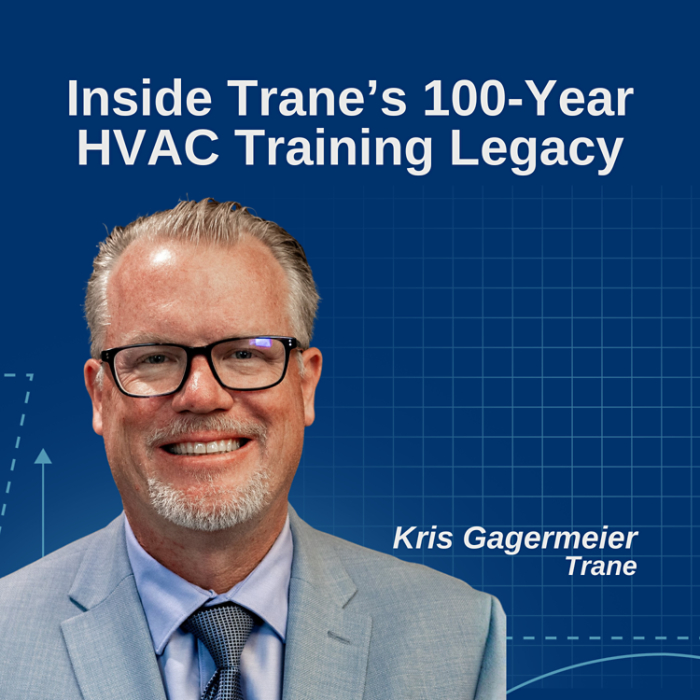
Charlie Jelen: All right, listener, today's guest and I go way back, I went through Train's graduate training program, GTP 20121.
Dan Gentry: Wow. It's a while ago, eh?
Charlie Jelen: That is a while ago.That's kind of [00:13:00] wild. Time
Dan Gentry: flies.
Charlie Jelen: Chris has been part of that program for over 25 years. He is one of the instructors. He's gonna give us a little background on, on his role with GTP and the training program in general for train and all the things that it encompasses.
So welcome to Cool Air Hot Takes, Mr. Chris Gagameyer.
Kris Gagermeier: It's great to be here, Charlie and Dan. Thanks for the opportunity to talk about GTP. We're having a big year. This is year number 100 for the program.
Charlie Jelen: Yeah, that, that is crazy. And you've been with just the GTP for 25 years or with Trane for 25 years?
Kris Gagermeier: Yeah, 28 years with Trane. Uh, I actually was attendee in the program. I did graduate in 1998-2.
Charlie Jelen: Nice.
Kris Gagermeier: And then I became an instructor in 2004, and I've had the opportunity to lead the program since 2007, so it's been quite a journey.
Charlie Jelen: Yeah, that's crazy. We're gonna get into GTP and, and all of the training that we do at Trane.
But before we do that, all of our guests, we ask them the same question, right? The name of the show is Cool Air Hot Takes. So we have everybody come on with a hot take. It could be anything, [00:14:00] personal life, professional life, anything in between. What do you got for us today?
Kris Gagermeier: Well, first of all, am I your first HR professional to come on the show?
Charlie Jelen: Oh yeah, easy. I can say that confidently, yes.
Kris Gagermeier: I figure it may be the last too. We'll see how this goes. So I'm gonna get a little touchy-feely with you. Oh boy. Um, I have the pleasure of working with young professionals through the graduate training program and, uh, the conversation I have with them, it might be in the, in the last lecture type of variety, is just talking about this elusive concept of life balance or life harmony, right?
Mm-hmm. And I share with them my take on that, what the most common mistake that people make in achieving it. And that is operating the assumption that your personal life is all wine and roses, or as I would say, summer shandy and golf. That would be equivalent for me. And work is all the grind. Mm-hmm. And so if you operate in the assumption, you know, personal life is all [00:15:00] great and work is real tough, you're never gonna hit that harmony, you're never gonna hit that balance because 50 years on this life, you will find challenges in your personal life.
They will happen. They can be really hard. And if you're not finding that joy in the workplace, you'll never be in balance. So you gotta look for joy at work, find it, you have great people to work with, that's how you can achieve some sort of harmony in your life.
Charlie Jelen: Love it. Wow. What's your harmony at work?
You have kind of a, a varied background, and we're gonna get into that here, because it's not just GTP, right? You're responsible for much more than that.
Kris Gagermeier: I work with a really talented team, and we support all of the professionals we have in our commercial sales offices across North America. And so, you know, a big part of that, of course, we spend a lot of time and energy developing the talent that intimately and every day interacts with customers.
And so it's really important that we put the best technical knowledge, technical capabilities in front of our [00:16:00] customers, and so we do that by training not only our sales professionals, our technicians, and our project managers.
Charlie Jelen: That's great.
Dan Gentry: Wow. Man, I'm, uh, is the only one on this that has not gone through GTP.
I feel really like, I feel really left out, like, hearing all these, like, exciting things already. So this is ... I'm, I'm excited about this.
Charlie Jelen: Yeah, Dan, you came in with too much experience to go, to go through
Dan Gentry: GTP. Yeah, it's like- That was
Charlie Jelen: your downfall.
Dan Gentry: It's my own fault. Uh-huh. You know, as they say. And, but the funny thing is I do get to contribute- Yeah.
to training sessions in the GTP, so I still get to interact with these wonderful individuals too, which is great.
Charlie Jelen: Yeah. Chris, so I think, you know, for the listener out there, so graduate training program is primarily been for account managers that are going out into the field, and it's expanded there. So it, it used to be a hundred years ago that these were the people that were going and setting up franchise offices out around the country.
So can you give us a little bit of that origin story on how GTP started and then kind of take us into where we're at [00:17:00] today, which is there's a couple of different facets of GTP in terms of it's not just account managers, we're looking at training technicians, we're looking at energy engineers, controls, et cetera.
Kris Gagermeier: Yeah, it's a great question, Charlie. We go back to 1926 and the purpose of the program, and, and we called it the technical training class. It, it's had a lot of names over the years, but the purpose of the program was to expand our train commercial business across North America. And so the men and women that came through the training program left La Crosse, Wisconsin and actually started up new branches across the country.
And so if you think about that's how we grew, uh, the program became international pretty quickly after its inception. And so we started having attendees from all over the globe, Asia Pacific, Latin America, Europe, Middle East, Africa, we have graduates that went everywhere. You mentioned about the other roles that we train.
So not only our commercial sales professionals, but also we have a lot of teams that support our commercial sales teams. We [00:18:00] have product management, product support engineers, software engineers that come through the program. So really it's, the focus, again, is on customer facing roles, but it has expanded to serve other audiences as well.
Charlie Jelen: And what are we training, what are we training these young professionals on? What are we training them to do?
Kris Gagermeier: Everything they need to do to go serve customers. So people typically look at the program and say, wow, it's a lot of technical training. We're very serious about our technical training. Mm-hmm. We have homework every night.
We have challenging evaluations that they're expected to perform well on. But really, if you've talked about the graduates, it, it's personal, professional growth along with the technical training. For many of our attendees in the program, this is their first full-time professional role. We take that very seriously to make sure we give them a good transition into the professional workspace.
Dan Gentry: Yeah. And this isn't just like one program you say there's different, there's say cater, uh, design programs for the different tracks that [00:19:00] we're gonna send folks down, right?
Kris Gagermeier: Yeah. So, uh, within our sales program, which was the one that started 100 years ago, again, so we have our building automation acco- uh, sales professionals, we focus in services, we have focuses in new construction as well.
And then recently we've started up two brand new programs for energy engineers, as well as our contracting project managers. So it continues to grow and expand.
Charlie Jelen: And give us an idea. So I think one of the things that shocks people about this program is I think a lot of the listeners out there are like, "Oh, you go, you take some online classes for two weeks and you get a piece of paper that says you're, you're certified for whatever."
Uh, give the listener idea of how intensive this is and what they need to do to complete it.
Kris Gagermeier: Yeah. So we take that first word graduate seriously, right? This is a graduate level program. The majority of our attendees are engineers, but we do have other majors as well. The biggest shocker is, so today's brand new curriculum that we launched, our, our new program structure, [00:20:00] we have our attendees spend, uh, first of all, they have an internship or at least three months of time on the job training in their commercial sales office.
They then start a formal four week program of on- the-job training with the program staff, preparing them for then a 14-week in- person experience on lacrosse. That is a consecutive 14-week program where we are in training all day and doing additional work and practice in the evenings. So people are a little shocked by that because that's usually not even how graduate school works, but it is full-time development to get ready to go serve customers.
Charlie Jelen: Yeah.
Dan Gentry: That's pretty intense. So what about bunking? You got like a, you got like, we got some trailers for these kids or they get hotels or-
Kris Gagermeier: Yeah. So-
Dan Gentry: That's a long time. We got to think about it.
Kris Gagermeier: So thankfully, we just moved into a larger house, so many of the attendees just stay in my basement, so that's cool.
We set up tents and campers outside. Um, we do have [00:21:00] housing set up for them to take care of them, so they do spend a lot of time with each other during the business hours and doing work in the evenings also.
Dan Gentry: I imagine they established some good long-term relationships throughout that.
Kris Gagermeier: They do. I have to share a quick story with you.
I just crossed paths with one of my 1998-2 classmates. Nice. His name's Clyde. Clyde works in our airside business and, and he's working with Trane in, in that part of the business again, and I hadn't talked to him in 20 years.
Charlie Jelen: Clyde who?
Kris Gagermeier: Clyde Stroman.
Charlie Jelen: Stroman. Oh, man. Oh, didn't know who that's who you're talking about.
So he does a lot of our airside selections on the data center side. He's great. Hmm. Shout out to Clyde. I hope he's listening.
Kris Gagermeier: Yeah. So he had a great journey through the airside business. And again, I, I found myself in HR today. And so the program prepares you for a lot of different career paths. And, and if I can touch on that a little bit, we have a president and a different business outside of our air conditioning business.
We have vice presidents and some of our other businesses, our parts business, [00:22:00] our residential business. And so really look at this as being an early career program- mm-hmm. ... that sets you up for success for a lot of different paths that you wanna take.
Charlie Jelen: Yeah, what was the ... I, I don't know if this was a made up line or if it was real, but I think it was Ruben Train said something like, you know, the reason we have the graduate training program or whatever it was called at the time is, "I can teach an engineer how to be a salesperson.
I can't teach a non-engineer how to be an engineer." Something like that.
Dan Gentry: Something like
Charlie Jelen: that. Yeah.
Kris Gagermeier: Something like that. So- Yeah. Yeah. We, we do talk about our graduates. We've had IT, business majors, some really talented folks that come through the program without that technical background. And, uh, they leave Lacrosse, Wisconsin with a, a degree in HVAC.
Charlie Jelen: Mm-hmm. And, and I think that's the thing I appreciated most going through it is I went through mechanical engineering, but I didn't take anything in, in the HVAC space. Some colleges kind of cater to that, like Purdue has a really big mechanical engineering specific to HVAC as well as others. Go bulldogs.
There you go, yep. Yep. Um, [00:23:00] but the GTP really grounded you in the fundamentals of HVAC and kind of gave you those building blocks to work up to and then you got into products and systems and then of course like the selling acumen side of it too.
Kris Gagermeier: You mentioned the history of a program, right? 100 years is a long time.
So my mentor's name was Mel Laytonen.
Charlie Jelen: Mm-hmm.
Kris Gagermeier: Mel was my mentor, my manager, and so the leadership of the program transitioned from Mal to myself. So Mal started the program in 1970 and he transitioned to me and we're here in 2026. So 56 of the 100 years were two gentlemen that were in leadership. So there can be a lot of positives that come from that experience.
Uh, the program has most certainly grown and matured along the way, but at the same time, a lot of continuity.
Charlie Jelen: Yeah. That, that's cool. I had, when I went through, I had, well, you were one of the instructors and then kind of the two that taught the most classes were Wayne Tabert and, and Rob Johnson. And you said earlier [00:24:00] about, you know, you take that graduate word seriously.
Two of the things that I remember from them being serious about this program. Oh yeah. One is Wayne would, would always tell stories. So Wayne, both Rob and Wayne were ex account managers and Wayne would talk about how if you didn't get this equation right or you didn't get this, you know, psychometric report right, you're gonna die.
And he came from Chicago and he just had that like Chicago accent, "You're gonna die." So that one always stood out.
Kris Gagermeier: We actually have some quotes on the wall from some of our, uh, most outstanding full-time instructors we've had in the program. And, and you mentioned Mel Layton and Mel's quotes is, "Maturity is the process of becoming."
Charlie Jelen: Mm-hmm.
Kris Gagermeier: We're never there. Wayne Taberts is, is about you better handle the details or, or, or you're gonna die. Um, so that's a great one. And we just had, uh, another outstanding instructor whose last class was, uh, here in 2025. His name was Tony Lee and Tony Lee's quote is about [00:25:00] never forget to look back down the mountain, right?
We're learning, we're growing, we're scratching and climbing, we're climbing the mountain. Don't forget to turn around and look at all the progress you've made and the experiences that you've had.
Charlie Jelen: Yeah, that's great.
Kris Gagermeier: And, uh- Great quotes. And you, you mentioned Rob Johnson. He's our lead instructor today, so, uh, we don't put quotes on the wall until you retire.
So- Rob's is so forthcoming.
Charlie Jelen: For a program that's been running this long, 100 years, talk to us about the evolution of it. Like, what are the things that, that you look back on that you're the most proud of and how it's evolved from where it started to where it's at today?
Kris Gagermeier: Yeah. So I, you know, we can start with the things that haven't changed, right?
Charlie Jelen: Yeah, oh sure. Yeah, go the other way.
Kris Gagermeier: We have excellent leadership in our commercial sales offices and an excellent talent acquisition teams that brings in the best talent each and every program. You know, when we think about what is the program, it's, it's not the building, it's not the curriculum, it's the people that come into the program.
And so that's been consistent throughout. [00:26:00] You know, in terms of the evolution of the program today, we have a videographer on staff. We brought in a curriculum designer, program designer from our local university. Um, and so with those two individuals, we can tap into even more technical expertise across our company.
And then of course the remaining staff are some, some really technical folks that are here every single day to provide that mentoring. But if you think about your college experience today, use a program like Canvas, we use Canvas here in the corporate training world as well. Sales training continues to evolve over time, right, in terms of how we interact and serve customers.
I'm sitting here today talking to you in a brand new training center, a building that we had on our trained portfolio on campus. We chose to remodel rather than build a new building. It's got a state of the art storage source heat pump system in it, uh, very proud of that and a learning space that the program's never had before.
In fact, a lot of people like to talk about it. We spent 30 years in a basement [00:27:00] before getting into this beautiful new training center.
Charlie Jelen: This is some rough years. That's what, uh, 2012 one, the year I went through- Yeah. We were, we were in the basement. Yeah. And, uh, it's a bit of an upgrade.
Kris Gagermeier: Yeah. It was always great.
Someone like Charlie would complain about having to be in the basement. I'd be like, "Hey, Charlie, I've been down here 20 years, so I can feel the pain, man."
Charlie Jelen: Fair,
Dan Gentry: fair enough. And, and the new place is awesome too. So other people that come back, they're like, "What?" Yeah. "This is what you guys have now." It's great.
Kris Gagermeier: But yeah, you know, talk about the evolution, even just the continued success of the program, how do you carry on for 100 years? Mm-hmm. And, uh, I think there's several reasons there, but, you know, just, just to share, it, it's the success of the graduates that we have then move into leadership roles within the company and send their newest hires.
Yeah. We have grandfathers with sons and daughters and moms and dads with sons and daughters, and that's really part of our, our trained family in terms of why we do that, but within that, the GTP legacy has [00:28:00] so many examples of second and third generations attending the program.
Charlie Jelen: That's awesome. So what's next?
You look at the horizon. You, you've got 100 years in the rear view mirror. Anything on the horizon that you can, you can speak to?
Kris Gagermeier: Yeah, you know, I, I just feel very blessed to be work for a company like Trane where we believe in our people and we continue to invest in our talent. It's very exciting-
Charlie Jelen: Uh, speaking of, uh, the HR guy on the, on the call.
Kris Gagermeier: Yeah, there you go.
Charlie Jelen: Okay, way to go. You got to check that box.
Kris Gagermeier: So we have a brand new class coming in in four weeks. We can't wait to get them arriving in lacrosse. Lacrosse is a great place to spend, you know, three, four months of your life.
Charlie Jelen: Absolutely.
Kris Gagermeier: Uh, our application of AI with this program will be the next step up for us.
All right. It's amazing about how we think differently and the impact of AI in learning.
Charlie Jelen: Mm-hmm.
Kris Gagermeier: So in a formal training program, how do we integrate intelligence as part of that process, but also preparing them for their role back in the sales offices or their [00:29:00] role back in our product teams is they will work differently, so therefore we need to prepare them differently.
Charlie Jelen: Yep. That's cool. Mm-hmm. If, if there's people out there and they're interested, like maybe we've got some young professionals listening to this podcast, how do they find out more about the program? How do they get in touch with you guys?
Kris Gagermeier: So we of course have information out on, on train.com. As I mentioned, we have three different programs, not only sales professionals, our energy engineers and contracting PMs, and then much of, many of our product engineers also have the opportunity to attend the program.
And so please check out careers@train.com and, uh, would love to see in the training program in the future.
Charlie Jelen: I love it. Sweet. Awesome. Thanks for joining us today, Chris. That was fun.
Kris Gagermeier: Thanks, guys.
Dan Gentry: Hey, Charlie, you ever wonder about how better building training could make a world of difference for the HVAC pros out in the field every day?
I mean, it's in, it's my top, it's in my top 10 list of things I think about. Well, Trained Symbio 700 training is here to do just that. At Trane, we understand that proper training is [00:30:00] crucial Well, to getting the job done. This training is designed specifically for technicians and contractors to help them master rooftop units and split systems.
All available on demand and completely free. So we can help contractors ditch the guesswork and focus on getting the job done right. Exactly. Head over to Symbio Training and Troubleshooting at Trane Commercial HVAC to dive into the latest training program from our experts at Trane.
All right folks. Time for Stat of the Day.
Charlie Jelen: Here come Joe.
Dan Gentry: Stat of the Day. Stat of the Day. Start of the Day.
Charlie Jelen: It's Stat of the Day by Dan Gentry.
Dan Gentry: Here you go. I got to pick this one so you guys, uh, get a little sneak peek into what I'm thinking about right now. So I was, uh, sitting at my table admiring my beautiful lawn, which I take very good care of. Yeah,
Charlie Jelen: listener, listener dance that guy on the block who's out there way before anybody needs to be trying to, trying to get the lawn ready [00:31:00] for the summer.
Dan Gentry: You know, um, no crabgrass, no dandelions. It's how I roll. So- Nice. I thought some landscaping industry statistics would be interesting for this, uh, springtime of year. And these come to us from Lawn Starter. So just a couple, I think, interesting stats here. $184 billion was a 2025 estimated revenue for landscaping or land care.
What? Uh, in our country, yeah. 184 billion bucks.
Charlie Jelen: Crazy.
Dan Gentry: There's like a lot of money to be made in cutting grass and trimming things. Wow. Right? 40 to 50 million acres of residential lawns to mow across the US.
Charlie Jelen: Okay. Yeah.
Dan Gentry: Quite a bit of lawn, lawn care. 652, 562,000 is the number of landscaping businesses in the US.
So quite a few businesses. Mm-hmm. Those businesses employ 1.4 million people to take care of our lawns. Quite a bit. 80, this is some good stuff. 85%. [00:32:00] Uh, percentage of lawnscapers who are men. Yeah. Not too many women in the lawn, lawn care these days. Some of ... Come on, ladies. It's great. You're outside, get nice and tan, get exercise.
It's a great job.
Charlie Jelen: Yeah, you were, you were part of that 85, weren't you?
Dan Gentry: I was part of that 85. I
Charlie Jelen: was too. I was too. My firs job, yeah.
Dan Gentry: That's what I mean. You get a sun tan. Uncle
Charlie Jelen: Jimmy. Uncle Jimmy's lawn care service.
Dan Gentry: I was working for Joe. Joe Bennett.
Charlie Jelen: There you go.
Dan Gentry: And this is my favorite one. 70 hours is the average time a homeowner spends on their lawn each year.
I think I spend a lot more than 70 hours.
Charlie Jelen: I was gonna say, yeah, your, your trip with that. Easy.
Dan Gentry: It's like 70 hours, man. I'll, I'll be loud there for, like, four hours a pop. I just got a little lawn. So there you go. Landscaping stats.
All right, guys. Thanks for listening to this episode of Cool Air Hot Takes, and remember, new episodes are released every two weeks on Tuesdays.
Charlie Jelen: Leave us a comment on Spotify or YouTube. Leave us a review on Apple.
Dan Gentry: And we've got merch. Send us your [00:33:00] hot takes to coolair.hottakes@train.com, and if we featured on the show, you might find some of that merch in your mailbox.
And until next time, stay cool and keep those takes hot.