What is In-Row Cooling?
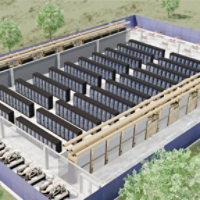
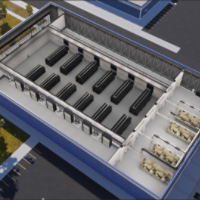
In-row cooling is a precision thermal management architecture used in data centers where the cooling equipment is installed directly within or alongside the rows of server racks. Unlike traditional perimeter cooling systems, where computer room air conditioning (CRAC) or air handler (CRAH) units line the outside walls of the room, in-row cooling is a close-coupled solution. By bringing the cooling equipment as close as possible to the heat source, it provides highly targeted, efficient temperature control for high-density IT environments.
How Does In-Row Cooling Work?
In-row cooling is designed around three ideas:
- Capture heat close to the source
Hot exhaust air from servers is pulled into the in-row unit from the hot aisle/row area or from the rack exhaust path, depending on configuration. - Reject heat to a heat-transfer medium
The in-row unit removes heat either by:- Liquid-to-liquid heat exchange – water/glycol loops supporting liquid-cooled IT
- Air-side cooling with a coil – chilled-water or DX coil
- Deliver conditioned air or cooling capacity back to the IT intakes
The system supplies cooled air directly to the cold aisle/near rack fronts (for air-cooled IT) or delivers cooling capacity into a liquid loop (for liquid-cooled IT), maintaining stable inlet conditions.
In-row solutions are often paired with hot-aisle/cold-aisle layouts and containment to further reduce mixing and improve control. Performance is significantly enhanced when combined with aisle containment, which prevents mixing of hot and cold air streams.
In-Row Cooling with Cooling Distribution Units (CDUs)
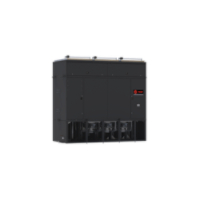
A coolant distribution unit (CDU) is a system that transfers hear from liquid-cooled IT equipment to a facility loop. The CDU circulates coolant through IT equipment, where it absorbs heat, then transfers that heat to a secondary loop via a heat exchanger before recirculating cooled fluid.
A CDU works by pumping coolant through the racks of IT equipment, where the liquid picks up heat. Then it brings the warm coolant back, removes the heat, and sends cooled liquid out again. Some systems use direct‑to‑chip cooling, where the coolant flows through plates that sit right on top of the chips to pull heat away more quickly.
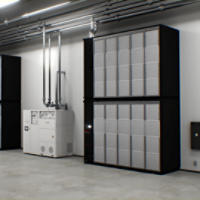
When deployed in an in-row configuration, CDUs provide effective data center cooling capability by utilizing facility water to support multiple server racks.
In-Row Cooling with Computer Room Air Handlers (CRAH)
A computer room air handler (CRAH) unit is a device within a data center that cools the air using a cooling coil filled with chilled water. The water is supplied to the CRAHs by a chilled water plant.
A CRAH uses fans, cooling coils and a water chiller system to remove heat. CRAHs can modulate fan speed to maintain a set static pressure, allowing for the stability of both temperature and humidity.
Benefits of In-Row Cooling for Data Centers
Implementing an in-row cooling strategy offers several distinct advantages for data centers, particularly those managing high-density computing (such as AI, machine learning, and cloud infrastructure):
- Elimination of hot spots: Because the cooling unit is adjacent to the heat source, localized hot spots that commonly plague high-density racks are neutralized before they can cause equipment damage or throttling.
- Improved energy efficiency: The shortened distance between the cooling unit and the servers dramatically reduces the energy required for fans to circulate air. Additionally, capturing hotter return air directly from the exhaust increases the efficiency of the cooling coils and the central chiller plant.
- Scalability: In-row cooling is inherently modular. As a data center's capacity grows or rack density increases, facility managers can easily add more in-row CRAHs and CDUs to specific zones without needing to overhaul the room's entire HVAC infrastructure.
- No raised floor required: Because the air is distributed horizontally within the aisles, in-row cooling eliminates the strict requirement for expensive raised-floor environments, freeing up vertical space and simplifying facility design.