
Customer Story & Case Study
Advancing Electrification Through Innovation at Trane Technologies’ Advanced Concepts and Capabilities Lab
Transforming an underused facility into a cutting‑edge lab proving the power of electrified, high‑temperature process heating for modern engineering.
Quick Facts
- Location
- Davidson, North Carolina
- Industry
- Industrial & Manufacturing
- Products
- Series R® Helical Rotary Screw Chiller • Agility® Centrifugal Water-Cooled Chiller
- Topics
- Sustainability • Energy Efficiency
Results
- 100 metric tons Of CO2 reduced annually*
- Delivers 210°F (99°C) Hot water temperatures
- More than 3x more efficient Than traditional gas-powered boilers
Expanding Capacity for a New Era of Engineering
Across Trane Technologies’ major engineering sites, the demand for testing space has never been higher. Electrification, data center growth, and increasingly complex engineered to order projects were stretching existing laboratories beyond their limits.
“All of the locations are out of space in their laboratories,” explained Julie Eagle, Senior Lab Manager for the Advanced Concepts and Capabilities (ACC) Lab. “There has not been a new engineering laboratory started up in several years.”
At the same time, an opportunity emerged: Building A on the Davidson, North Carolina., campus, a massive industrial building had been sitting vacant.
“This is a really big building… it’s set up to be an industrial or laboratory type space,” Julie said. “It was a good place to grow. It’s not hard to attract good talent to the Charlotte metro area.”
What began as an underutilized asset has rapidly transformed into a thriving engineering hub. In just two years, Building A grew from a handful of engineers to more than 40. This momentum helped fuel the creation of the ACC Lab, an innovation center designed to support Trane’s most ambitious technology advancements.
Engineering Challenge: A Modern Lab for Modern Demands
The ACC Lab needed more than just space, it required a highly flexible, electrified process heating system capable of exceptional performance. Unlike comfort heating and cooling applications, lab product testing demands frequent and dramatic temperature swings.
“We’re changing temperatures all the time,” Julie noted. “We need to run at 95°F then 140°F, then back to 40°F. We’re pushing equipment to the edges of where they like to operate.”
Originally, early designs called for a traditional boiler. An approach that, while familiar, didn’t align with Trane’s commitment to sustainability or future-forward engineering.
“We’re building an electrification test facility—why would we put a boiler in it?’” Julie recalled.
Many customers entering the electrification space have expressed skepticism that heat pump technology could reliably achieve high temperatures in demanding industrial environments.
“Sometimes it takes seeing it in action… for customers to really believe it works,” Julie explained.
The ACC Lab needed a solution that would help eliminate fossil fuels, expand testing capabilities, and prove to customers that electrification is not only possible, but effective.
The Solution: Trane Series R® RTZA high temperature heat pump chillers
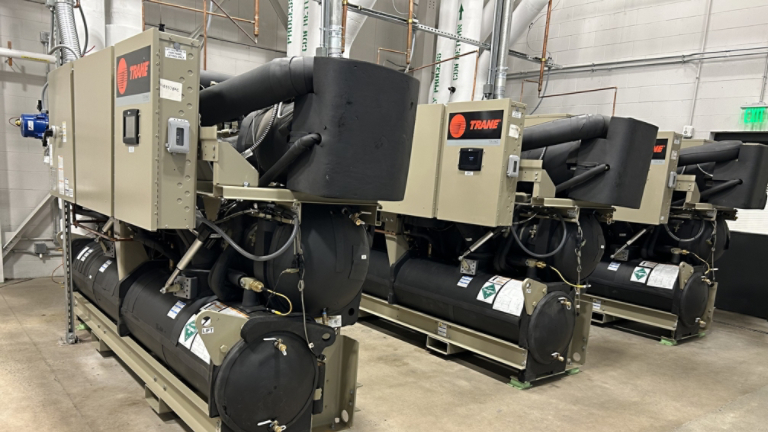
To meet these challenges, the ACC Lab chose the Series R® RTZA high temperature heat pump chiller, a new technology capable of producing the high leaving water temperatures required for process heating without relying on gas-powered boilers.
Built on the legendary Series R® helical rotary screw platform, the RTZA heat pump chiller provides the lab with the robust, flexible, and efficient performance required for rapid and extreme temperature cycling.
Key features that support the ACC Lab’s demanding environment include:
Delivers hot water to 210°F (99°C), which is believed to be the highest of any helical rotary screw heat pump chiller in North America.
Over three times the efficiency of traditional gas-powered boilers, dramatically improving energy performance.
Exceptional turndown capability, operating effectively at loads as low as approximately 30% of capacity.
Rapid Restart™ technology, enabling recovery to 80% design capacity within approximately three minutes after loss of power.
Direct drive compressor with fewer moving parts, improving reliability, uptime, and operating precision.
Integrated system flexibility, including the ability to reclaim heat from cooling loads, a perfect match for the ACC Lab’s simultaneous heating and cooling demands.
The lab also benefits from integration with industrial‑grade PLC controls. While the units include Symbio® interfaces, the ACC Lab manages them through an Allen‑Bradley PLC for tighter control of facility setpoints, pump skids, valves, and other subsystem operations. This control strategy demonstrates the system’s flexibility and reflects the preferences of many industrial customers who favor PLC‑based environments.
These features allow the ACC Lab to operate a system that not only performs under rapid temperature changes but also aligns with the company’s sustainability commitments and electrification roadmap.
“It’s a showcase for customers… and a demonstration that electrified heating units really can sustain those high temperatures and be used in a challenging environment,” Julie said.
The Series R® RTZA chillers offer the ACC Lab even greater efficiency, by using the heat from existing Agility® magnetic bearing centrifugal chillers to boost temperatures to the required application temperature. Due to the laws of thermodynamics, it takes less energy to transfer heat than to generate it, which results in significant energy and cost savings. Heat pumps are a practical, efficient solution for electrification.
“Our heat source is the Agility chillers,” Julie explained. “We’re not creating the heat, we’re recycling it off of our other system that’s operating in the opposite mode.”
This alignment of heating and cooling loads, common in industrial process environments, allowed the team to create a robust, fully electrified system with no fossil fuel backup.
And performance exceeded expectations.
The Results: High Performance, Low Carbon Impact
The ACC Lab not only expands Trane’s engineering capabilities, but it also demonstrates the powerful potential of electrified process heating.
The Series R® RTZA heat pump chiller units serve as a real-world demonstration environment where customers can see high temperature electrification operating under intense, variable loads, something traditional comfort heating systems rarely encounter.
By replacing traditional gas-fired boilers, the Series R® RTZA heat pump chiller helped reduce carbon emissions by nearly 100 metric tons of CO₂ annually* at the ACC Lab facility. That’s the equivalent of the annual electricity use of a 25,000 sq ft office building or a small K–12 school.
*Based on U.S. grid average emission factors (0.39 metric tons CO₂ per MWh) and product usage testing completed in Davidson, NC.*