
Customer Story & Case Study
Protecting What Matters Most at Allen County Public Library
See how Trane and the county aligned infrastructure upgrades with sustainability goals, reducing waste and energy costs while protecting critical assets and prioritizing the community.
Quick Facts
- Location
- Fort Wayne, Indiana
- Industry
- Local Government
- Products
- Chillers
- Topics
- Sustainability • Energy Efficiency • Solar
- Services
- Building Modernization • Energy Services • Smart Buildings
Results
- $74K estimated annual energy savings
- 20+ years of collaboration with Trane
- $500K in insulation costs avoided through reuse
- 83 dumpsters of waste diverted from landfill
Highlights
- Integrated approach aligned roof, chillers, and solar into one coordinated project.
- One of the first solar arrays of its size for any Allen County public facility.
- New rooftop chillers improved access and reliability.
- Secured Inflation Reduction Act (IRA) funding to help pay for energy efficient upgrades with rebates invested into future facility renovations.
- Library remained open to serve the community throughout the project.
The Challenge: Protecting ACPL’s Genealogy Collection Without Disrupting Service
Inside the Allen County Public Library’s (ACPL) main building sits one of the largest public genealogy collections in the United States. Researchers travel to Fort Wayne, IN, from across the country and around the world to access these records, bringing millions in economic impact to the area.
Unfortunately, protecting these assets was becoming increasingly challenging. Leaks in the roof were threatening the collections, while aging chillers in a cramped basement were difficult to access when service was required, which was becoming more frequent.
ACPL leadership saw an opportunity to invest in solar energy and capture Inflation Reduction Act incentives. However, installing new systems on an aging roof would only increase risk. They needed a solution that would protect irreplaceable assets, modernize infrastructure, and support sustainability goals without disrupting their ability to serve the community.
The Solution: Sustainable Infrastructure Upgrades with Trane’s Integrated Approach
ACPL leadership has worked with Trane since 2004. Today, Trane supports all 15 library buildings across the county in some capacity, helping the system serve approximately 1.7 million visitors each year. That 20-plus-year history has led to a deep understanding of the main building and its systems as well as the importance of implementing sustainable solutions that serve the community.
“It really is an asset and makes my day-to-day workload a lot more manageable knowing we’ve got Trane to lean on,” said Jake Ullom, ACPL Facilities Manager. “There have been times I’ve texted at 6am in the morning or 8pm at night. They always respond.”
A Collaborative and Comprehensive Approach
The roof, 20 thermal storage units, and new solar array could have been approached as separate projects, but Trane helped ACPL evaluate everything holistically, shaping a coordinated approach that aligned infrastructure needs with long-term sustainability goals.
Solar incentives from the Inflation Reduction Act included parameters that made the timing tight, but installing panels on a roof that needed to be replaced made no sense.
To help gain alignment on the proposal, members of the Trane team joined library leadership at a board meeting to present the plan and answer questions live. Their ability to clearly explain the integrated approach, along with the long-term operational and financial benefits, helped build confidence with the Board. Approval followed quickly, especially for a project of this scope.
Serving the Community and the Planet
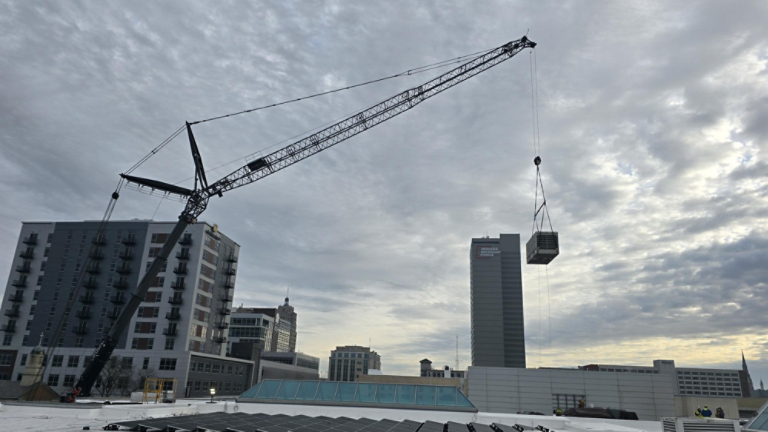
The roof was replaced and prepped for a rooftop solar array, one of the first of its size for any Allen County public facility. The aging basement chillers were retired, and new air-cooled units were situated on the roof where they can now be easily accessed.
With sustainability as a core objective, the team was able to reuse 106,000 square feet of insulation, replacing only 500 square feet that had been compromised. That alone diverted more than 83 dumpsters of material from the landfill and helped the library avoid more than $500,000 in insulation replacement costs.
The system also leveraged ACPL’s existing 20-year-old ice bank system, engineering a solution to integrate it with the new rooftop chillers. The ice banks freeze water overnight when electricity demand is lower, then use that stored cooling during the day to reduce strain on the air-cooled chillers during peak temperatures. By shifting energy use away from peak demand hours, the system supports both operational efficiency and long-term sustainability goals while avoiding the need to replace existing infrastructure.
The upgrades balanced environmental and fiscal responsibility, earning strong community support. Throughout the entire project, the library remained open.
"We take being public stewards of this community very seriously… we want to get it right for the people who depend on us today and for those who will rely on us in the future,” said Susan Baier, Executive Director of Allen County Public Library.
The Results: ACPL Lowers Energy Costs and Boosts Sustainability
The completed project is on pace to save the library approximately $74,000 per year in utility cost savings with solar performance already exceeding expectations.
A rooftop tour drew city leaders and local stakeholders, along with front-page coverage recognizing the project as a model for environmental leadership.
For Baier, the response confirmed that public institutions no longer must choose between fiscal responsibility and sustainability.
“Anything that’s good for the environment and good for the bottom line is universally well received,” Baier said. “It can be hard to find things that check both of those boxes, so when you can check both, it’s a win.”
Inside the main building, the ACPL genealogy collection continues to draw researchers and conferences from around the world, now supported by reliable systems and a more sustainable foundation for the future.