
Customer Story & Case Study
Watchtower World Headquarters Innovative Campus Design
Pioneering a fossil-free future in Ramapo, NY with advanced chiller plant innovation and the state’s largest geothermal fields.
Quick Facts
- Location
- Ramapo, New York
- Industry
- Commercial
- Products
- RTWD • HDWA • Thermal Storage
- Topics
- Energy, Environmental and Sustainability • Sustainability • Efficiency
Results
- 100% fossil-free campus
- 2,650 tons of CO2 avoided per year
- 2,200 tons per hour of ice thermal energy storage
- 2,620 kW on-site solar photovoltaic (PV) generation
Highlights
- First-of-its-kind, fully electrified campus integrated with New York State’s largest geothermal field.
- Earned NYSERDA’s Buildings of Excellence Award.
- Advanced Trane solution delivers responsive performance and long-term system adaptability.
- Innovative hybrid chiller achieves 130°F hot water to meet campus needs.
- Collaborative team committed to excellence.
The Challenge
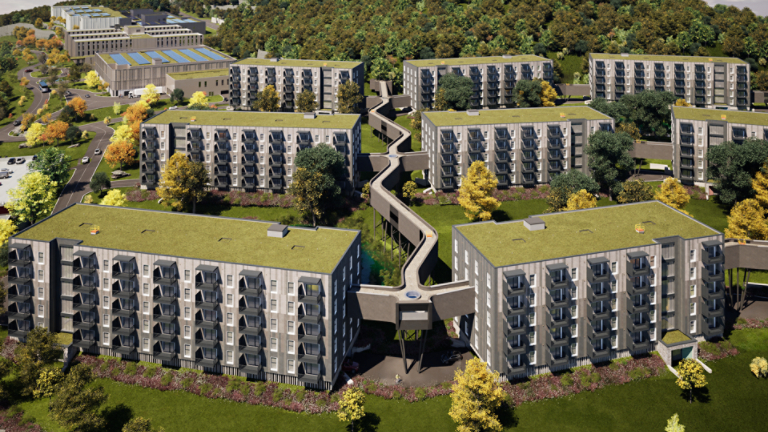
When the Watchtower team set out to build a first-of-its kind, fully electrified campus in Ramapo, N.Y., they knew it wouldn’t be easy. The new 1.6 million square foot facility would expand Watchtower’s existing world headquarters in Warwick, N.Y. It was designed as a work-live-play campus powered by renewable energy and anchored by one of the largest geothermal fields in New York State.
The challenge was to deliver efficiency, capacity, and operational flexibility across a complex environment that included 10 residential buildings, a 245,000 square foot audio-visual production center, and a commercial kitchen serving approximately 1,300 meals daily.
The Solution
Early collaboration ensured the systems were thoughtfully integrated from the start. Together, they engineered a solution that included:
- Four HDWA centrifugal chillers for maximum cooling capacity and optimized performance during peak demand periods
- Three RTWD screw chillers to provide greater operational flexibility
- Integration with New York’s largest geothermal field, creating a reliable, fossil-free energy foundation.
The fully integrated system, managed through advanced building automation controls, allows the central plant to respond dynamically to fluctuating demands while preserving operational efficiency and equipment life.
Adapting to Evolving Needs with a Hybrid Chiller Plant Approach
During early design phases, the team considered standard chillers for the project. However, detailed performance modeling identified challenges, especially with producing the higher temperatures required for residential domestic hot water needs.
"Domestic hot water needs to be maintained or heated to a higher temperature than we would typically see with a heat recovery chiller," said Kyle Pelcher, Trane Account Manager. "We needed chillers capable of creating higher lead-in condenser water temperatures than we had designed in the past."
Rather than rigidly adhering to the initial specifications, Trane and BR+A recommended a hybrid approach combining screw and centrifugal chillers. This flexibility expanded the system’s operational range, improved seasonal performance, and helped ensure long-term reliability.
Sustainable Design Leads with Large-Scale Heat Recovery
Watchtower embraced large-scale heat recovery at a time when the strategy was still emerging. The central chiller plant design captures and redeploys heat that would otherwise be wasted, dramatically improving energy efficiency and reducing carbon emissions across the sustainable campus.
"This is truly a groundbreaking project because it was implemented so early on in the adoption period of large-scale heat recovery," said Patrick McBride, Trane Business Development Account Manager.
The system’s design not only supports Watchtower’s immediate operational goals but positions the headquarters to adapt seamlessly to future technologies and regulatory standards.
The Results
With the central chiller plant complete, Watchtower headquarters is now well-positioned to achieve its long-term sustainability goals. With full campus completion scheduled for 2030, multiple significant milestones have already been reached.
Trane’s customized system configuration not only enables production of high temperature hot water up to 130°F but also ensures the campus can efficiently meet diverse load demands, from residential spaces to high-capacity production studios and busy dining facilities. The system's exceptional energy efficiency results in 73% heating and cooling savings compared to code baseline, while its all-electric design eliminates fossil fuel consumption entirely, avoiding 2,650 tons of CO2 per year.
The project has already earned the New York State Energy Research and Development Authority (NYSERDA) Buildings of Excellence Award and will likely achieve U.S. Green Building Council (USGBC) Leadership in Energy and Environmental Design (LEED) Silver certification for core buildings. The recognition is even more notable given Watchtower’s unique role as both building owner and installer, relying entirely on a volunteer workforce throughout construction.
Despite the inevitable complexities of such a large undertaking, collaboration between Watchtower, BR+A, and Trane remained strong.
"You buy from a person, not a company," McBride said. "When problems happen, we do not run away. We face them head on and we get through it."
The fully electrified campus is designed to operate with geothermal energy, large-scale heat recovery, and on-site solar technologies, setting a powerful example for projects across New York and beyond.