
Blog
Published: August 12, 2026
Smarter Energy Management: How Trane Enables Intelligent Buildings
Discover how Trane can help make your building more flexible, efficient, and grid-responsive.

Emily Harris
Energy Market Intelligence Analyst
Quick Facts
- Topics
- Energy, Environmental and Sustainability
- Services
- Energy Management & Controls
Demand Response (DR): Short-Term, Event-Based
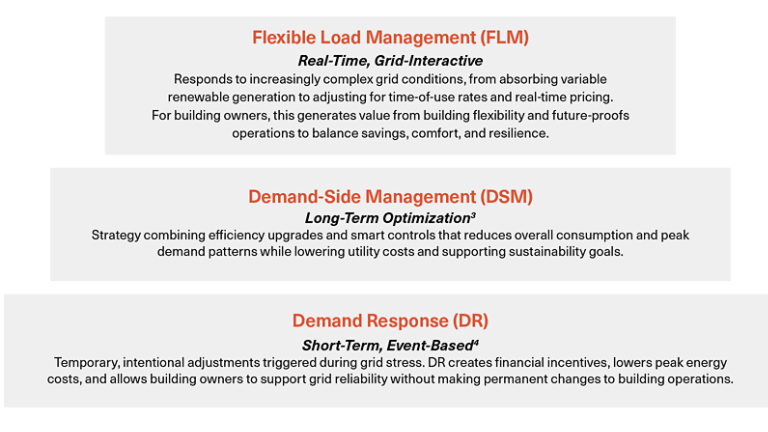
Demand Response is a type of load management that focuses on temporary, intentional reductions or shifts in energy use during periods of grid stress.3
Why we care: DR can create financial incentives, lower peak energy costs, and allow building owners to support grid reliability without making permanent changes to building operations.
How Demand Response Works
Demand Response is:
- Triggered by utilities based on grid conditions like high demand peaks and reliability events
- Typically short in duration (minutes to hours)
- Often includes financial incentives
Example:
A building receives a DR signal and raises its thermostat by a couple of degrees for one hour. Energy use drops slightly at a critical time, the grid avoids strain, and the building earns an incentive.
Demand-Side Management (DSM): Long-Term Optimization
Demand-Side Management is a broader, long-term approach to shaping energy use, focused on energy efficiency and demand response being used together.4
How Demand-Side Management Works
Demand-Side Management:
- Can help reduce overall consumption and peak demand patterns
- Is often implemented through upgrades, controls, and operational improvements
Why we care: For building owners, DSM can help lower utility costs, reduce peak demand charges, improve operational efficiency, and support sustainability goals.
Example:
A building installs a high efficiency HVAC system and a smart automation system that optimizes HVAC schedules based on occupancy and weather. It precools in the morning, reduces conditioning in empty spaces, and slightly raises afternoon setpoints—lowering both total energy use and peak demand.
Flexible Load Management (FLM): Real-Time, Grid-Interactive
Flexible Load Management expands on DSM by enabling continuous, dynamic control of flexible loads.
How Flexible Load Management Works
Flexible Load Management:
- Can includes DR, but goes beyond one-time events
- Can help adjust building loads in real time or near real time, responding to live grid or utility signals
- Can respond to increasingly complex grid conditions, such as:
- Absorbing variable renewable generation, such as excess midday solar
- Adjusting to steep electric rate increases and time-of-use charges, as well as market structures like real-time pricing
- Coordinating electrification-driven demand growth to avoid new peak demand
- Relieving localized constraints like equipment overloads or electric circuit congestion
FLM allows buildings and devices to automatically and continuously respond to grid signals by shifting, shedding, or even increasing load when beneficial.
Why we care: For building owners, FLM is not just about saving money. It can also generate value from building flexibility and future proofing buildings to balance savings, comfort, and resilience.
Example:
A large commercial building uses an advanced control system to continuously adjust HVAC, thermal energy storage, and ventilation in response to real-time grid conditions. On a hot afternoon, it slightly reduces cooling in non-critical areas and discharges stored cooling to avoid peak demand. Later, when grid conditions ease or renewable generation increases, it ramps systems back up to restore comfort and recharge thermal storage—all automatically and without disrupting occupants.
The Role of HVAC and Trane’s AI Control in Flexible Load Management
Why HVAC Is Critical in Managing Building Energy Use
- HVAC represents 40% or more of commercial building energy use5
- Potential for precooling, preheating, dynamic setpoint adjustments, and automation through AI and smart building controls – unlocking buildings as thermal batteries.
Trane’s AI Control, powered by BrainBox AI, helps create grid interactive buildings by automatically identifying the best times and ways for a building to reduce or shift energy use. AI-driven optimization services predict and adjust to grid signals like high renewable energy and low emission electricity, and demand response events. These forms of flexible load management allow buildings to reduce costs and meet sustainability goals, all while keeping occupants comfortable and maintaining operational continuity.
Looking Forward: Trane's AI Control Demand Response
The use of AI in buildings has the potential to enable building owners to participate in demand response programs automatically and without a noticeable impact on occupant comfort.
By continuously predicting local weather, occupancy patterns, and utility signals, AI can transform a building’s structure into a dynamic “thermal battery.” It can autonomously shift energy consumption ahead of peak hours through subtle, predictive temperature adjustments.
This continuous, real-time optimization can reduce grid strain and capture financial incentives, converting passive building operations into active, flexible energy assets.
[1] Flexible Loads and Generation | PNNL
[2] Flexible Loads - IEEE Power & Energy Society
[4] https://www.sciencedirect.com/science/article/abs/pii/S1364032115001860