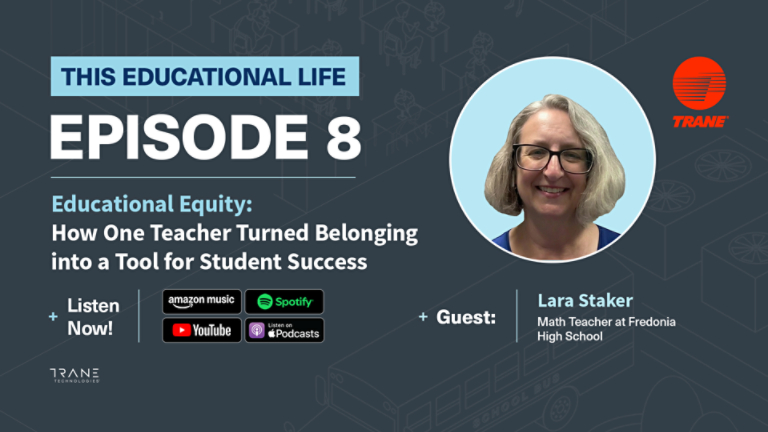
Mariah (00:00)
Welcome to This Educational Life, a trained podcast where we share the stories of heroes in education who turn everyday resourcefulness into innovation and big impact.
Lara (00:10)
It makes a difference that they have somebody that believes in them enough that they come back to let you know what they're doing and how they're doing it. hopefully those are going to be my business owners later on, most likely in our community. So I look forward to seeing what they might end up doing later on.
Mariah (00:26)
That's Lara Staker, a rock star math teacher in Fredonia, Kansas, who saw potential where others saw limits. In her alternative learning program, often a last stop for students who feel disconnected from school, Lara built something new, a bridge between classrooms and careers that gave students a sense of belonging at school and in their community.
Lara (00:47)
Kids wanted to come to class. Kids that normally don't come to class or it's right after lunch, they disappear after lunch, they were in class. They're like, what are we doing next? And they were hands on and getting into it and figuring out what to do. It's so exciting that it builds and builds and builds.
Mariah (01:02)
I'm Mariah Pressley, the Education and Industry Programs Lead at Trade. And this episode is about student belonging and the journey one teacher took to reimagine what school can be for every student. Let's get to it. Welcome, Laura. Thank you for being here. Let's just start with your story and tell us a little bit about your background and what actually got you into the work of working with alternative students in the first place.
Lara (01:29)
Okay, well, I was definitely a daddy's daughter, you know. So he was the original Mr. Mom, stayed home while my mom worked at the hospital. And I was able to watch him do a whole bunch of great things. He was great at doing woodwork. He was great at landscaping. But when he was in school, during social studies, they said, just go pop the popcorn real quick. And then you can sell that after school instead of actually doing his academics, even though my dad had hard knocks all the way through, he still ended up being a business owner. He ended up working at a minimum-security facility, teaching them industrial arts over there and increased that program. You know, within one year, the five-year plan was already done and then he passed away unexpectedly. So this is my work continuing remembering him and remembering what kind of student he was and what students I can help out. I wanted to give students an opportunity to do something hands-on that didn't imply doing something just a menial task.
Mariah (02:26)
What Lara shares here really highlights something we already know from research and alternative learning programs. When students haven't felt seen or understood in traditional settings, belonging becomes the foundation that unlocks their learning. These are students who often juggle real responsibilities and consistent learning experiences or just need instruction that honors how they process and apply knowledge. When we shift the environment, not the learner, we give them agency, relevance, and a reason to re-enter the learning space with confidence.
Lara (03:02)
I started off in education as like a student support monitor and then a paraprofessional and then went back to get my math degree. And when I first got hired, I got actually hired to work with students that struggled with math. So I got hired on first to do an algebra class that went two years instead of one year. And then I was trying to find different ways to get kids engaged with math. And then my principal said, well, why don't we try a vocational math route? And so I brought them into this vocational one class. and we had a group project. They were having to design something that was going to be a device for a character. And so we went ahead and developed a scale model of something that their character could use. And my first group sat there and looked at each other for three days, talking about productive struggle. They looked around, the A student wasn't there at all. And then the one kid finally said, you know what? We better get moving on this. Nobody else is gonna do it. We better get going on it. As I looked at these kids, they're not successful in their regular classroom. Why are they not successful? We need more hands-on, more things that relate to them, and more things if they're not going to college, what can get them into trade school and get them into the workforce with the best knowledge and the most pay once they get out of here.
Mariah (04:19)
empowering them with options. think that's such an important thing to do. And I love this idea of bringing, you said vocational math, and I know that sometimes our ideas are not as always easy to bring to life, right? So you've got the spark, you've got this idea. It sounds like you delivered on it well, but how did you get down the path of getting started to bringing some of those ideas together? And what were some of like the initial steps that you took to make it such a success?
Lara (04:45)
My classroom is filled with stuff from previous teachers that would go into this. So I have lots of tools and lots of different equipment, which I absolutely love. I absolutely love going to the hardware store. So how do I bring this to my kids? And I do a little bit of construction. So I actually did a geometry and construction class for a while that we co-taught with the construction teacher, which was great because they can see the results right off the bat. What they do for math goes right into there. But we had to kind of do something to get those third year math kids into something that they're successful in. So a lot of them are going into welding, a lot of them into construction. And we really wanted to try and get them into HVAC, into electrical, into automotive, into electricians, because electricians in our area, well, we have two master electricians and they're retiring. So how do we keep that trade going in our community? They needed something to kind of say that I'm successful and I can do those things.
When I went to a conference through NCTM, our National Council of Teachers of Mathematics, they had a regional one in Kansas City. I saw a presenter that was doing an integrated geometry class and I didn't get a chance to go see his presentation, so I had an opportunity to just go and observe him for a day over in Missouri. And so I got to take some of his curriculum and change it into what my kids need. And so we kind of worked the program from there and I kept looking for opportunities. Where else can I manage to do things? And so that led me during a pathway that I wasn't really expecting, but here we are now.
Mariah (06:16)
A common practice for leading innovation is to borrow ideas from other areas and align them so that they become multipliers for your application, which is exactly what Laura is doing when she leverages industry relevance to disrupt traditional classroom prep. It's a reminder that when teachers are given freedom to iterate, students gain pathways that feel real, purposeful, and connected to futures they can actually see. ⁓
Lara (06:43)
So of course when I did geometry and construction, we worked on NCCER. And so I kind of brought in that construction math, basic construction math for the kids to kind of do. And then I'm like, okay, what else is out there for them? Even though I'm a math teacher, I keep up with the CTE stuff that's going out. And we just happened to have our service center for education that ended up doing a free training on data analytics. And so I did that and I was kind of waiting, but I knew that this was going to be something I was going to integrate into my course.
And then two years ago, I ended up having a bunch of students and normally I do a farm project that they go ahead and do a loan application and they have to figure out where they're doing their plot of land and what they're going to grow and all that encompasses with that because I'm in rural area. But then I'm like, okay, you guys do this or I have this data analytics we can do and you get certified for that. And I had one student hand up already ready to go. He said, they always tell us that we need to have certifications. That looks good for our resume and it gets us hired and it gets us more money when we go ahead and get jobs, I think that we really should do this. And the other kids are like, I don't know. I'll just pick one. We'll just go ahead. Halfway through doing data analytics, they're like, oh my goodness, this is so hard. We can't get this at all. But the one student and another student, they both were like, oh, we got this. We'll help you out. We'll do things. so...they worked on how to do their different data analytics. And still the kids are like, oh, we're not gonna be able to pass this test. We gotta do it by a certain percentage. We're not gonna do it. Well, the first one didn't go so well on some of them. So I said, okay, let's sit here and let me just read it to you. No difference in what I say, but let me just read it to you. And they're like, oh, I didn't read it that way at all. Of course it's this because you talked about it in class. So I'm just gonna mark that one down. And they all ended up passing.
And as soon as they passed their smiles, these are kids that don't know what they're going to be doing in life. They usually are just trying to pass to be able to get to the next thing and just graduate. And they're like, ooh, so they were so happy once they got that certification. Well, Ms. Daker, can you laminate those also? I want to make sure that I'm able to keep it. And I'm like, sure, I'll go ahead and laminate that also. And then I took another picture with them with their laminated colored individual pictures and they managed to get it on Facebook with our school district and everything like that. And then we had a new year and some of those kids went into vocational too. They're like we don't want to stop here.
Mariah (09:12)
When students accomplish something challenging and relevant, something that carries real value, their confidence skyrockets. Certifications, hands-on projects, and applied problem-solving give students a sense of agency that traditional worksheets simply can't. Once they feel that momentum, belonging isn't just emotional. It becomes tangible.
Lara (09:36)
My trainers that trained me on the data analytics, they caught wind of what they were doing. And I was like, hey, this is what my kids are doing. I said, well, can we go ahead and zoom with those kids? I said, sure. So they got a zoom with this group of six kids that kept on going. Little Fredonia, we have 300 students in a seventh through 12th grade building. And they got to speak with people that were in the business, that were doing things, and something that they could talk about and get excited about.
And so they were really excited about that. And then those six kids are like, you know what? I'm doing plumbing. And then other one's like, I'm doing HVAC. Another one says, I'm doing HVAC. Another one's doing construction. I said, you just need an electrician in there and you guys can start your own business and be full service in the community. So they went ahead and did a mockup of a business and you know, what they needed. Did they need trucks? What kind of trucks do they need? kind of equipment did they need? What would their logo be? How would they sell it? How would they present it? And they had to present that again by video about their project.
And then as we went into doing the energy, they started doing their data with that and trying to do that part. They presented in front of site council with the community. This is not something these kids do. They don't like presenting. They don't like getting in front of people, but they got up there. They got free pizza out of the deal. They saw the meeting and then they went, what is this meeting? Can we come to this meeting anytime? I'm like, yes, it's a community meeting. You can come anytime. This is what happens. So they got more engagement with civic engagement because of it and understanding that.
Mariah (11:08)
This is such a great example of what happens when industry partners show up for students. The work becomes authentic. Students begin to see themselves not just as learners, but as contributors. And belonging becomes exponential when students feel valued by the very community that they hope to join.
Lara (11:27)
Kids wanted to come to class. Kids that normally don't come to class or it's right after lunch, they disappear after lunch, they were in class. They're like, what are we doing next? And they were hands on and getting into it and figuring out what to do. that's just, it's so exciting that it builds and builds and builds.
Mariah (11:43)
Based on your experience having done a lot of really cool, innovative things in the classroom, what about this kind of learning, or what made it different in your opinion?
Lara (11:51)
I think once they finished doing that data analytic one, they kind of ended up taking more ownership of what they were doing. They did something that was hard. They did something that the other kids aren't doing. Nobody else in the school was doing this. They did it. It was their accomplishment that they did. And they were like, well, we didn't think that we could, but we did. So they were able to do more projects and feel more confident going into it. These aren't the kids that are in STUCO. They're not the kids that are in the Renaissance. They're not joining different things. This is the only thing that they did that was actually involved with the school. They represented the school. Civic engagement went in with that. Be able to public speak.
Because they also, with the energy project, they found things that were wrong in our building. And they had to present that to people and say, you know what, we're losing energy and our costs are going up because of this, this, and this. So they went through the school. We didn't have the equipment yet, but they went through the school to figure out where all the stuff is. They were touching walls. They were seeing if there was anything blowing anywhere that shouldn't be blowing. They had clipboards. They looked like they were important. They went walking through classes and kind of looking and seeing what was going on there, what was going well, what was not, what the temperature in the room was, if our system was working okay, if there was gaps in the door, in the windows, and they wrote that all down. And they felt accomplished by doing that. They felt important.
And I had one kid, I've had him before. He's tried several of my classes, has not been successful. And he ended up coming to me each day, what are we doing today? And he's the one that kind of pushed the construction of the windmills a little bit more. And he would be talking about what we need to do to improve it because of the speed and da da da. And he just really got into it and he knew the energy stuff and it just absorbed into him. Well, he's now at Wichita State University. I did not see that coming at all, you know.
So I'm pretty sure that he's probably doing the vocational program through that because he wanted to do HVAC, but he's over there, you know, and he's taking care of his brother that needs a little bit of help. It's older than he is, but he's jumping in and just doing it. His brother comes back to town and is just so excited. I'm going to Wichita State, you know, and everything like that. And he's able to go out there and do stuff.
So they had to say, it wasn't just the popular kids, it wasn't just the kids that had money, it was just basic kids making a difference in our community and our school. I'm a math coach, I coach my kids. I'm not coaching teachers, I'm coaching my kids so that when the big game comes, they are able to do whatever they need and they have all the tools and the belts.
Mariah (14:32)
When we combine industry relevance with agency driven learning, students don't just participate, they lead. And stories like this student going to Wichita State show how identity shifts can happen when learning feels purposeful and belonging is supported. We mentioned a few times the opportunity the kids had to meet with different community partners, industry partners, and I genuinely believe if you want to go fast, go long. If you want to go far, go together.
What do you think that that industry support or industry collaboration has brought to the overall experience for you as a teacher and also for your students as part of their experience?
Lara (15:11)
It aligns to what we're doing. I think when I'm going through my data, the one area that is really lacking is our data and statistics. Where is that data and statistics? It's at the end of the book. And do all of our teachers get to the end of the book? They don't. Well, with data analytics, they actually see a reason for doing it. And so they can see and they can be creative with it. It's not just doing Google Sheets and doing Google and doing Excel and just kind of putting some stuff in there and making some stuff. They can be very creative. So one of my kids, he's working at a car dealership, but one of my kids was a very good artist. And so of course, when we did the project, he drew the trucks and drew the logo and all that type of stuff. That was his contribution because that was his talent. Not everybody is a kid that will sit in class, go through the book and do everything there and understand it. They need to have a chance to go ahead and explore it hands-on. They need to be able to talk it out.
Talking data is not fun sometimes, but if you're able to put it with sports, if you're able to put it with saving energy, you actually see the real reason behind it, then it gets them all excited. They need to be able to experience it here, have those ups and downs and why not do it here instead of in a job that they might get fired right off the bat. So we need to give them those skills. Just sitting and just doing the book work is not going to do that. These kids need to have the hands-on to be able to go ahead and do that.
Mariah (16:37)
Appreciate the pre-work you do to that, going into different industries, vocational centers, really trying to put yourself in that vocation and understand how to bring it back to the classroom is such a powerful thing. And I think there's a lot that industry can learn from our education system and our educators and people like you who are really putting that time in to understand it. So if you knew that there were some industry partners listening that were kind of thinking about helping or supporting these kinds of programs, what like lesson maybe do you hope that those industry leaders would take from the success that you have really cultivated with this group of kids?
Lara (17:15)
Well, what I would say is this is my goal of this particular class to begin with is try and build those community people out there and businesses and say, okay, give me a math problem your work crews are currently working on. Okay, give that to me. I will put it in class. I will see if the kids can figure it out without telling them anything else. And then I would like you to come in the next day either physically or by Zoom or Teams and talk to them about things and then tell them that the problem that they were given the day before is actually something you guys are working on right now. And after that, I can work with them on those problems and how to solve it. And then we have a follow-up call and actually see what their work crew was doing and what they made with those decisions that they made mathematically. And then they can be a part of that and kind of see and go, okay, well, if I understand this math, I can easily do that.
Mariah (18:08)
And ask the questions, right? Knowing the questions to ask to really figure out what is the problem or is there even a problem to begin with, right? So I think that's really incredible. I know we talked before about some students in particular. I just wanted to take a minute and maybe step back to the student impact. Can you just share a story about a student or maybe you've got like one or two students that you wanna highlight that just really came alive through some of the work that you guys were doing through this certification?
Lara (18:36)
Yeah, so I have one that really drove this. Without him, we would have had buy-in at all. Like I said, I gave him a chance, know, which would you like to go with this? I have this or this. And I was really wanting to do it. But unless the kids want to do it, I'm kind of hand tight on that. And it's towards the end of the year too. So I need them to still be able to buy in until we finish it at the very end. He's like, we've been told this over and over and over again. So here's the opportunity for us to get the certificate. Let's just try it. Let's see what happens. But once they got that done and they got that certificate in their hand, then they're really to keep on going. And so when we came into vocational two, that kid was in that class and he's like, okay guys, you what are we going to do? And I said, this is more project-based. I have to have the math in there. So more project-based. What are you guys interested in doing? Where are you guys going to go into your different fields? And so they really liked the energy project and they talked about a couple more certifications that were coming up and
The kids are looking at me and yes, we want to do that. And it's like, okay. They love getting that acknowledgement. They know it's something that's nationwide acknowledgement with that. And so he really pushed everybody else to keep on going. He's now graduated, but some of those kids are still with me and they still have that, you know, yes, we finished that data analytics and that's great. I have three of them in your book right now doing different data stuff in the book all the way through as far as taking polls with kids. Every couple of weeks we ask what kind of different questions we can ask them so that we can take those polls and put them throughout the book. I'm looking forward to them actually using some of the stuff that they did in data analytics to actually make that pop and be something that like, this is so unique how they did these, you know, and kind of add to that layer on the yearbook.
Mariah (20:18)
So just really quickly, because you kind of started the story with the story of your father and how he's inspired you to be in the role that you were in and what you really wanted to do different for those kids and give them something, you know, substantive to really like focus on and utilize their strengths. A lot of what I've heard you talk about today, like the word belonging comes to my head like so hard. And I think what you've really done is really cultivate this world where not just at school, these students maybe feel like they belong even in the community and with those industry partners. What is the importance of that mentality for students when it comes to learning to feel like they can belong in a place?
Lara (20:57)
It makes them marketable. gives them something instead of, my goodness, those teenage boys, what are they doing now? As you see them walking down the street. Yeah. You're like, those are the kids that presented at that one side council. They had some pretty good ideas. It becomes a different type of topic that they're talking about. They can talk to adults a little bit better. These are the people are, if they're staying in the community, they're going to get hired by. So if they see that they have made some initiative during school then that's gonna come out in the business too. So they are very marketable because they have some innovation behind them and they have some skills behind them to go ahead and do what they need to do. So now they're not outsiders in the community. Now they have some status. They have a purpose in there. They know that I'm here. Some of them still contact me. Out of the blue, I'll get a phone call. Just wanted to let you know that I'm still around and this is what's happening with me right now. It makes a difference that they have somebody that believes in them enough that they come back to let you know what they're doing and how they're doing it. hopefully, you know, those are going to be my business owners later on.
Mariah (22:02)
Industry partners don't just validate learning, they amplify it. When students see how their skills map to real careers, they begin to understand their own strengths differently. It turns classroom tasks into workforce preparation and shows students that they already have a place right now within their community's economic future.
Lara (22:25)
In fact, one of the ones that I first started with in this vocational math that ended up taking stuff to Nebraska, he has his own business now and he's doing a great job. you know, I go to other towns and his product is there and I'm like, I know the kid that delivered this to you. This is one of my kids, you know? So it's just that belief that they can do something that goes out everywhere else because then they start, you know, that chest up. Seeing people in the eyes and everything like that. So when they see a community member, they're looking at them. They're not hunched over, like doing other stuff. They're presenting themselves a little bit better out there. And so it kind of all snowballs with that. And then that affects their friends and then their friend group starts doing that and just kind of snowballs from there. So every little bit makes a difference. So many other places.
Mariah (23:13)
That is incredible. And Lara, thank you for what you do, because this work isn't easy. Like you said, to just take a step back and meet a bunch of students who all are in different places, where they are at, take such courage and perseverance. What is like one thing that you would advise they do to get started to bring these kinds of programs to their students too?
Lara (23:34)
I say, find those people that are already doing it. See what they're doing, see what could be replicated. I'm also a math leader for the state of Kansas. So I even more so dive into things that I see things happening and I'm like, I want to know more about that. And so I'll go to those things. So I'm not afraid of professional development at all. I'm always looking for those different things. And so if we can incorporate that, and then a lot of that also is doing some community involvement with that. The kids get involved with that and they get so excited about the math and what they're accomplishing.
So, you know, look around, see what you guys already have in your area, talk to your business members, see if they would love coming in and talking to your classes every so often. So what is something that the kids could do industry wise that's kind of missing in your industries, in your community and finds, you know, see if you can create a program that kids can be involved with because it deals with marketing, it deals with math, it deals with data, it deals with talking to community. I have a love for my kids here at Fredonia to know that their application's on the top of the stack because the community knows that we're doing whatever we can to get them ready. If they come from Fredonia, they're gonna be at the top of the stack.
Mariah (24:45)
Laura's journey is a reminder for all of us that when students feel seen, supported, and connected to real opportunities, everything changes. Belonging isn't just a bonus. It's the engine of confidence and long-term success for students. And when educators and industry partners come together, students don't just learn, they thrive. Thank you for listening.
I'm Mariah Pressley, Education and Industry Programs Leader at Train, and I look forward to learning with you on the next episode of this educational life, a train podcast. We'll see you next time.