Intro: [00:00:00] You are listening to Cool Air Hot Takes.
Charlie Jelen: Welcome, welcome to Cool Air Hot Takes. It has been a minute, but we are back for season four and we we're fired up for this.
Dan Gentry: Hey
Charlie Jelen: Danny. I've seen you a bunch lately, but not in the studio.
Dan Gentry: It's been a while,
Charlie Jelen: so this, this feels good. I like this.
Dan Gentry: I'm glad to be back. It feels good.
Charlie Jelen: We're back in the, the, the Cozy Studio Stoddard, Wisconsin.
Dan Gentry: Cold outside, cozy in the studio.
Charlie Jelen: That's right. Alright, listen, we are your host. My name is Charlie Gellan.
Dan Gentry: I am Dan Gentry.
Charlie Jelen: And this show is all about buildings, energy and HVAC. And if any of that is interesting to you, you're in the right spot.
Dan Gentry: Thank you to everyone who's been with us for the past three seasons, and of course, a very warm welcome to any first time listener.
We are pumped. You guys are here.
Charlie Jelen: Oh, to any voice? Excited.
Dan Gentry: Yeah.
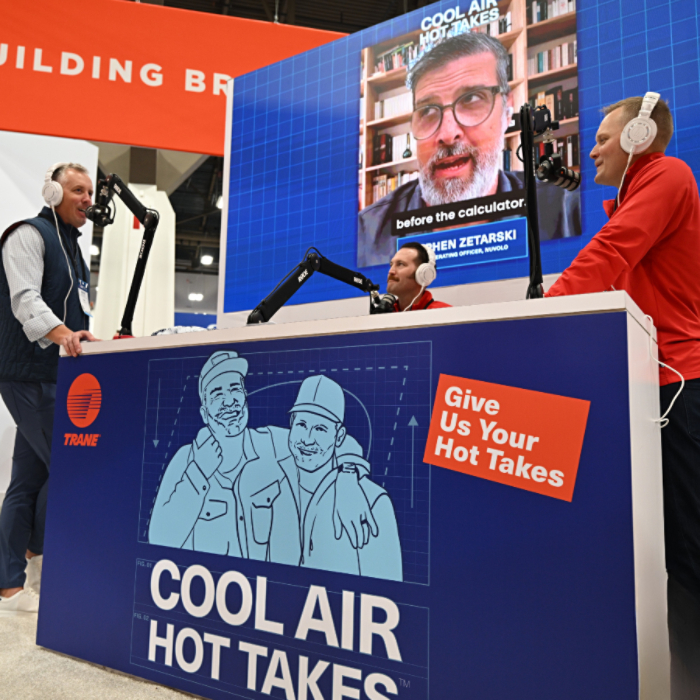
Charlie Jelen: So we are kicking off season four here, and we are fresh off the floor at a [00:01:00] HR. We were both there. The Cool Air Hot Takes Booth and the Cool Air, I'll call it the Cool Air, hot Takes Family was in, was in Full Forth. We had Bailey, Ainsley, Christie, we had the whole crew there,
Dan Gentry: gangs all there.
Charlie Jelen: That's right. And we had a great time. Thank you to everybody out there that stopped by the booth that gave us their hot take. That gave us some feedback, some criticism, some thoughts for the show. Thought it was all very good. We had a great time and one of the things that we're switching up this year for Cooler Hot Takes is we are trying to get out and meet the people.
So we're gonna do more conferences, more events, more face-to-face, and we're, we're excited about it.
Dan Gentry: Yeah, we've already done a couple already. It's still a, I'd say the beginning of the new year still. Uh, we had a HR, which was great. Charlie just said we're gonna talk more about that. Uh, we are at IDEA International District Energy Association over in Washington, DC a couple weeks ago, so we're already getting out and about.
Charlie Jelen: Where else we're gonna go? What else you got lined up?
Dan Gentry: We got some data center shows.
Charlie Jelen: Nice.
Dan Gentry: I head out to uh, [00:02:00] GTC.
Charlie Jelen: I'm gonna go there too. That was a total set of questions.
Dan Gentry: We're gonna go to gt.
Charlie Jelen: So there's a bunch of people like all over the AI space that are gonna head out there. If you're, if a fan of the show and you want to come say hi, stop over.
Otherwise we're gonna have a bunch of train technology stuff dedicated, the data center market there to see as well.
Dan Gentry: Don't miss it.
Charlie Jelen: That's right.
Dan Gentry: And we got, well, one more. We got D, CD too, right?
Charlie Jelen: D, CD. New York. Coming up in like the short next window here. There you go. And we'll keep you all updated on where else we're gonna be as the year progresses.
For the rest of the show, we're gonna talk a little bit about HR and what we saw. It's kind of fun starting off the new year with hr 'cause you get kind of a pulse for what people think. Mm-hmm. Is gonna be important for the rest of the year. You know, people bring a lot of equipment ideas, a lot of their new technologies and so we're gonna take a little time.
We're gonna go through some of our favorite interviews from the show, from the show floor. Uh, but before we do that, let's do, uh, instead of our hot takes, let's do hot takeaways.
Dan Gentry: Hot takeaway. Ooh, I like to think that. I
Charlie Jelen: like that. That was good. That was total [00:03:00] accident, but hot. Hot takeaways from hr. Top Hot takeaway.
Dan Gentry: I always look for equipment. I'm an equipment guy, so I'm always looking for,
Charlie Jelen: know heavy metal gentry,
Dan Gentry: every heavy metal, you know, I'm always looking for chillers and heat pumps. And, uh, there were several new chillers for data centers, new, uh, heat pumps. One thing that I noticed when it comes to equipment is everybody's got a CDU.
So like my observation, my takeaway was like. Everybody wants to make a CDU. Everybody's building the CDU. It's like, this is, I, I saw 'em all over. Yeah. I thought it was just really interesting.
Charlie Jelen: There's a bunch of 'em. So listener, you gotta explain. CDU. What does it stand for? What's it do?
Dan Gentry: It's a coolant distribution unit.
Yeah. And really what you, it really is just a heat exchanger. It's a box with a heat exchanger, some pumps, some controls, control valves. And, uh, that device really isolates the, say, call it the chilled water loop from the chillers. Isolates that loop to the loop that does the cooling for the chips or the computers, the [00:04:00] devices itself.
Um, so it, you know, just saying what it is, it's a heat exchanger with pumps. It's a pretty basic device. Um, what I didn't do is like poke around into all the specs of everybody. So I don't know if somebody's, you know, moving the cheese with their design, if you will, but like I did notice that c there's a, there's a CDU box and a ton of booths there.
So that's kind of one thing I noticed as a takeaway from the show.
Charlie Jelen: Yeah, I'll, I'll kind of tag onto your hot take with a little bit of a headline. Oh. Uh, in case you didn't see it out there, train did purchase Liquid Stack, which is a CDU manufacturer. So now that's, it's part of the family in case anybody out there is interested
Dan Gentry: growing family.
Charlie Jelen: Alright. My hot takeaway from HR was that I agree there was a ton of data center stuff. CDUs were very prevalent all over the spot from people I've never even heard of.
Dan Gentry: Yeah. Yep.
Charlie Jelen: But I was expecting that I was expecting a massive amount of data center stuff, because it's such a big part of the industry right now, and everybody wants to try to figure out how do they get in or what's their play in the space.[00:05:00]
What I was surprised to see is the amount of electrification stuff. I feel like electrification has been kind of playing a little bit of a lesser role lately, especially compared to the data center stuff. 'cause it's been exploding at such a high level.
Dan Gentry: That's a hot take so far like this.
Charlie Jelen: I wasn't expecting to have that much at the show and there was, there was way more than I was expecting.
Not just equipment, heat pumps being one of 'em, but people talking about energy efficiency as mm-hmm. As a big solution and having some of that call it blocking and tackling for that space.
Dan Gentry: Yeah. Yeah.
Charlie Jelen: So I thought that was interesting. That was my, that was one of my take. I was, that was the thing that surprised me the most.
Dan Gentry: To the heating stuff. What I think is interesting is we get so many folks asking us about like, Hey, with the administration and with the EPA and with all this stuff, like, is all this going away? Like, are we gonna, you know. Go back to 1 34 A. Mm-hmm. Are we gonna like, quit doing electrification? Is decarbonization just like a, [00:06:00] a thing of the past?
And it's like, no. I mean, I, I just, I don't see that because there's so much momentum already in the industry and so much desire from an end user perspective to do a lot of these things. Energy efficiency, like that's a basic thing. Who the heck doesn't want more efficient systems? So it like, I think it still like, makes a lot of sense to see that out there.
Even given like, maybe I'm gonna say like political perceptions. Mm-hmm. May think that does, that's gonna change. But I, I don't know. I, I mean, I get asked about electrification every day.
Charlie Jelen: Yeah, I think, yeah, two different, like I, I kind of compartmentalize, decarbonization into two sides, electrification and then emission reduction, which whatever you wanna call it.
You generally call it energy efficiency.
Dan Gentry: Yeah.
Charlie Jelen: I think electrification is hard to make business sense in a lot of cases. I think it's a really hard investment for most clients on the commercial side.
Dan Gentry: Yeah.
Charlie Jelen: Um, energy efficiency's, not that one's really straightforward. And with the amount of energy that's [00:07:00] getting allocated into new processes, whether it's industrial or data centers, energy efficiency is only going to have a bigger swing or a bigger lever in terms of its impact on a project.
Dan Gentry: Yeah. Like when you talk about a plant capacity that's tens, hundreds of thousands of tons, like mm-hmm. A few. Percentages. Yeah. Yeah. Equate different. That equates to some serious,
Charlie Jelen: I got asked for, we were working on a data center project, and I gotta asked for a PUE to the third digit. It's
Dan Gentry: like, yeah.
Charlie Jelen: Oh.
Like, okay, that's, here we go. That's all, that's a gigawatt scale.
Dan Gentry: That's, but it gets important when it get, when you get to that scale.
Charlie Jelen: Alright, listen, more of this banter to come here. We're gonna break down some of our favorite interviews from a HR from the floor that's coming up. Stay tuned.
Dan Gentry: Hey Charlie, what's small, mighty, and somehow makes freezing cold mornings. Feel kind of co.
Charlie Jelen: Buddy, uh, your, your heated mattress pads, eh, that's [00:08:00] close. The Thermo FITT Modular Air water heat Pump System from Trane. Ah, yes. Future ready. All electric hydronic comfort, even in tight spaces and even on the coldest days.
Oh, this thing is
Dan Gentry: expandable up to 12 modules per bank with multiple banks for maximum flexibility
Charlie Jelen: and with combined cop Ps up to eight plus advanced controls. It prioritizes heat recovery and efficiency like a champ. Head to train.com to learn more.
All right, listener, to help us facilitate this next segment. We're bringing in our brand new producer, Mel Webb. She's great. She's gonna be awesome for the show. We're super excited to have her with us. Um, so what we're gonna do here is we are going to break down some of the best interviews we had at the HR show floor.
So we were right in the middle of the train booth. It was really cool setup, front and
Dan Gentry: center.
Charlie Jelen: We had people coming through the whole time. We had a little podcast set up. We were interviewing 'em, asking 'em what they liked, what they didn't like, what some of their hot takes were. [00:09:00] So we're gonna play back some of those segments for you guys, and we're gonna break 'em down as we saw 'em.
Dan Gentry: And I have to say, just to give the teams kudos, the setup was sweet. We had a table set up. They had three microphones with headphones on booms. It was very, very professional.
Charlie Jelen: I agree. It was great. It was very cool. We were giving away t-shirts, so I can't wait to see some cooler hot Takes shirts just walking around out in the wild out and this would be great.
Alright, Mel, why don't you hit us up with the first clip here.
Mel: Alright guys, here we go. Let's take a trip back to HR 2026. First up, we've got Allison Clements.
Charlie Jelen: We are at a HR Live 2026 live, and we've got with us today a consulting engineer.
Allison Clements: Yep. Allison Clemmens from Madison, Wisconsin.
Dan Gentry: All right. Another Madison guest.
Allison Clements: I love
Dan Gentry: it.
Charlie Jelen: Yeah. Allison, what do you do?
Allison Clements: I'm a mechanical project engineer, so lots of commercial building design. Sustainable focus. Yeah.
Charlie Jelen: Very good. And the company you're with?
Allison Clements: Uh, design engineers.
Charlie Jelen: Alright. And now Allison was in the background here while we were recording the last one and, and we heard you had a hot take.
Allison Clements: Yeah,
Charlie Jelen: we heard you came prepared. [00:10:00] Yes. Seemed
Dan Gentry: pretty eager. We're excited.
Charlie Jelen: So what do you, what do you got for us
Allison Clements: on the manufacturing side, but especially on the design and specifying side, make sure you're talking to your contractors especially, but also you're building maintenance guys. My father-in-law does building maintenance and he's called me multiple times to ask about his systems and things that.
He doesn't know how they work in the last meeting. And so I left, didn't leave him any information. And so my take is that you can design the most sophisticated system, but remember that there's gonna be a human in 10 years that's gotta figure it out.
Charlie Jelen: I love that.
Dan Gentry: I I love that. I think that's a great one.
And I. I bring that up a lot of times in with. Mm-hmm. When we're talking with customers about this stuff, like, you know, can we do this? Can we do that? Can we add that? And kind of what I say a lot is, you can do whatever you want. Mm-hmm. You can add a level of complexity to achieve that, but when you're adding complexity, you have to think about the operation as well.
Yeah. 'cause somebody has to understand how that works and they have to run it.
Allison Clements: Exactly.
Dan Gentry: And you may be doing a disservice too. Customers that aren't [00:11:00] prepared for that.
Allison Clements: And I think especially in the sustainability world, that's a super easy pitfall to fall into because there's some really great and innovative sustainability strategies.
Charlie Jelen: Yeah.
Allison Clements: But you also gotta make sure that you're balancing that with, okay, in the long term, how's this gonna operate? How's this gonna get maintained? And make sure that you don't have a system that needs major Retrocommissioning in 10 years because they don't know how to use it.
Dan Gentry: Yes. This is spot on. So to her point exactly, is thinking about the operators.
I talk about this all the time. When we're getting questions about new systems, it's like, okay. What's the building? What does the maintenance staff look like? Yeah. Like is this a school and they don't have like a trained engineer on site that's looking at all this stuff. There's, you know, minimal, just think of building maintenance kind of stuff.
Changing filters and belts and simple stuff like that. Or do you have, you know, like operating engineers trained on staff that are trained on more complex systems that, that are built, trained, [00:12:00] suited for that. Yeah. And I think it's a, it's, it's a great, it's a great point.
Charlie Jelen: Who were you just talking about?
That I think was the design engineer on a really complicated project and then stuck with it to get the thing running for years.
Dan Gentry: Yes. Yeah.
And
Charlie Jelen: we can bleep the name out later. But
Dan Gentry: yeah, that was a project, uh, at a hospital up in
Charlie Jelen: All
Dan Gentry: right. It was super cool. 'cause like I've been working with him for like years on this job now.
Right. And he's helping. Design it and now he's has complete operational understanding mm-hmm. Of the plant. And it's like, it's a beautiful thing. Mm-hmm. It's a very complex Yeah. Plant, but like he stayed with it. He's there running it now. Yeah. Like, that's not always how it goes.
Speaker 4: I'm pretty sure you guys are gonna know this one straight away.
Let's give it up for Ray Riling.
Ray Reiling: My name's Ray. I'm from Trade Water. We are a carbon offset project developer that focuses on the destruction of ozone depleting substances. So for the most part, that's end of life, refrigerants, CFCs, and [00:13:00] H CFCs. We work with some other substances, but that's our main thing.
Charlie Jelen: Where are you finding success?
Ray Reiling: A lot of places you would be amazed at how many people have CFCs out in their shed. We buy refrigerant, 30 pounds, 50 pounds at a time from just regular folks who have it in their shed, in their garage. Maybe they use to charge up their classic car or something like that. So we buy a lot of refrigerant that way.
Charlie and I do some very interesting work with end of life refrigerant coming out of HVAC replacements, uh, for large corporations. So there's a lot of corporations out there that are phasing out R 22. So every time an R 22 chiller is taken offline, R 22 comes outta that. So we also work with large corporates as they're decommissioning HVAC assets to collect the end of life refrigerant programmatically in that way.
Charlie Jelen: Yep. So what do you want the listener to know?
Ray Reiling: I want the listener to know that there is refrigerant everywhere around them in their air conditioner, at home, in their refrigerator, in their air conditioner, at work. Pretty much anywhere you could think and very few people take responsibility for it, right?
It doesn't end of life. Refrigerant exists outside of the greenhouse [00:14:00] gas accounting value chain. It's not considered part of scope one, two, or three end of life refrigerant that you pull out and sell. Mm-hmm. Most people, unless you. Or listening to this podcast, uh, aren't really thinking about end of life refrigerant.
So I would encourage your listeners to wherever they are, think about what is happening to the refrigerant and make sure it's being disposed of responsibly. Yeah. God forbid it's not being vented. At the very least, it's being reclaimed and reused. But I'd really encourage everyone to consider destroying their refrigerant at end of life.
And you can work with trade water to do that.
Dan Gentry: There you go. You heard
Charlie Jelen: it here. I love it. I love it. Thanks for jumping on today.
Ray Reiling: It's nice to talk to other people who know about it too.
Charlie Jelen: Well,
Ray Reiling: my friends and family are like, oh my gosh, shut up.
Dan Gentry: Hey, welcome to the club. Welcome to the Club.
Charlie Jelen: That's, that was, that was a great line.
So that was Mr. Ray Riling from Trade Water. Do you remember? He was, was he season one?
Dan Gentry: I think so.
Charlie Jelen: I think so. Ray was a season one guest. We, we had him on for a, a pretty deep interview. Uh, trade water does refrigerant destruction. One of the few companies out there that does it, they, they destroy refrigerant to [00:15:00] create certified carbon offsets.
So they're out there kind of scrounging around looking for the, the highest global warming potential refrigerants, the one that have, you know, the most impact on, on ozone and global warming. So they're out there trying to find these refrigerants and then they destroy 'em to, to create offsets for the people that are looking for 'em.
Dan Gentry: It's an interesting business. Like I get it makes sense. I just don't get asked about it much.
Charlie Jelen: Yeah.
Dan Gentry: I'm not gonna be know a guy if we do get asked about it. So it's good to, good to know.
Charlie Jelen: Yeah.
Dan Gentry: And uh, you know, maybe things will change more and it'll become a larger thing, but, uh,
Charlie Jelen: yeah, I see it more, I see it more at like a, a corporate level.
Dan Gentry: Yeah.
Charlie Jelen: Sustainability managers at large corporations that are looking to
Dan Gentry: universities.
Charlie Jelen: Yeah, maybe universities too. The clients we've worked with, a few clients with trade water on a program for them to recycle refrigerant or destroy refrigerant at the, at the end of life. So if we're taking out a piece of equipment, replacing it with next generation refrigerants, what do we do with this old piece of [00:16:00] equipment that has high GWP material in it?
While you can work with a company like Trade Water to do something with that refrigerant and actually have a gain on the back end in terms of. Like the offsets.
Dan Gentry: Yeah. Like if that's your situation, it makes a ton of sense.
Charlie Jelen: Yeah. If you're into it, like, again, like the carbon offset market isn't crazy mature and, and you don't see a lot of like just everyday Yep.
Players or smaller players like dealing in that yet. So, yeah, no, it's, it's very, very interesting company and what they do. Uh, so if you're interested in refrigerant destruction, check 'em out. You can go back and listen to season one. Listen to Ray and, and the interview we had with him. Uh, but the company that he works for is called Trade Water.
Dan Gentry: Hey. Hey, Charlie.
Charlie Jelen: What's up dude?
Dan Gentry: Uh, you remember engineers newsletters from trade?
Charlie Jelen: Ooh, yeah. Very, very good. What do you got? Well,
Dan Gentry: let me remind you of the ultimate resource for HVAC engineers. Engineers newsletters offer self-paced learning on topics like acoustics, [00:17:00] water piping, ashray standards, and sustainable systems.
Charlie Jelen: These are some of the best, and it's not just reading material, is it?
Dan Gentry: Oh, it's not just reading material. It gets better. They also have in-depth 60 minute engineers newsletter live video programs available on demand. And guess what? They're free and offer continuing education credits on hot trends like expert guidance on electrified heating systems.
Charlie Jelen: Oh, that's great. How did we get ahold of these?
Dan Gentry: Just join over 40,000 professionals who rely on engineers newsletters.
Charlie Jelen: I tell you what, that enthusiasm right there for ENLs. I'm gonna go, I'm gonna go check those out,
Dan Gentry: subscribe now at tra.com/en.
Mel: You guys seem to have a lot of fun with these two guests.
Next up, we've got David and Conrad Bishop.
David Bishop: Hi, I'm David Bishop. I live in Milwaukee, Wisconsin. I'm a partner in Twin Bishop Strategies. We're a business management consulting firm that focuses on helping field service companies grow [00:18:00] profitably. Love it. And my partner and twin brother, thus the twin Bishop strategist name is Conrad.
Let him introduce himself.
Conrad Bishop: Yes. I'm Conrad Bishop, and I joined my brother after I retired from Trane in 2023. And, uh. What he does is much different than what I did. I was more on the system side because I was in the commercial sales office. Yeah,
Charlie Jelen: yeah.
Conrad Bishop: As a sales, uh, account manager as well.
Charlie Jelen: Yep.
Conrad Bishop: And now today I help David out, but I also help train out in the sustainable systems group.
Charlie Jelen: I love it. And yeah, we have a whole section of the booth here at Trane on the floor dedicated to sustainable systems and the work that you guys are doing. So let's, first, biggest question, I know our listeners are dying to know who's older.
David Bishop: Well, I'm the younger one. He's 12 minutes older. I'm 12 minutes older.
Charlie Jelen: 12 minutes older. That's wild. Yeah. 12 minutes smarter too. You got 12, you got 12 minutes of experience on him.
David Bishop: I sure do. I sure do. And he, he boasts about that quite a bit too.
Charlie Jelen: Alright. Alright. So do, have you guys been at the show for the last two [00:19:00] days?
David Bishop: We have.
Charlie Jelen: Walking around.
David Bishop: Oh yeah,
Charlie Jelen: walking around. Train booth, other people's booth.
What stands out?
David Bishop: So two things that jump out at you is electrification of heat and data centers.
Charlie Jelen: Yeah.
David Bishop: And it's probably the two. I'd say it was the two technologies that I wanted to understand better.
Charlie Jelen: Yeah.
David Bishop: And so it's, it's almost, almost every booth has got some tie to, yeah. To one of those two things.
Charlie Jelen: What, what'd you learn? What'd you learn about either one of those this last two days?
David Bishop: I look at it from a service standpoint. Yeah. Yeah. Okay. How, how is the service industry gonna change as a result of all this? And I think that what I've learned is there's a tremendous amount of training that's needed for technicians.
Ray Reiling: Mm-hmm.
David Bishop: I think there's gonna be, uh, different ways of providing service. Just the mass size. Absolutely. Some of these systems, especially data centers.
Ray Reiling: Yeah.
David Bishop: If you look at the number of motors and systems that are gonna have to be maintained. Um, it's mind boggling. Yeah. Uh, we, you know, we're not only increasing our demand on the, on the grid mm-hmm.
We're increasing the demand on technicians.
Charlie Jelen: Yeah.
David Bishop: Uh, drastically through that.
Charlie Jelen: The amount of [00:20:00] digital service that's gonna be required over the next 10 years, it has to, has to increase. It
David Bishop: has to.
Charlie Jelen: Yeah.
David Bishop: There's no way we can in our industry, you know? Train, develop and deploy that many technicians to deal with that much growth.
So yeah, we're gonna have to work smarter as well as, uh, you know, work harder. Yeah. You have to be the combination of the two.
Charlie Jelen: Absolutely.
David Bishop: Yeah.
Dan Gentry: That's another good one.
Charlie Jelen: Smarter and harder. I tell you what, the, the Bishop brothers were, were fun to talk to.
Dan Gentry: Well, and one thing I didn't, I did not know there were, I've worked with Conrad.
For like a long time.
Charlie Jelen: Yeah.
Dan Gentry: They had no idea. Like they walked up and I was like, whoa,
Charlie Jelen: you didn't know there was a better looking bishop. I did know
Dan Gentry: there was a better looking bishop.
Charlie Jelen: Just kidding. Con Justin, what they're talking about is spot on and, and there's a lot of people in the industry that. You are taking notice of this and there's a lot of companies, including Trane, that are trying to get ahead of it and trying to, to shore that up.
Being able to service the amount of equipment that's going out into the field, not even [00:21:00] talking about the new. Things that we're doing inside some of these applications. Like for example, CDUs, CDUs weren't a thing five years ago. Yeah. You know, like,
Dan Gentry: yeah.
Charlie Jelen: So now training people on these new things, and then on the other side of the CDUs is billions and billions of dollars of, of chips and racks and equip equipment.
It's pretty important. Right? And so it's not just like going and working on, on a regular old chilled water loop. It's something different. And technicians are great. They're gonna be able to handle it. The scale that this stuff is going in at is, is unprecedented and we need to be able to adapt with it.
And you know, they said work harder and smarter. It's gonna have to get a lot smarter a a lot faster.
Dan Gentry: Well, I think your comment in there about the, like digital services and connected digital and all that kind of stuff is the, is gonna be the key enabler. To get us to that point.
Charlie Jelen: Absolutely.
Dan Gentry: Where we can do that.
Man, this gives me a, this gives me an idea for a Dan in the factory. I really need to go over to our training center and interview one of those guys over there. [00:22:00] I think that would be
Charlie Jelen: one of the, one of the technician trainers.
Dan Gentry: Yeah. Yeah. I mean, 'cause this is a huge thing. I, you we're into this too, and, um, training is a huge thing that's, uh, maybe a future segment.
Charlie Jelen: Yeah, for sure. What do we got next? Mel?
Mel: Last but certainly not least, we've got Spencer Engleton from Darcy.
Spencer Ingaldson: I am Spencer Engelson. I'm the Chief Development Officer at, uh, Darcy Solutions. And we are, we have launched, uh, uh, an innovative groundwater enabled geothermal technology, uh, and our pushing, uh, groundwater enabled geothermal technologies into the market so we can expand the.
The footprint and uh, where we can take geothermal. We say we wanna take geothermal everywhere.
Dan Gentry: Alright, what does groundwater enabled mean?
Spencer Ingaldson: Yeah, great question. So, uh, historically, uh. Geothermal systems at large have been conduction based, so we think of traditional geothermal as horizontal or vertical bores.
Charlie Jelen: Yep.
Spencer Ingaldson: Closed loops, grouted into the ground and doing conductive based thermal transfer with the surrounding substrata dirt and rock.
Charlie Jelen: So this is like [00:23:00] basically every thermal storage project that people think of today. When
Dan Gentry: you think
Spencer Ingaldson: of geo,
Charlie Jelen: when you think of geothermal, it's 400 feet, maybe more, maybe a little less.
Spencer Ingaldson: Yep.
Charlie Jelen: And, and there's massive acres of, of land for hundreds of tons of heat transfer.
Spencer Ingaldson: Yeah. You'd say you, you hit the nail on the head 400 feet gives you about two or two and a half tons in a vertical grouted U loop.
Charlie Jelen: Yep.
Spencer Ingaldson: Uh, you're gonna place those wells 15 or 20 feet on center typically. And so to get, to get to 200 tons, let's say you need about a half acre of land space.
And that's what we can deliver from a capacity standpoint with one. Single 12 and 12. Whoa. About 225 to 250 cooling tons today. Yep. And about a thousand to 1200 MBH of heat and all of that's, uh, pre-heat of compression. So,
Charlie Jelen: yeah.
Dan Gentry: Wow. So that's a big deal.
Charlie Jelen: So give us a little bit of the rundown of the technology.
So what are we actually doing underground that's different from the current technology today?
Spencer Ingaldson: We're a geology company first. So Hydrogeologists and biophysicists make up a large portion of our staff, and their expertise lies in [00:24:00] understanding groundwater systems at your building site. And how we might leverage what's there in the geology to deliver thermal capacity to buildings.
So we're gonna design and construct these groundwater enabled systems, and our core solution is drilling municipal grade water wells, installing Darcy's proprietary heat exchanger, and positioning it in the right spot in those wells so that we can get. Thermal separation between where we draw open loop aquifer water across the heat exchanger, and on the other side we have a closed loop that does heat transfer and takes that thermal energy back to a building.
So the expertise is really innovative hardware. Hydrogeologic expertise and an end-to-end delivered solution, including all the construction, permitting, controls, everything.
Charlie Jelen: Wow. So, uh, Mr. Ingles, we, we've both known Spencer for, for a number of years. Wow. And Darcy's out of University of Minnesota, my alma mater.
Dan Gentry: Yeah.
Charlie Jelen: That's what they spun out of
Dan Gentry: go the golfers.
Charlie Jelen: Yeah. And, uh, you know. Spencer used a couple of, uh, big words there, but this technology has a lot behind it. Uh, I am a big [00:25:00] fan of this. I am a proponent of the technology in general, so he keeps saying groundwater enabled. Mm-hmm. Um, Darcy has a, a few different solutions, but the core one that he's talking about is one that I, I think has potential, especially in heat pump solutions, where you're both extracting and rejecting BTUs to the same heat exchanger.
But a lot of people when they hear this, they think geothermal in one of two ways. One is traditional geothermal where you have a closed loop system where you're just using radiative forces, you know, like it's just a tube in the ground. Send hot water down, pretty
Dan Gentry: simple
Charlie Jelen: cold water back, or vice versa.
The other system is people just generally call it pump and dump, where you pull groundwater up, run it through a heat exchanger, and then dump it down the drain. This does not do either of those. It's, it's a bit of a combination. So you, you drop a heat exchanger down into the water table and there's multiple layers that you can get to, and I've learned this from, from that team over there.
Uh,
Dan Gentry: interesting.
Charlie Jelen: So you could go 400 [00:26:00] feet, hit water, you can go 600 feet, you can go 800 feet. There might be water all the way down, different temperatures, different pockets, but the geology behind it, they're working to get it into the right layer. Like the most consistent layer, but you have a heat exchanger down there and there's a pump in that heat exchanger, and you're pulling that water across the heat exchanger.
You're not pulling the groundwater up, and so you have a closed loop from the building down to the heat exchanger and then back up so the groundwater stays in the ground. You're just exchanging the BTUs in that heat exchanger. So I think it, it gets ar it gets around a lot of the, the environmental side of, of how people kind of view that, where, you know, you're bringing fresh groundwater up and then just dumping it somewhere.
Dan Gentry: Well, and the downside then to that is with the, with the, call it the pump and dump.
Charlie Jelen: Yep.
Dan Gentry: You have to pay sewer.
Charlie Jelen: Yeah. Yeah.
Dan Gentry: But this like bipa, this, this is not that.
Charlie Jelen: This is not that at at all. Right? The groundwater stays in the ground. It's just moving through a heat exchanger. And so I
Dan Gentry: think it's super cool and like [00:27:00] the, the capacity you get per well is the exciting part.
Charlie Jelen: Yeah. It's, it's crazy, right? So like, if you traditionally would get, you know, one to two tons for every 400 foot, well, in a traditional geothermal system, they're talking about 50, a hundred tons, even 150, 200 tons. It's
Dan Gentry: crazy.
Charlie Jelen: In one. Well, and so you, you don't need this, you know, acres of land in order to do geothermal.
Dan Gentry: It seems like such a enabler. From a geothermal perspective,
Charlie Jelen: it really does open up a lot of opportunity, uh, for, for geothermal where you otherwise wouldn't think about using it. Yep. Whether it's just downsizing a massive field or putting it into a smaller application, maybe a a hundred ton building where you never would've thought about using geothermal, now you have an opportunity to do it.
Dan Gentry: Yeah. Yeah. We have, um, here in town one of the hospitals is, has one of these. You got it Systems.
Charlie Jelen: Yep.
Dan Gentry: And it's pretty cool you drive by. I, I, because I'm a nerd. I like to tell people when you drive by and you see the little stubs with the green caps sticking outta the ground. Yeah. Like, that's their geothermal [00:28:00] system right there.
Charlie Jelen: That's right.
Dan Gentry: Really? Oh, well that's cool. Yeah, I know.
Charlie Jelen: It's a unique system. So if you're out there and, and you're interested in, in geothermal systems, reach out to Spencer Darcy Solutions. They do a good job at it.
All right, listener, we could keep going. How many hours do you think we had into that?
Dan Gentry: Oh man. I, I, I hear we have over two hours of, of interviews to go through, so I think, um, yeah, we got, uh, we've probably got some more work to do on, uh,
Charlie Jelen: yeah,
Dan Gentry: talking through these.
Charlie Jelen: Yeah, we, we have a ton. Those are some of the ones that stood out.
There were plenty more, and so throughout the season we'll try to bring some of those in. We'll, we'll, we'll sprinkle 'em in as we go through the season.
Dan Gentry: And thank you everybody for stopping by. That was great. We had a, we had a great time. And I, I love that.
Charlie Jelen: Absolutely.
Thanks for listening to this episode of Cool Air Hot Takes. We're very happy to be back for season four. Remember, new episodes are released every two weeks [00:29:00] on Tuesdays. Leave us a comment on Spotify or YouTube or leave us a review on Apple.
Dan Gentry: If we've got merch, send us your hot takes to Cool air.hot takes@trane.com.
If we featured on the show, you might find some of that merch in your mailbox. Until next time, stay cool and keep those takes hot.