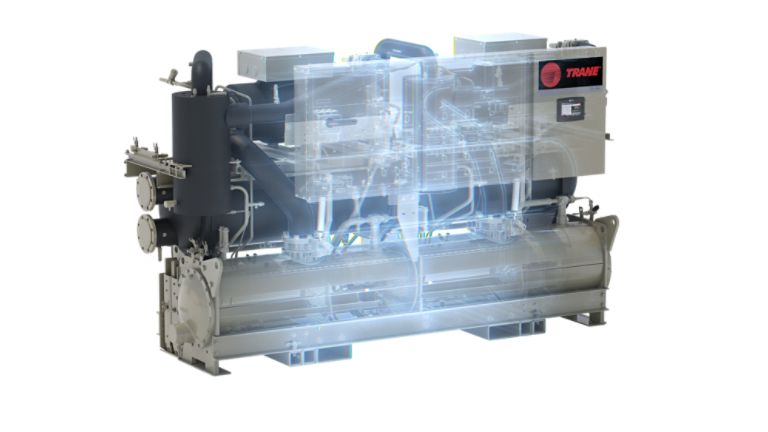
What Does an HVAC Compressor Do?
The purpose of the compressor in a refrigeration system is to raise the pressure of the refrigerant vapor from evaporator pressure to condensing pressure. It delivers the refrigerant vapor to the condenser at a pressure and temperature at which the condensing process can be readily accomplished, at the temperature of the air or other fluid used for condensing. It is one of the primary energy consuming components in an HVAC system.
How Does a Compressor Work in HVAC?
The compressor is a key component in the refrigeration cycle, which is used in the process of moving heat from inside a building to the outside. Here's a breakdown of its role:
- The compressor takes low‑pressure, low‑temperature refrigerant vapor from the evaporator and compresses it into a high‑pressure, high‑temperature vapor.
- This high‑pressure, high-temperature vapor flows to the condenser, where it rejects heat and condenses to liquid. The liquid refrigerant flows through an expansion device then into the evaporator—completing the refrigeration cycle.
- By creating the required pressure difference between evaporator and condenser, the compressor enables continuous refrigerant flow and heat transfer, which is the fundamental process used in cooling and heat pump systems.
Types of HVAC Compressors
There are several types of compressors used in commercial HVAC systems, each with its own working principles and ideal applications.
- Scroll Compressors utilize two spiral-shaped scrolls to compress the refrigerant. One scroll is stationary, while the other orbits around it, trapping and compressing pockets of refrigerant gas.
- How it Works: The orbiting motion creates progressively smaller pockets, increasing the pressure of the refrigerant gas as it moves toward the center of the scrolls.
- Applications: Widely used in modern residential, light commercial unitary, and small chillers due to their high efficiency, and reliability.
- Screw Compressors, also known as helical rotary compressors, use two interlocking helical rotors, often referred to as screws, to compress the refrigerant. They are known for their ability to handle large volumes of refrigerant and are common in larger commercial and industrial applications.
- How it Works: As the screws rotate, they trap refrigerant gas in the space between their threads. The volume of this space decreases as the gas moves along the rotors, resulting in compression.
- Applications: Often used in large-scale applications such as chillers for large buildings and industrial processes.
- Centrifugal Compressors use a rotating impeller to increase the velocity of the refrigerant. This high-velocity gas is then slowed down in a diffuser, which converts the kinetic energy into pressure. These are typically used in very large commercial and industrial HVAC systems.
- How it Works: The impeller spins at a high speed, flinging the refrigerant gas outward by centrifugal force, which increases pressure.
- Applications: Often used in large-scale applications such as chillers for large buildings and industrial processes.
Regular Compressor Maintenance Is Essential
Without the compressor, your HVAC system wouldn't be able to regulate temperatures effectively because it acts like the heart of the system, pumping refrigerant in a continuous loop, ensuring consistent climate control. To ensure smooth and efficient operation, it's important to keep a regular maintenance schedule with a qualified HVAC technician that includes the following tasks:
- Routine checks: Inspect the suction/discharge pressures and temperatures, oil level/quality, motor amps, vibration and refrigerant charge.
- Oil management: Check oil for contamination (acid, moisture), change filters and separators per schedule.
- Leak detection: Refrigerant leaks reduce capacity and harm the environment; detect and repair promptly.
- Filter/drier and suction strainer replacement: Keep contaminants out of compressor internals.
- Electrical checks: Inspect motor starters, contactors, wiring and controls.
- Compressor-specific checks: Inspect the crankcase heater operation (for some types), belt tension (belt-driven), valve condition (reciprocating) and impeller clearances/shaft seals (centrifugal).
- Recordkeeping: Track run hours, starts, maintenance events, refrigerant usage and alarms.
If you are concerned that your HVAC system's compressor is malfunctioning or you are considering updates to your system, reach out to your local Trane representative to discuss your options.