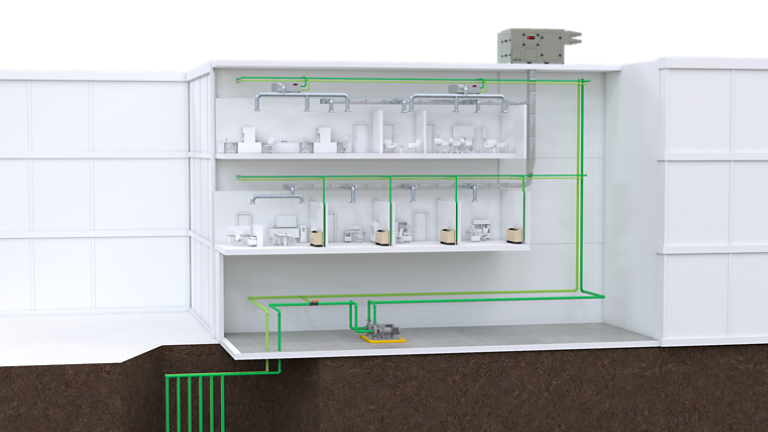
Water-source heat pump (WSHP) and ground-source heat pump (GSHP) systems are used to provide comfort in a wide range of building types and climates. As energy efficiency and decarbonization become priorities across many industries, interest in WSHP and GSHP systems continues to grow. Our revised application manual offers updated guidance for engineers and designers of water-source and ground-source heat pump systems, including modern electrification strategies.
How WSHP and GSHP Systems Work
In a typical WSHP or GSHP system, each zone is served by a dedicated heat pump that cools or heats air to maintain the desired temperature in that zone. Each heat pump contains all the components of a refrigeration circuit, including:
- one or more compressors
- a refrigerant-to-air heat exchanger
- a refrigerant-to-water heat exchanger
- an expansion device
- a reversing valve that allows it to reverse the direction of refrigerant flow and change the operation of the refrigeration circuit to provide either cooling or heating
All the heat pumps are connected to a common water distribution loop, which also contains a “heat rejecter” (such as a cooling tower, fluid cooler, or ground heat exchanger), a “heat adder” (such as a hot-water boiler or ground heat exchanger), and water-circulating pumps. Outdoor air required for ventilation is typically conditioned and delivered by a separate, dedicated outdoor-air system (DOAS).
WSHP and GSHP System Benefits
WSHP systems offer significant opportunities to improve the energy efficiency of a building and can help reduce the carbon footprint of a building, often referred to as decarbonization. In addition to the heat pumps using electricity for heating, the system can be designed to further reduce on-site fossil fuel use by:
- adding a ground heat exchanger to eliminate the need for a boiler altogether;
- using an air-to-water heat pump in place of both the cooling tower and boiler;
- or employing an electric boiler or electric resistance heat.
To encourage the proper design and application of these systems, our updated Water-Source and Ground-Source Heat Pump Systems application manual discusses the advantages and drawbacks of these systems, reviews the various components that make up each system, proposes solutions to common design challenges, explores several system variations (including boiler/tower, ground-coupled, ground-water, and surface-water systems), and discusses system-level control.
This newly-revised version also contains a new section on “electrified” WSHP systems, which reduce both on-site carbon emissions and on-site water use.
Download the Water-Source and Ground-Source Heat Pump Systems application manual (SYS-APM010D-EN) today.