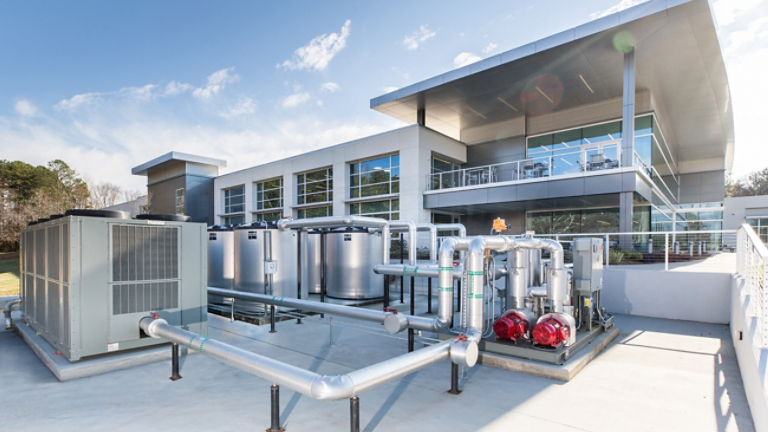
What is thermal management?
Thermal management refers to the strategies and technologies used to control temperature and heat flow within a system or space. In the context of HVAC, this involves using cooling and heating systems to transfer excess heat or provide warmth, maintaining stable environmental conditions that support equipment reliability and human comfort.
HVAC thermal management systems work by removing heat from spaces that are too warm and distributing it elsewhere, or by adding heat where needed. Air conditioning units extract heat from indoor air and release it outside, into thermal storage or into the ground, while heat pump systems do the reverse. Modern thermal management solutions, like VRF systems and heat pump chiller systems, can simultaneously heat and cool different zones, delivering significantly higher efficiency than traditional systems.
Thermal management systems prevent overheating or overcooling, which can lead to equipment malfunctions, occupant discomfort, and increased energy costs. Proper thermal management also involves strategic airflow control to ensure even temperature distribution throughout a building.
Innovative Thermal Management Technologies
The concept of thermal management is not new, but the process has improved with each generation. With recent advances in low global warming potential (GWP) refrigerants, more energy-efficient equipment, and artificial intelligence (AI), controlling the temperature and humidity of a facility can help achieve an organization's sustainability goals while reducing energy costs.
Here are just a few examples of Trane's innovative technologies:
- Liquid cooling for data centers with our Coolant Distribution Units
- Trane and Mitsubishi Electric HVRF, which exchanges heat between refrigerant and water, reducing the use of refrigerant while operating more efficiently.
- The Fan Coil Wall for data centers provides flexibility and scalability for a growing industry.
- The AI-powered ARIA is a virtual building agent that enables facilities teams to leverage building data for streamlined operations, faster decisions, and optimal performance.
- Thermal battery storage systems improve cooling and heating flexibility by storing energy to lower utility bills and increase sustainability.
Resources for Thermal Management:
Thermal management influences the entire building ecosystem. It affects equipment performance, occupant comfort, and productivity. In mission-critical facilities like data centers or manufacturing plants, thermal management is essential for preventing operational failures and maintaining business continuity.
Contact your local Trane representative and ask how Trane's innovations can contribute to your organization's comfort, productivity, and sustainability.