What Is a Load Bank?
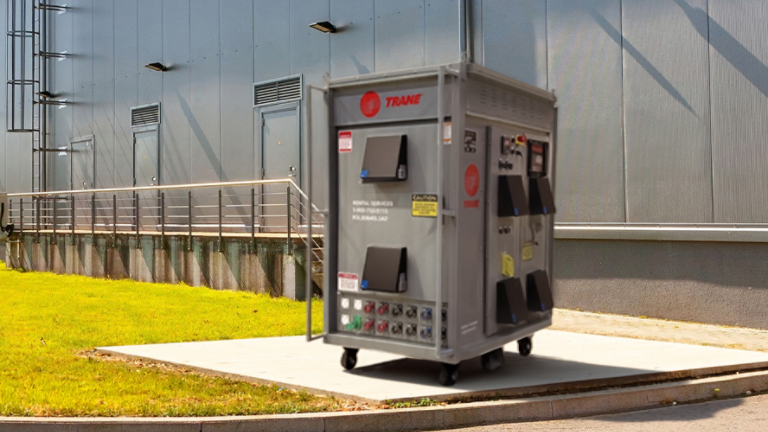
A load bank is a testing device designed to simulate the electrical and thermal load of operating equipment, such as servers and racks in data centers. Using a load bank allows the data center project, commissioning, operations, and facilities team to test cooling systems, generators, and other critical infrastructure under controlled conditions before they are placed into active service.
For hyperscale and colocation operators, load banks help validate cooling and electrical readiness before live IT is deployed. By creating controlled test conditions that reflect AI, high-performance computing (HPC), and other high-density workloads, load banks help teams verify system readiness, reduce commissioning risk, protect project schedules, and support faster, more confident capacity turn-up.
How Does a Load Bank Work?
A load bank applies a controlled electrical load and converts that energy into heat. That heat creates a simulated operating condition, allowing connected systems, such as cooling equipment, electrical infrastructure, or generator systems, to respond as they would during normal operation.
For example, in a data center or high-performance computing environment, a load bank can help teams validate performance before server installation, before customer move-in, or ahead of introducing new high-density workloads. This can help project teams observe system behavior, verify cooling performance, and identify potential issues before the facility supports critical applications.
What Is Load Bank Testing?
In data centers, load bank testing is the process of using a load bank to verify that cooling and electrical systems perform as designed under simulated operating conditions.
Load bank testing can help support:
- Commissioning of new systems, including phased capacity deployments.
- Start-up before critical equipment is placed into service.
- Integrated system testing across cooling and electrical infrastructure before occupancy.
- Maintenance validation after repairs or system modifications.
- Validation of liquid cooling and hybrid thermal strategies in high-density rack environments.
- System readiness checks ahead of colocation customer turnover or hyperscale campus expansion.
Testing is commonly performed during initial commissioning, after major system modifications or repairs, and as part of preventive maintenance programs to help verify ongoing system performance. In a typical load bank testing process, teams may:
- Connect the load bank to the system being tested.
- Apply load in controlled steps.
- Monitor electrical, flow, pressure, and temperature conditions.
- Observe how connected cooling or power systems respond.
- Make adjustments before the system supports live operations.
Why Load Bank Testing Matters
For data center operators, the benefits of load bank testing are largely operational. Finding a problem under simulated load is far less disruptive than finding it after live IT is running. Load bank testing can help teams:
- Reduce commissioning risk by confirming that cooling and electrical systems perform as designed.
- Identify issues earlier, while they are simpler and less costly to correct.
- Reduce rework late in construction or after turnover.
- Validate capacity before occupancy, so each phase is ready for its planned load.
- Compress time to readiness and support predictable turnover to tenants or internal IT teams.
Types of Load Banks
Load banks can be grouped in different ways depending on how they create and manage load. Common categories include:
- Resistive load banks: A resistive load bank applies an electrical load and converts that energy into heat. This type is commonly used when the goal is to simulate real power demand and observe how equipment performs under controlled load conditions.
- Reactive load banks: A reactive load bank simulates loads that include inductive or capacitive characteristics. These may be used when a test requires evaluation of both real and reactive power behavior.
- Combined load banks: A combined load bank can include both resistive and reactive elements. This type may be used when testing requires a more complete simulation of electrical operating conditions.
- Air-cooled load banks: An air-cooled load bank rejects heat to the surrounding air. These units may be used where sufficient airflow and space are available for heat dissipation.
- Liquid-cooled load banks: A liquid-cooled load bank uses a liquid loop to absorb and remove heat generated during testing. Trane offers liquid-cooled load bank rentals designed to simulate real-world cooling and electrical demands in data centers and high-performance computing environments. These units can support data center commissioning, integrated system testing, new construction, facility expansions, and equipment upgrades. Because they remove heat through a liquid loop, liquid-cooled load banks are well suited to testing liquid cooling systems built for AI and HPC workloads.
Common Load Bank Applications
Load banks can be used in a variety of commercial and mission-critical applications where system performance needs to be verified before normal operation.
Common applications include:
- Data center commissioning: Simulate IT loads before servers or racks are fully installed or operating.
- AI and high-performance computing environments: Test cooling and electrical systems that may support high-density racks and heat-intensive workloads.
- Integrated system testing: Observe how cooling, electrical, controls, and supporting systems work together under simulated load.
- New construction: Verify system performance before a facility is turned over or placed into operation.
- Facility expansions: Test new or modified systems before they support additional load.
- Equipment upgrades: Validate performance after cooling or electrical infrastructure changes.
- Planned maintenance: Support performance checks after repairs, modifications, or preventive maintenance activities.
- Temporary testing needs: Provide a controllable load source without relying on permanent equipment to create demand.