Skip to content
Select Your Language

Selecting a language changes the language and content on the Trane site.

  • United States English
  • Canada English French
  • Argentina Spanish
  • Mexico Spanish
  • Brazil Portuguese
  • Aruba English
  • Bahamas English
  • Belize English
  • Bermuda English
  • Bolivia Spanish
  • Bonaire English
  • Chile Spanish
  • Colombia Spanish
  • Costa Rica Spanish
  • Dominican Republic Spanish
  • Ecuador Spanish
  • El Salvador Spanish
  • Grenada English
  • Guadeloupe English
  • Guatemala Spanish
  • Guyana English
  • Haiti English
  • Jamaica English
  • Martinique English
  • Netherland Antilles English
  • Nicaragua Spanish
  • Panama Spanish
  • Paraguay Spanish
  • Peru Spanish
  • Puerto Rico Spanish
  • Saint Lucia English
  • St. Vincent & Grenadines English
  • Suriname English
  • Trinidad & Tobago English
  • Venezuela Spanish
  • Armenia English
  • Austria German
  • Azerbaijan English
  • Belgium French Dutch English
  • Croatia Croatian
  • Czech Republic Czech
  • Denmark English
  • Estonia English
  • Finland English
  • France French
  • Georgia English
  • Germany German
  • Greece Greek
  • Hungary Hungarian
  • Israel English Hebrew
  • Ireland English
  • Italy Italian
  • Kazakhstan English
  • Kyrgyzstan Russian
  • Latvia English
  • Lithuania English
  • Luxembourg French German
  • The Netherlands Dutch
  • Norway English
  • Poland Polish
  • Portugal Portuguese
  • Romania Romanian
  • Serbia English
  • Slovakia Czech
  • Slovenia English
  • Spain Spanish
  • Sweden Swedish
  • Switzerland French German Italian
  • Turkey Turkish
  • Ukraine English
  • United Kingdom English
  • Tajikistan Russian
  • Turkmenistan Russian
  • Uzbekistan Russian
  • United Arab Emirates English
  • Qatar English
  • Kuwait English
  • Egypt English
  • Lebanon English
  • China Simplified Chinese English
  • Korea, Republic of (South Korea) Korean English
  • Vietnam Vietnamese English
  • India English
  • Australia English
  • Japan Japanese
  • Guam English
  • Thailand Thai English
  • Taiwan Traditional Chinese English
  • Hong Kong SAR English
  • Indonesia English
  • Malaysia English
  • Philippines English
  • Singapore English
  • New Zealand English

ComfortSite Login

Trane ComfortSite is an extranet site designed to save you time. With your secure login, you can:

  • Order Equipment, Parts, Literature and track Order Status
  • View product literature
  • Register for Training programs
  • Complete Warranty requirements online
  • Search for specific Product Information
  • Use interactive Product Support functions
  • View and print invoices through Account Track Online
  • and More
Log In

Trane Connect

This is the login for Trane® Connect™ and other Trane® commercial applications. Trane® Connect™ is our secure, cloud-based customer portal to access your building systems to remotely monitor and manage building systems, and conduct routine maintenance.

Log In
Trane Commercial
  • Products
    • Products

    • Air Handling
      • Air Handling
      • Performance Air Handlers
      • Air Handlers for Data Centers
      • Variable-Air-Volume Units
      • Terminal Units
      • Air Rotation Units
      • Terminal Units
      • Unit Heaters
    • Chillers
      • Chillers
      • Air-Cooled Chillers
      • Chiller Heaters
      • Modular Chillers
      • Process Chillers
      • Water-Cooled Chillers
    • Design & Analysis Software
      • Design & Analysis Software
      • TRACE®
      • Trane® Design Assist™
      • myC02e™
      • myPLV®
      • Trane® Select Assist™
      • System Analyzer
    • Heat Pumps
      • Heat Pumps
      • Heat Pump Chillers
      • Domestic Hot Water Heat Pump
    • Liquid Cooling Systems
      • Liquid Cooling Systems
      • Coolant Distribution Unit (CDU)
    • Packaged Units & Split Systems
      • Packaged Units & Split Systems
      • Dedicated Outdoor Air Units
      • Rooftop Units
      • Self-Contained Units
      • Split Systems
      • Water Source Heat Pumps
    • Thermal Energy Storage
      • Thermal Energy Storage
      • Thermal Battery Systems
      • Thermal Energy Storage Solutions
    • Trane Drives
      • Trane Drives
      • TR200 Variable Frequency Drive
    • Smart Buildings
      • Smart Buildings
      • AI Solutions
      • Building Control Solutions
      • Cybersecurity
      • Digital Technology
      • Equipment Controls
      • Systems Integration
    • Systems
      • Systems
      • Comprehensive Heat Pump Chiller Systems
      • Comprehensive Chilled Water Systems
      • CoolSense Systems
      • Geothermal Systems
      • Indoor Agriculture System
      • Intelligent VAV Systems
      • Thermal Battery Systems
      • VRF Systems
      • Zoned Rooftop Systems
  • Services
    • Services

    • Optimization
      • Optimization
      • Energy Efficiency
      • Controls Upgrades
      • HVAC Upgrades
    • Repair & Maintain
      • Repair & Maintain
      • Controls System Maintenance
      • HVAC Maintenance
      • HVAC System Repair
      • Warranty
    • Rentals
    • Sustainability & Resiliency
      • Sustainability & Resiliency
      • Decarbonization Solutions
      • Resiliency Solutions
    • Whole Building Solutions
      • Whole Building Solutions
      • Building Modernization
      • Energy Services
  • Education & Training
    • Education & Training

    • Education & Training
      • Education & Training
      • Trane University
      • Design & Analysis Tools Training
      • Engineers Newsletters & Engineers Newsletters Live!
    • Roles
      • Roles
      • Engineers
      • Contractors
      • Facility Managers
  • Industries
    • Industries

    • Commercial Real Estate
    • Data Centers
    • High Tech
    • Industrial
    • National Accounts
  • About
    • About

    • About Us
    • Contact Us
    • Locate a Sales Office
    • Trane Newsroom
    • Customer Stories
    • Trane Blog
    • Events & Webinars
    • Press Releases
    • ComfortSite Login
    • Trane Connect
      • North America

      • United States English
      • Canada English French
      • Latin America

      • Argentina Spanish
      • Mexico Spanish
      • Brazil Portuguese
      • Aruba English
      • Bahamas English
      • Belize English
      • Bermuda English
      • Bolivia Spanish
      • Bonaire English
      • Chile Spanish
      • Colombia Spanish
      • Costa Rica Spanish
      • Dominican Republic Spanish
      • Ecuador Spanish
      • El Salvador Spanish
      • Grenada English
      • Guadeloupe English
      • Guatemala Spanish
      • Guyana English
      • Haiti English
      • Jamaica English
      • Martinique English
      • Netherland Antilles English
      • Nicaragua Spanish
      • Panama Spanish
      • Paraguay Spanish
      • Peru Spanish
      • Puerto Rico Spanish
      • Saint Lucia English
      • St. Vincent & Grenadines English
      • Suriname English
      • Trinidad & Tobago English
      • Venezuela Spanish
      • Europe

      • Armenia English
      • Austria German
      • Azerbaijan English
      • Belgium French Dutch English
      • Croatia Croatian
      • Czech Republic Czech
      • Denmark English
      • Estonia English
      • Finland English
      • France French
      • Georgia English
      • Germany German
      • Greece Greek
      • Hungary Hungarian
      • Israel English Hebrew
      • Ireland English
      • Italy Italian
      • Kazakhstan English
      • Kyrgyzstan Russian
      • Latvia English
      • Lithuania English
      • Luxembourg French German
      • The Netherlands Dutch
      • Norway English
      • Poland Polish
      • Portugal Portuguese
      • Romania Romanian
      • Serbia English
      • Slovakia Czech
      • Slovenia English
      • Spain Spanish
      • Sweden Swedish
      • Switzerland French German Italian
      • Turkey Turkish
      • Ukraine English
      • United Kingdom English
      • Tajikistan Russian
      • Turkmenistan Russian
      • Uzbekistan Russian
      • Middle East

      • United Arab Emirates English
      • Qatar English
      • Kuwait English
      • Egypt English
      • Lebanon English
      • Asia Pacific

      • China Simplified Chinese English
      • Korea, Republic of (South Korea) Korean English
      • Vietnam Vietnamese English
      • India English
      • Australia English
      • Japan Japanese
      • Guam English
      • Thailand Thai English
      • Taiwan Traditional Chinese English
      • Hong Kong SAR English
      • Indonesia English
      • Malaysia English
      • Philippines English
      • Singapore English
      • New Zealand English
  • Air Handling
  • Performance Air Handlers
  • Air Handlers for Data Centers
  • Variable-Air-Volume Units
  • Terminal Units
  • Air Rotation Units
  • Terminal Units
  • Unit Heaters
  • Chillers
  • Air-Cooled Chillers
  • Chiller Heaters
  • Modular Chillers
  • Process Chillers
  • Water-Cooled Chillers
  • Heat Pumps
  • Heat Pump Chillers
  • Domestic Hot Water Heat Pump
  • Thermal Energy Storage
  • Thermal Battery Systems
  • Thermal Energy Storage Solutions
  • Packaged Units & Split Systems
  • Dedicated Outdoor Air Units
  • Rooftop Units
  • Self-Contained Units
  • Split Systems
  • Water Source Heat Pumps
  • Trane Drives
  • TR200 Variable Frequency Drive
  • Systems
  • Comprehensive Heat Pump Chiller Systems
  • Comprehensive Chilled Water Systems
  • CoolSense Systems
  • Geothermal Systems
  • Indoor Agriculture System
  • Intelligent VAV Systems
  • Thermal Battery Systems
  • VRF Systems
  • Zoned Rooftop Systems
  • Design & Analysis Software
  • TRACE®
  • Trane® Design Assist™
  • myC02e™
  • myPLV®
  • Trane® Select Assist™
  • System Analyzer
  • Liquid Cooling Systems
  • Coolant Distribution Unit (CDU)
  • Smart Buildings
  • AI Solutions
  • Building Control Solutions
  • Cybersecurity
  • Digital Technology
  • Equipment Controls
  • Systems Integration
  • Optimization
  • Energy Efficiency
  • Controls Upgrades
  • HVAC Upgrades
  • Sustainability & Resiliency
  • Decarbonization Solutions
  • Resiliency Solutions
  • Repair & Maintain
  • Controls System Maintenance
  • HVAC Maintenance
  • HVAC System Repair
  • Warranty
  • Whole Building Solutions
  • Building Modernization
  • Energy Services
  • Rentals
  • Education & Training
  • Trane University
  • Design & Analysis Tools Training
  • Engineers Newsletters & Engineers Newsletters Live!
  • Roles
  • Engineers
  • Contractors
  • Facility Managers
  • Commercial Real Estate
  • Data Centers
  • High Tech
  • Industrial
  • National Accounts
  • About Us
  • Contact Us
  • Locate a Sales Office
  • Trane Newsroom
  • Customer Stories
  • Trane Blog
  • Events & Webinars
  • Press Releases
Find Trane Rep

Blog

Published: July 10, 2017

If it walks like a DUC and talks like a DUC

When natural gas producers successfully drill a new well, they do not automatically extract all the gas. Some of these wells are capped, their gas to be used another day...

If it walks like a DUC and talks like a DUC

By: Trevor Sutherland

July 10, 2017

changes in number of ducs

When natural gas producers successfully drill a new well, they do not automatically extract all the gas.  Some of these wells are capped, their gas to be used another day.  Many factors must be considered when making the decision to cap a well, including current prices, expected future prices, takeaway capacity, and land rents.  Once a well is capped, it is labeled “drilled but uncompleted,” or a DUC (pronounced “duck”) in industry jargon, and the crew moves on to drilling the next well.  Once the situation is optimal, the well is uncapped, the gas is extracted, and the well becomes “completed.”

Every month, the EIA publishes information for major drilling regions that shows how many wells were drilled, how many were completed, and how much oil and gas they produced.  From these numbers, one can get a feel for the drilling characteristics of each region and the economics that drive it.  For example, the Permian basin produces the second greatest amount of gas of any region, but the least amount per rig.  This is because the Permian is utilized primarily for oil production and the gas that comes from the region is simply what is incidentally recovered while extracting the oil, also known as associated gas (this also means that there are a LOT of rigs in the Permian, a topic that we have discussed before).

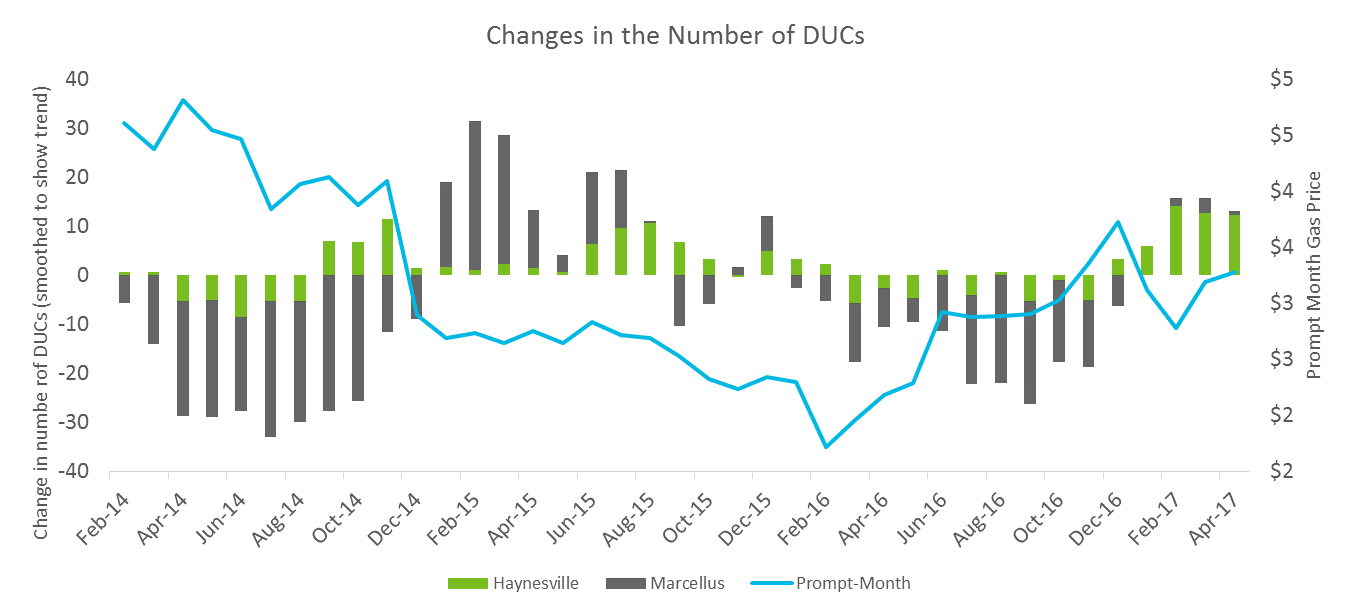
DUCs are an indicator of both the current fundamentals that are driving the exploration and production (E&P) companies running the rigs and overall cost to produce in the region.  Consider the included chart that shows the change in DUCs in two of the regions that produce mainly natural gas: the Haynesville and Marcellus shales.  A decrease in DUCs represents producers completing wells, thus surging production, while an increase in DUCs represents a delay in production, keeping gas in the ground for a later date.

Historically, when prices were low, E&P companies would create a surplus of DUCs to enable them to produce as much as possible when prices recovered.  This is what is seen on the left side of the graph: DUCs decrease (representing surging production) in the high-price environment of late 2014 until prices crash in November.  Then, on lower prices, more wells are drilled, but not completed, raising the number of DUCs and allowing production to be maximized when prices increase again.

As the low-price environment dragged on, however, a new model for using DUCs emerged.  As companies struggled to remain solvent over an extended period of low incomes, DUCs came to represent an inexpensive way to get marginal gas produced, as most of the costs of extraction (i.e. the actual drilling of the well) had already been paid.  This is what we see starting on the chart around August of 2015, when DUCs begin to quickly decrease in spite of prices changing relatively little.

Then, in late December of 2016, prices began to rise, at least a little.  True to this new paradigm, rather than continue to utilize DUCs to surge low-cost production, drillers in the Marcellus and Haynesville begin to increase their supply of DUCs, correctly anticipating the return to low prices that we continue to see today.

It should be pointed out that this is a simplified look at how DUCs are managed by E&P companies.  The final decision to uncap a well is dependent on the time, place, and local pricing and is highly technical.  Most significantly, per federal law wells may only remain capped for two years, after which they must be “sealed,” meaning that the length of the well is filled with concrete.  Though there are situations in which this is desirable, this law usually means that DUCs will be completed within that two year span.

While we are not sure how long this current low-price environment for natural gas will continue, producers seem to have adjusted their methods accordingly and seem to be bracing for an extended period of lower-than-average incomes.  Many long range forecasts have prices in the $4.00 - $5.00 per MMBtu range over the next several years, but these are all making highly speculative assumptions about market drivers. 

Few foresee the return to the $1.75 lows that we saw in 2015, however, with one or two months excluded, prices are struggling to get above $3.50.  Put together with uniformly bullish long range forecasts, these facts point to a market with many upside risks that is quietly waiting to find a higher range in which to trade.  Until this does happen DUCs will likely continue to be completed in times of low pricing and stockpiled in times of higher prices.


Looking For Parts?

Visit Trane Supply

For General and Corporate Questions:

Contact Us
  • Energy and Building Services
  • Products and Systems
  • Education & Training
  • Newsroom
  • About Us
  • Contact Us
  • Indoor Environmental Quality
  • Locate a Sales Office
  • Engineering Support
  • Contractor Support
  • Careers
  • Environmental Compliance
  • Quality
  • Ethical Business Conduct
  • Supplier Terms
  • Safety Data Sheets
  • LinkedIn
  • YouTube

Privacy Policy English | French 
Terms of Use English | French

All trademarks referenced are the trademarks of their respective owners.

© 2025 Trane. All Rights Reserved.

Trane Technologies