Skip to content
Select Your Language

Selecting a language changes the language and content on the Trane site.

  • United States English
  • Canada English French
  • Argentina Spanish
  • Mexico Spanish
  • Brazil Portuguese
  • Aruba English
  • Bahamas English
  • Belize English
  • Bermuda English
  • Bolivia Spanish
  • Bonaire English
  • Chile Spanish
  • Colombia Spanish
  • Costa Rica Spanish
  • Dominican Republic Spanish
  • Ecuador Spanish
  • El Salvador Spanish
  • Grenada English
  • Guadeloupe English
  • Guatemala Spanish
  • Guyana English
  • Haiti English
  • Jamaica English
  • Martinique English
  • Netherland Antilles English
  • Nicaragua Spanish
  • Panama Spanish
  • Paraguay Spanish
  • Peru Spanish
  • Puerto Rico Spanish
  • Saint Lucia English
  • St. Vincent & Grenadines English
  • Suriname English
  • Trinidad & Tobago English
  • Venezuela Spanish
  • Armenia English
  • Austria German
  • Azerbaijan English
  • Belgium French Dutch English
  • Croatia Croatian
  • Czech Republic Czech
  • Denmark English
  • Estonia English
  • Finland English
  • France French
  • Georgia English
  • Germany German
  • Greece Greek
  • Hungary Hungarian
  • Israel English Hebrew
  • Ireland English
  • Italy Italian
  • Kazakhstan English
  • Kyrgyzstan Russian
  • Latvia English
  • Lithuania English
  • Luxembourg French German
  • The Netherlands Dutch
  • Norway English
  • Poland Polish
  • Portugal Portuguese
  • Romania Romanian
  • Serbia English
  • Slovakia Czech
  • Slovenia English
  • Spain Spanish
  • Sweden Swedish
  • Switzerland French German Italian
  • Turkey Turkish
  • Ukraine English
  • United Kingdom English
  • Tajikistan Russian
  • Turkmenistan Russian
  • Uzbekistan Russian
  • United Arab Emirates English
  • Qatar English
  • Kuwait English
  • Egypt English
  • Lebanon English
  • China Simplified Chinese English
  • Korea, Republic of (South Korea) Korean English
  • Vietnam Vietnamese English
  • India English
  • Australia English
  • Japan Japanese
  • Guam English
  • Thailand Thai English
  • Taiwan Traditional Chinese English
  • Hong Kong SAR English
  • Indonesia English
  • Malaysia English
  • Philippines English
  • Singapore English
  • New Zealand English

ComfortSite Login

Trane ComfortSite is an extranet site designed to save you time. With your secure login, you can:

  • Order Equipment, Parts, Literature and track Order Status
  • View product literature
  • Register for Training programs
  • Complete Warranty requirements online
  • Search for specific Product Information
  • Use interactive Product Support functions
  • View and print invoices through Account Track Online
  • and More
Log In

Trane Connect

This is the login for Trane® Connect™ and other Trane® commercial applications. Trane® Connect™ is our secure, cloud-based customer portal to access your building systems to remotely monitor and manage building systems, and conduct routine maintenance.

Log In
Trane Commercial
  • Products
    • Products

    • Air Handling
      • Air Handling
      • Performance Air Handlers
      • Air Handlers for Data Centers
      • Variable-Air-Volume Units
      • Terminal Units
      • Air Rotation Units
      • Terminal Units
      • Unit Heaters
    • Chillers
      • Chillers
      • Air-Cooled Chillers
      • Chiller Heaters
      • Modular Chillers
      • Process Chillers
      • Water-Cooled Chillers
    • Design & Analysis Software
      • Design & Analysis Software
      • TRACE®
      • Trane® Design Assist™
      • myC02e™
      • myPLV®
      • Trane® Select Assist™
      • System Analyzer
    • Heat Pumps
      • Heat Pumps
      • Heat Pump Chillers
      • Domestic Hot Water Heat Pump
    • Liquid Cooling Systems
      • Liquid Cooling Systems
      • Coolant Distribution Unit (CDU)
    • Packaged Units & Split Systems
      • Packaged Units & Split Systems
      • Dedicated Outdoor Air Units
      • Rooftop Units
      • Self-Contained Units
      • Split Systems
      • Water Source Heat Pumps
    • Thermal Energy Storage
      • Thermal Energy Storage
      • Thermal Battery Systems
      • Thermal Energy Storage Solutions
    • Trane Drives
      • Trane Drives
      • TR200 Variable Frequency Drive
    • Smart Buildings
      • Smart Buildings
      • AI Solutions
      • Building Control Solutions
      • Cybersecurity
      • Digital Technology
      • Equipment Controls
      • Systems Integration
    • Systems
      • Systems
      • Comprehensive Heat Pump Chiller Systems
      • Comprehensive Chilled Water Systems
      • CoolSense Systems
      • Geothermal Systems
      • Indoor Agriculture System
      • Intelligent VAV Systems
      • Thermal Battery Systems
      • VRF Systems
      • Zoned Rooftop Systems
  • Services
    • Services

    • Optimization
      • Optimization
      • Energy Efficiency
      • Controls Upgrades
      • HVAC Upgrades
    • Repair & Maintain
      • Repair & Maintain
      • Controls System Maintenance
      • HVAC Maintenance
      • HVAC System Repair
      • Warranty
    • Rentals
    • Sustainability & Resiliency
      • Sustainability & Resiliency
      • Decarbonization Solutions
      • Resiliency Solutions
    • Whole Building Solutions
      • Whole Building Solutions
      • Building Modernization
      • Energy Services
  • Education & Training
    • Education & Training

    • Education & Training
      • Education & Training
      • Trane University
      • Design & Analysis Tools Training
      • Engineers Newsletters & Engineers Newsletters Live!
    • Roles
      • Roles
      • Engineers
      • Contractors
      • Facility Managers
  • Industries
    • Industries

    • Commercial Real Estate
    • Data Centers
    • High Tech
    • Industrial
    • National Accounts
  • About
    • About

    • About Us
    • Contact Us
    • Locate a Sales Office
    • Trane Newsroom
    • Customer Stories
    • Trane Blog
    • Events & Webinars
    • Press Releases
    • ComfortSite Login
    • Trane Connect
      • North America

      • United States English
      • Canada English French
      • Latin America

      • Argentina Spanish
      • Mexico Spanish
      • Brazil Portuguese
      • Aruba English
      • Bahamas English
      • Belize English
      • Bermuda English
      • Bolivia Spanish
      • Bonaire English
      • Chile Spanish
      • Colombia Spanish
      • Costa Rica Spanish
      • Dominican Republic Spanish
      • Ecuador Spanish
      • El Salvador Spanish
      • Grenada English
      • Guadeloupe English
      • Guatemala Spanish
      • Guyana English
      • Haiti English
      • Jamaica English
      • Martinique English
      • Netherland Antilles English
      • Nicaragua Spanish
      • Panama Spanish
      • Paraguay Spanish
      • Peru Spanish
      • Puerto Rico Spanish
      • Saint Lucia English
      • St. Vincent & Grenadines English
      • Suriname English
      • Trinidad & Tobago English
      • Venezuela Spanish
      • Europe

      • Armenia English
      • Austria German
      • Azerbaijan English
      • Belgium French Dutch English
      • Croatia Croatian
      • Czech Republic Czech
      • Denmark English
      • Estonia English
      • Finland English
      • France French
      • Georgia English
      • Germany German
      • Greece Greek
      • Hungary Hungarian
      • Israel English Hebrew
      • Ireland English
      • Italy Italian
      • Kazakhstan English
      • Kyrgyzstan Russian
      • Latvia English
      • Lithuania English
      • Luxembourg French German
      • The Netherlands Dutch
      • Norway English
      • Poland Polish
      • Portugal Portuguese
      • Romania Romanian
      • Serbia English
      • Slovakia Czech
      • Slovenia English
      • Spain Spanish
      • Sweden Swedish
      • Switzerland French German Italian
      • Turkey Turkish
      • Ukraine English
      • United Kingdom English
      • Tajikistan Russian
      • Turkmenistan Russian
      • Uzbekistan Russian
      • Middle East

      • United Arab Emirates English
      • Qatar English
      • Kuwait English
      • Egypt English
      • Lebanon English
      • Asia Pacific

      • China Simplified Chinese English
      • Korea, Republic of (South Korea) Korean English
      • Vietnam Vietnamese English
      • India English
      • Australia English
      • Japan Japanese
      • Guam English
      • Thailand Thai English
      • Taiwan Traditional Chinese English
      • Hong Kong SAR English
      • Indonesia English
      • Malaysia English
      • Philippines English
      • Singapore English
      • New Zealand English
  • Air Handling
  • Performance Air Handlers
  • Air Handlers for Data Centers
  • Variable-Air-Volume Units
  • Terminal Units
  • Air Rotation Units
  • Terminal Units
  • Unit Heaters
  • Chillers
  • Air-Cooled Chillers
  • Chiller Heaters
  • Modular Chillers
  • Process Chillers
  • Water-Cooled Chillers
  • Heat Pumps
  • Heat Pump Chillers
  • Domestic Hot Water Heat Pump
  • Thermal Energy Storage
  • Thermal Battery Systems
  • Thermal Energy Storage Solutions
  • Packaged Units & Split Systems
  • Dedicated Outdoor Air Units
  • Rooftop Units
  • Self-Contained Units
  • Split Systems
  • Water Source Heat Pumps
  • Trane Drives
  • TR200 Variable Frequency Drive
  • Systems
  • Comprehensive Heat Pump Chiller Systems
  • Comprehensive Chilled Water Systems
  • CoolSense Systems
  • Geothermal Systems
  • Indoor Agriculture System
  • Intelligent VAV Systems
  • Thermal Battery Systems
  • VRF Systems
  • Zoned Rooftop Systems
  • Design & Analysis Software
  • TRACE®
  • Trane® Design Assist™
  • myC02e™
  • myPLV®
  • Trane® Select Assist™
  • System Analyzer
  • Liquid Cooling Systems
  • Coolant Distribution Unit (CDU)
  • Smart Buildings
  • AI Solutions
  • Building Control Solutions
  • Cybersecurity
  • Digital Technology
  • Equipment Controls
  • Systems Integration
  • Optimization
  • Energy Efficiency
  • Controls Upgrades
  • HVAC Upgrades
  • Sustainability & Resiliency
  • Decarbonization Solutions
  • Resiliency Solutions
  • Repair & Maintain
  • Controls System Maintenance
  • HVAC Maintenance
  • HVAC System Repair
  • Warranty
  • Whole Building Solutions
  • Building Modernization
  • Energy Services
  • Rentals
  • Education & Training
  • Trane University
  • Design & Analysis Tools Training
  • Engineers Newsletters & Engineers Newsletters Live!
  • Roles
  • Engineers
  • Contractors
  • Facility Managers
  • Commercial Real Estate
  • Data Centers
  • High Tech
  • Industrial
  • National Accounts
  • About Us
  • Contact Us
  • Locate a Sales Office
  • Trane Newsroom
  • Customer Stories
  • Trane Blog
  • Events & Webinars
  • Press Releases
Find Trane Rep

Blog

Published: February 21, 2017

The U.S. Natural Gas Profile: A Guide for Domestic Consumers

All natural gas consumers should understand the dynamic U.S. gas demand structure as the competition for gas is becoming increasingly fierce. Given low prices and broadening environmental goals, natural gas is easily...

The U.S. Natural Gas Profile: A Guide for Domestic Consumers

By: Jude Clemente

February 21, 2017

U.S. Natural Gas Demand Structure

Demand Structure

All natural gas consumers should understand the dynamic U.S. gas demand structure as the competition for gas is becoming increasingly fierce. Given low prices and broadening environmental goals, natural gas is easily our fastest growing major fuel source. Gas emits about 50% less CO2 than coal and 30% less CO2 than petroleum, and gas is now our primary source of electricity generation for the first time ever.  

Moreover, given a quick “ramp up” ability of a matter of minutes, gas is the preferred backup generation fuel for naturally intermittent wind and solar power. In fact, although ranked third in the preferred “loading order” behind demand response and renewables, gas-fired generation is typically dispatched first across the grid because it is more reliable.  

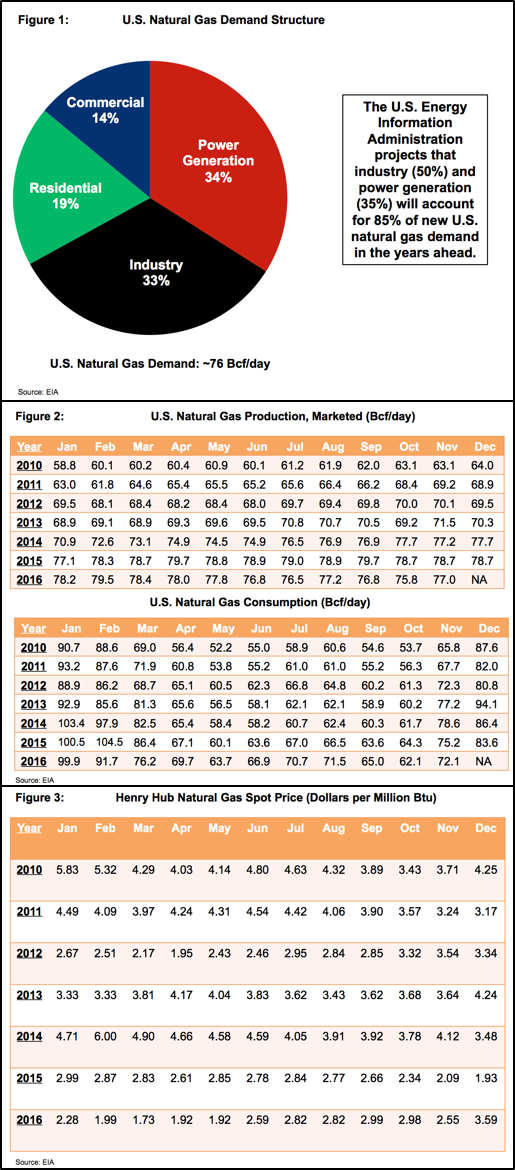
As seen in Figure 1, the versatility of natural gas explains why it is used across a variety of sectors – in contrast to coal (93% for power generation) and petroleum (75% for transportation).  Thus, consumers should realize that gas faces a variety of pressure points that can increase price volatility.  

Production and Consumption Patterns

The U.S. shale revolution has been in full swing since about 2010.  Shale now accounts for 65% of U.S. gas production, up from less than 10% a decade ago.  And shale is expected to account for nearly all incremental U.S. output in the years ahead.  Likened to a manufacturing process, shale production can be brought online very quickly in response to rising prices and new infrastructure builds, thereby lowering the chance for cost spikes. For example, since 2010, monthly Henry Hub gas pricing has reached $6.00 per MMBtu or more just once (during the “Polar Vortex” in February 2014), compared to over 50 times from 2004-2008 alone.  

And as demonstrated in Figure 2, shale gas production does not exhibit much seasonal variation.  Even as our new gas production has shifted toward the colder Appalachia (where freeze-offs are more likely) U.S. gas production has remained very consistent throughout the year.  And as an onshore phenomenon, the shale boom has offered the U.S. gas supply system a tremendous security blanket: the hurricane prone Gulf of Mexico, for instance, now accounts for just 5% of U.S. production, versus 25% in 2000.

In contrast to production, U.S. gas demand varies wildly throughout the year, climbing to as high as 135 Bcf/day on cold winter days and falling to 60 Bcf/day during the shoulder months. As gas continues to gain market share in the power sector, gas prices will be pressured on both sides of the temperature scale: increases in gas demand during heating season and increases in gas demand for power generation in the cooling season. To illustrate, hot summers can now see 70 Bcf/day in total U.S. gas demand, compared to the 55 Bcf/day seen in the hot summers before 2010.

Pricing Patterns

Counterintuitively, while heating load surges demand and maxes out pipeline capacity in the colder months, gas prices since 2010 have generally been comparable between winter and summer (see Figure 3). And based on prices patterns over the past 15 years or so, it is difficult to make definitive statements about the correlation between oil and natural gas prices. Looking forward though, the “dash to gas” does present risks for consumers:  demand growth in the power generation, industrial, and export sectors could increase U.S. gas demand by 25% to 95 Bcf/day by 2020.

Exports Could Be Game Changer

U.S. natural gas consumers must also know that we are increasingly opening up our market to international buyers.  Exports now appear as the only domestic demand market that could potentially spiral away from us: natural gas is expected to become the world’s primary fuel in our post-COP21 climate agreement world.  The global liquefied natural gas (LNG) importing pool is projected to double to 70 nations by 2030, and hungry Asian buyers like to outbid and lower import taxes to take in more oil and gas.

U.S. natural gas is highly desirable: it’s cheaper, has more flexible contracts, and comes from a stable democracy with transparent and reliable public companies. Seven U.S. export LNG projects are currently approved, and the U.S. Energy Information Administration projects 550 U.S. LNG vessels passing through the newly expanded Panama Canal to deliver supplies to Latin America and Asia over the next few years. Overall, the U.S. could be exporting 10-12 Bcf/day by 2020, up from virtually nothing a year ago.  

In just a year’s time, the U.S. has shipped LNG to nearly 20 nations, with the focus of our supplies steadily shifting across the regionalized markets, first to Latin America then to Asia and now to Europe. Today, the U.S. exports about 4 Bcf/day of gas to Mexico, 2.5 Bcf/day to Canada, and 2 Bcf/day of LNG to the world. This is some 12% of current U.S. gas production, and the export share of our output could double to 25% as soon as 2020.

The booming U.S. gas export business represents a potential concern for domestic consumers. In short, there is a huge amount of gas that will be leaving the U.S. domestic delivery system, and the more we become integrated with the globalizing gas market, the more precarious our domestic prices could become. For example, as Australia’s LNG exports have increased, gas prices in parts of the country have doubled. And this past summer, some Australian gas consumers were paying 40% more for domestic supply than Japan was paying for Australian LNG.

Looking For Parts?

Visit Trane Supply

For General and Corporate Questions:

Contact Us
  • Energy and Building Services
  • Products and Systems
  • Education & Training
  • Newsroom
  • About Us
  • Contact Us
  • Indoor Environmental Quality
  • Locate a Sales Office
  • Engineering Support
  • Contractor Support
  • Careers
  • Environmental Compliance
  • Quality
  • Ethical Business Conduct
  • Supplier Terms
  • Safety Data Sheets
  • LinkedIn
  • YouTube

Privacy Policy English | French 
Terms of Use English | French

All trademarks referenced are the trademarks of their respective owners.

© 2025 Trane. All Rights Reserved.

Trane Technologies