Which Trane Heat Pump Is Best for Your Home?
Key takeaways:
- Which Trane heat pump is best for your home depends on your climate, your priorities, and your budget.
- Cold climate heat pumps and dual-fuel systems satisfy heating needs in colder climates.
- Proper sizing, appropriate ductwork, and installation are key to getting the optimal system performance.
- HVAC financing can help you afford a more energy-efficient heat pump system with easy monthly payments.
By Anne Fonda
If you’re looking at replacing the heating and cooling system in your home, you’re smart to be doing your research into heat pumps. Heat pumps work to heat and cool your home without burning fossil fuels.
Whether you’re looking at heat pump replacement or you’re exploring the pros and cons of a heat pump system, understanding industry jargon and features is important.
For a heat pump, that includes understanding
- Efficiency ratings
- Number of heating and cooling stages/speeds
- Cold weather performance
- Cost: How more efficient heat pumps will cost more upfront, but can offer increased comfort and decreased energy consumption.
Understanding SEER2 and HSPF2 ratings
Two important efficiency ratings cover heat pumps: SEER2 and HSPF2.
SEER2
SEER2 stands for Seasonal Energy Efficiency Ratio, and measures a heat pump’s cooling efficiency averaged over an entire cooling season, in temperatures ranging from 65°F to 104°F. The higher the SEER2 rating, the better the unit is at keeping you cool.
HSPF2
HSPF2 stands for Heating Seasonal Performance Factor and measures a heat pump’s heating efficiency over an entire heating season. The higher the HSPF2 rating, the more efficient the heat pump is at heating your home.
Understanding single-stage vs multi-speed vs variable speed
“When a heat pump can adjust how it runs, whether it has a few stages or full variable‑speed technology, it’s simply better at keeping your home comfortable. That flexibility helps the system use energy more efficiently while keeping temperatures and humidity right where you want them. It’s a noticeable difference in day‑to‑day comfort.”
- Chelsea Hudson, Product Manager, Heat Pumps

Trane offers single-stage, multi-speed, and variable-speed heat pumps.
- Single-stage systems are either ‘On’ or ‘Off’. That means they either run at 100% full power or they are off.
- Multi-speed systems offer better efficiency than single or two-stage systems but are simpler than variable speed systems and are available at a lower price.
- Variable speed heat pumps are the most efficient as they can vary their output from 30-100% and draw the least amount of power required to maintain your desired temperature.
To achieve maximum efficiency, the heat pump system must be sized correctly and installed by an experienced HVAC professional. You must also have properly sized ductwork. An improperly sized system can result in decreased comfort and early breakdown.
Refer to our heat pump installation guide for more information.
Cold weather performance
Lastly, if you live anywhere where you have to heat your home in the winter, you’ll want to understand a heat pump’s cold-weather performance. While this is tied to the HSPF2 rating, it is more closely tied to the Heating Capacity Ratio (HCR).
In the comparison table below, the HCR of a heat pump is expressed as the ability to provide 100% of your heat at a certain temperature and at what temperature it can provide 70% of your heat. Improved heat pump technology makes them more dependable in cold temperatures.
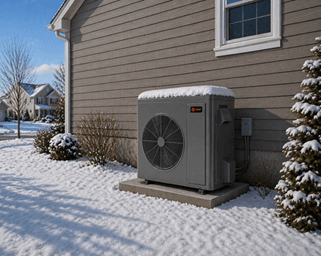
Cold climate heat pumps (CCHPs) use a special inverter technology to deliver reliable heating at lower temperatures than standard heat pumps.
“Today’s cold climate heat pumps are engineered to perform reliably in much lower temperatures than traditional systems. Advanced inverter technology allows them to maintain meaningful heating capacity even in single-digit or subzero conditions, giving homeowners in northern climates an efficient alternative to fossil fuel heating.”
- Chelsea Hudson, Product Manager, Heat Pumps
Comparing Trane heat pumps
Let’s compare some of Trane's heat pumps. For a look at all of our heat pumps, visit the heat pump product page. For the efficiency and cold weather performance ratings below, these are the best a unit can do when paired with the correct indoor unit and running at peak performance.
Your actual performance and efficiency will vary. These numbers reflect when a system is performing at its best, paired with the correct indoor unit, installation, ductwork system, and more.
| Trane Heat Pump | SEER2 | HSPF2 | Cold Weather Performance | Fan Stages | Cost |
|---|---|---|---|---|---|
| 20 TruComfort™ Variable Speed with WeatherGuard™ | Up to 22.4 | Up to 10.5 | 100% heating capacity down to 32° 70% down to 5° | Variable | $$$$$* |
| 18 TruComfort™ Variable Speed | Up to 18.1 | Up to 8.5 | 100% heating capacity down to 32° 70% down to 5° | Variable | $$$$ |
| 17 Multi-Speed with WeatherGuard™ | Up to 18 | Up to 11 | 100% heating capacity down to 27° 70% down to 5° | Multi-Speed | $$$ |
| 16 Single-Stage with WeatherGuard™ | Up to 17 | Up to 8.5 | 70% down to 17° | Single-Stage | $$ |
| 14 Single-Stage | Up to 14.3 | Up to 7.5 | 70% down to 17° | Single-Stage | $$ |
| 20 TruComfort™ Variable Speed Cold Climate Heat Pump with WeatherGuard™ | Up to 20 | Up to 10.3 | Up to 107% heating capacity down to 5° and substantial capacity down to -15° and even -20° | Variable | $$$$$ |
| 19 Multi-Speed Low Profile CCHP | Up to 21 | Up to 9.2 | 100% heating capacity down to 5° 70% down to -13° | Multi-Speed | $$$$$ |
| 17 Multi-Speed Low Profile CCHP | Up to 18.5 | Up to 9.1 | 100% heating capacity down to 5° 70% down to -13° | Multi-Speed | $$$$ |
| 16 Multi-Speed Low Profile CCHP | Up to 19 | Up to 10 | 100% heating capacity down to 5° 70% down to -13° | Multi-Speed | $$ |
70% down to 5°
70% down to 5°
70% down to 5°
-20°
70% down to -13°
70% down to -13°
70% down to -13°
“Depending on the homeowner’s region, selecting the right heat pump is key. For those in milder heating climates, running a heat pump will likely be the simplest, cost-efficient solution (depending on energy rates). In climates that have more heating hours but don’t run at or below 0°, a heat pump with high heating capacity at 5° will likely suffice (homeowners should ask their installer to provide the 5°/47° capacity ratio and confirm that it’s at or above 70%).”
- Taylor Heenehan, AC & HP Engineering Leader

“Pairing these systems with a furnace can provide extra configurability to set a transition point on the thermostat to operate the heat pump or furnace for increased efficiency and heating comfort,” Heenehan added.
“For those in the harshest heating climates, a cold climate heat pump is a recommended option. These types of units can generally maintain maximum capacity down to 0° and continue maintaining heating capacity down between -10° and -20°. Pairing with a furnace will increase the available heating capacity to the home to keep the homeowner warm and comfortable.”
- Taylor Heenehan, AC & HP Engineering Leader
As you can see, higher efficiency ratings and more heating and cooling speeds translate to a higher upfront cost. However, more efficient units offer increased comfort and reduced energy consumption for the long term. Single-stage units have a lower upfront cost but will cost more to operate and result in higher energy bills in the long term.
Deciding between a standard heat pump and a cold climate heat pump will depend on how cold your winters are and if you want to pair the heat pump with a gas furnace in a dual-fuel system, also known as a hybrid heating system.
“Variable‑speed heat pumps are a great choice for homeowners who want the quietest, most consistent comfort Trane offers. They use energy more thoughtfully, maintain even temperatures in every season, and provide advanced system insights that help support long‑term reliability. It really comes down to how much value you place on next‑level comfort and performance.”
- Chelsea Hudson, Product Manager, Heat Pumps
Check out our updated Pricing Guide for some price ranges. The best way to get specific pricing for your HVAC replacement is to contact your local Trane dealer.
Why a WeatherGuard™ top?
A note about the WeatherGuard™ top: this protective top helps keep debris out of the unit and helps funnel off rain, freezing rain, and snow melt to help protect the unit’s inner workings. In addition, units with the WeatherGuard™ included are eligible for a 12-year limited warranty on the compressor rather than the standard 10-year limited warranty (with registration).
Trane heat pump reviews
Here are some snippets of reviews from satisfied homeowners. Many mention efficiency, quiet operation, and a reduction in energy bills. You can see full reviews on each product page.
20 TruComfort™ Variable Speed Heat Pump with WeatherGuard™
- Very quiet unit. Keeps up with the Texas heat.
- Love the new Trane heat pump. It's quieter than my old one and my heating/cooling bills are less each month.
- High efficiency unit, which is a great feature. Unit is quiet. Great value for the money.
18 TruComfort™ Variable Speed Heat Pump
- Great product. So worth the extra cost. Have noticed a difference in the cooling and heating of our home.
- We are very pleased with the new system as it works very quietly and keeps the house more comfortable. The variable speed unit has cut our kWh daily usage by about 30%.
- System is very quiet, very affordable, and provides precise temperatures.
17 Multi-Speed Heat Pump with WeatherGuard™
- It is quiet and efficient, and keeps our house at a constant temp setting. This unit heats/cools better than our previous unit, while decreasing electric usage by 30% so far.
- Outstanding product, it's very quiet, this unit is outside under the bedroom window. You can't hear it turn on or off. The different stages keeps the house just right.
- All year this heat pump is cost-efficient and dependable.
16 Single-Stage Heat Pump with WeatherGuard™
- Good uncomplicated unit that does what is needed.
- It's quiet and very reliable.
- The system is efficient, quiet, and provides a mobile app to allow setting adjustments while I’m away from home.
14 Single-Stage Heat Pump
- Cooling the house as expected, we didn't count on the noise reduction versus our old unit.
- Quiet and efficient. Would recommend to anyone that would purchase a heat pump.
- Works great, quiet, and reduced our power bill.
19 Multi-Speed Low Profile CCHP
New product; no reviews yet.
17 Multi-Speed Low Profile CCHP
New product; no reviews yet.
16 Multi-Speed Low Profile CCHP
New product; no reviews yet.
Enhance comfort and maximize energy savings with a Trane smart thermostat
To take advantage of all your new system has to offer, pair it with a Trane smart thermostat. If you purchase a communicating variable speed (VSPD) system, the Trane smart thermostat is essential. No 3rd party or standard 24V smart thermostats work with our variable speed systems as our VSPD thermostat includes proprietary and patented algorithms to manage the variable speed system.
Every Trane smart thermostat is compatible with remote monitoring and Trane Diagnostics to give you peace of mind. Third-party smart thermostats are not compatible with Trane Diagnostics.
Our smart thermostats have ranked in the top 3 in the proprietary Lifestory Research 2021-2026 America’s Most Trusted® Smart Thermostat Brand studies. Learn more about Trane’s Best Smart Thermostats.
Explore your HVAC financing options
Replacing a heat pump (and commonly, the entire HVAC system) can be expensive, but it doesn’t have to break the bank. Research your HVAC financing options to determine how best to pay for your new system. Many Trane dealers offer 0% HVAC financing with a new Trane system, with affordable monthly payments.
Work with your local Trane dealer for the best results
Work closely with your local Trane dealer to help ensure you get the Trane heat pump system that’s best for your home, climate, and budget. They’ll listen to your concerns and goals for your home comfort to help you make an informed decision. They’ll help ensure proper sizing and installation so you get the most out of your new heat pump system.
Anne Fonda, Content Writer
A Content Writer with Trane Technologies, Anne Fonda researches topics and writes for Trane® and associated residential HVAC brands. She works in collaboration with Trane Technologies subject matter experts, offering easy-to-understand, informative content on complex topics. Her goal is to help consumers make informed decisions on the products and services they need.
She has written for HVAC and other service provider websites for over 16 years. Before transitioning to web content writing, Anne had a 14-year stint as an award-winning journalist. She graduated cum laude from the University of Missouri-Columbia School of Journalism.
When she’s not working, Anne enjoys playing word games, reading, gardening, spending time with family, and visiting gardens and museums.
Expert review by Chelsea Hudson, Product Manager, Heat Pumps and Taylor Heenehan, AC & HP Engineering Leader
Related Articles